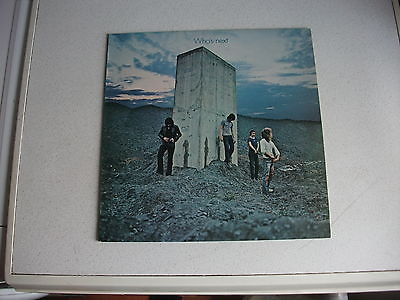
THE WHO "WHO'S NEXT" ORIGINAL STEREO 1971 TRACK RECORDS 2403102 12" ALBUM 33RPM
£
15
$
20


Favourite Auctions
To save auctions to your favourites, please login
If you don't have an account, please register
Description
THE WHO "WHO'S NEXT" ORIGINAL STEREO 1971 TRACK RECORDS 2403 102 12" SINGLE ALBUM 331/3RPM AND ORIGINAL NEWSPAPER CUTTING FROM RELEASE.
Who's Next is the fifth studio album by English rock band The Who, released on 14 August 1971. Its origins lie in an abortive multi-media rock opera written by chief songwriter Pete Townshend called Lifehouse. The album was commercially and critically successful, and became the only one by the group to top the UK charts.
Townshend had begun to consider a follow-up to Tommy (1969) during the latter half of 1970, and came up with Lifehouse as a means of integrating the band and audience together, using rock music as a means of enlightenment. The group played a series of concerts at the Young Vic theatre in London, and recorded material at the Record Plant studios in New York, before abandoning the project due to its complexity and manager Kit Lambert's addiction to hard drugs. Following the cancellation of Lifehouse, Townshend was persuaded to record the songs as a straightforward studio album, with assistance from recording engineer Glyn Johns. After recording "Won't Get Fooled Again" at Mick Jagger's house Stargroves using the Rolling Stones Mobile Studio, the group relocated to Olympic Studios where most of the material was recorded and mixed. The album makes prominent use of the synthesizer, particularly on the tracks "Baba O'Riley" and "Won't Get Fooled Again".
The album was an immediate success when it was released, and has been certified 3× platinum by the RIAA. It continues to be critically acclaimed, including being cited by Time magazine as one of the best 100 albums of all time, and has been reissued on CD several times with additional material intended for Lifehouse. The cover artwork, featuring the group members having urinated against a monolith found on a slag heap, has also achieved critical recognition and was listed as one of VH1's greatest album covers of all time.
By 1970, the Who had obtained significant critical and commercial success, but they had started to become detached from their original audience. The mod movement had vanished, and the original followers from Shepherd's Bush had grown up and acquired jobs and families. The group had started to drift apart from manager Kit Lambert due to his preoccupation with their label, Track Records.[8] They had been touring since the release of Tommy the previous May, with a set that contained most of that album, but realized that millions had now seen their live performances, and Pete Townshend in particular recognized that they needed to do something new.[9] A single, "The Seeker", and a live album, Live at Leeds were released in 1970,[10] and an EP of new material ("Water", "Naked Eye", "I Don't Even Know Myself", "Postcard" and "Now I'm a Farmer") was recorded, but not released as the band felt it would not be a satisfactory follow-up to Tommy.[11]
The album had its roots in a project called Lifehouse. This evolved from a series of columns Townshend wrote for Melody Maker in August 1970, in which he discussed the importance of rock music, and in particular what the audience could do.[12] Of all the group, he was the most keen to use music as a communication device, and wanted to branch out into other media, including film, to get away from the traditional album / tour cycle.[13] Townshend has variously described Lifehouse as a futuristic rock opera, a live-recorded concept album and as the music for a scripted film project.[14] The basic plot was outlined in an interview Townshend gave to Disc and Music Echo on 24 October 1970.[15] Lifehouse is set in the near future in a society in which music is banned and most of the population live indoors in government-controlled "experience suits". A rebel, Bobby, broadcasts rock music into the suits, allowing people to remove them and become more enlightened. Some elements accurately describe future technology; for example, The Grid resembles the internet and "grid sleep" virtual reality.[16]
Released 14 August 1971 (1971-08-14)[1] Recorded April–June 1971, Olympic Studios, Barnes, London; mixed at Olympic Studios;[2] "Won't Get Fooled Again" recorded at Stargroves and mixed at Island Studios, London[3] Genre Hard rock[4] Length 43:38 Label Track, Decca Producer The Who, Glyn Johns (associate producer)The record will be packaged, protected and posted out in bubble wrap, card and ‘jiffy’ bag envelope. This is a definite collectable and "Must Buy" for all Rock and Pop Fans.
Vinyl Condition: Excellent
Cover Condition: Excellent
Inner Condition: Excellent
Postage UK=£3.30 GBP £2.80.
Postage Europe = £5.50 Euro 7.70.
Worldzone 1 = North America, South America, Africa, the Middle East, the Far East and South East. Asia. £7.70 GBP (12.12 USD), (14.93 CAD) (1,502.18 JPY).
World Zone 2 = Australia, Australasia, New Zealand £8.45 GBP (17.38 AUD), (19.43 NZD).
price rating


