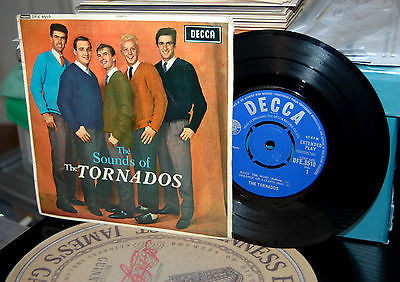
THE TORNADOS. "THE SOUNDS OF THE TORNADOS" EP. DECCA UK 1962 ORIG P/S. EX.
£
20
$
27


Favourite Auctions
To save auctions to your favourites, please login
If you don't have an account, please register
Description
More Images
Tornados, The ?– The Sounds Of The Tornados
Label: Decca ?– DFE 8510 Format: Vinyl, 7", EP, MonoCountry: UK Released: Oct 1962 Genre: Rock Style: Pop Rock
TracklistHide Credits
A1 Ridin' The Wind Written-By – Bellamy* A2 Dreamin' On A Cloud Written-By – Burt* B1 Red Roses And A Sky Of Blue Written-By – Joe Meek B2 Earthy Written-By – Caddy*Companies etc
- Published By – Ivy Music
Credits
- Bass Guitar – Heinz Burt*
- Drums – Clem Cattini
- Guitar [Lead] – Alan Caddy
- Guitar [Rhythm] – George Bellamy
- Organ – Roger LaVerne*
- Producer – R.G.M. Sound
Notes
Recording First Published 1962Barcode and Other Identifiers
- Matrix / Runout (A - Label): EFF.2523
- Matrix / Runout (B - Label): EFF.2524
- Matrix / Runout (A): EFF - 2523 - IC
- Matrix / Runout (B): EFF - 2524 - IC
Artist Biography by Cub Koda
One of the saddest stories in rock & roll history surrounds the Tornados, an instrumental group from Britain. Although there were other groups with the same name (see listing for their American surf-band counterparts), this batch of Tornados were the creation of British producer Joe Meek. Meek was England's first independent producer, being equal parts Thomas Edison, Phil Spector, and Ed Wood. An inveterate tinkerer, he designed his own compression units and microphone pre-amps, giving his productions their own distinct sound. Setting up a homemade studio in a three-story flat on Holloway Road in London, Meek pioneered such recording techniques as close miking of instruments, distortion, his aforementioned trademark compression, loud drums fortified by percussion from pocket combs, milk bottles, and stomping the floorboards himself. He put together the original Tornados in late 1961 as a studio session group, its original lineup consisting of Alan Caddy and George Bellamy on guitars,Roger LaVern on organ, Heinz Burt on bass, and Clem Cattini on drums. After one single flopped,Meek had the group do one of his compositions, an instrumental called "Telstar." Utilizing willful distortion, cheap tape echo, beeping satellite sound effects, a cheesy-sounding Clavioline (a two-octave keyboard powered by a battery), and massive amounts of tube compression, the resulting production sounded like nothing else at the time, or since. It became the first number one record on the American charts by a British rock group and ended up selling five million copies worldwide. It should have made Meek a millionaire and the Tornados a household name. But a French copyright infringement suit kept all royalties tied up for six years, and the Tornados were kept from touring the United States behind their international hit due to a contract employing them as a backup group to U.K. pretty boy Billy Fury. By the time the dust settled, the Tornados had gone hitless for several years, and so had Joe Meek. After numerous personnel changes, the original members scattered to various groups, Heinz Burt starting his own solo career and Cattini becoming a British session mainstay of producer Shel Talmy. The copyright infringement suit was ruled in Meek's favor six years later, a year after he had blown his face off with a hunting rifle after murdering his landlady, ending his life in his beloved but debt-ridden studio.
Record Collector Magazine's Grading Guide:
"MINT: The record itself is in brand new condition with no surface marks or deterioration in sound quality. The cover and any extra items such as the lyric sheet, booklet or poster are in perfect condition. Records advertised as Sealed or Unplayed should be Mint.
EXCELLENT: The record shows some signs of having been played, but there is very little lessening in sound quality. The cover and packaging might have slight wear and / or creasing.
VERY GOOD: The record has obviously been played many times, but displays no major deterioration in sound quality, despite noticeable surface marks and the occasional light scratch. Normal wear and tear on the cover or extra items, without any major defects, is acceptable.
GOOD: The record has been played so much that the sound quality has noticeably deteriorated, perhaps with some distortion and mild scratches. The cover and contents suffer from folding, scuffing of edges, spine splits, discolouration, etc.
FAIR: The record is still just playable but has not been cared for properly and displays considerable surface noise; it may even jump. The cover and contents will be torn, stained and / or defaced.
POOR: The record will not play properly due to scratches, bad surface noise, etc. The cover and contents will be badly damaged or partly missing.
BAD: The record is unplayable or might even be broken, and is only of use as a collection filler."
price rating







![The Gun Club [Jeffrey Lee Pierce] - Miami (Vinyl Record, 1982, Animal/Chrysalis)](https://www.popsike.info/php/thumbnail.php?url=https://www.popsike.pics/pix/20250510/306294866492.jpg)