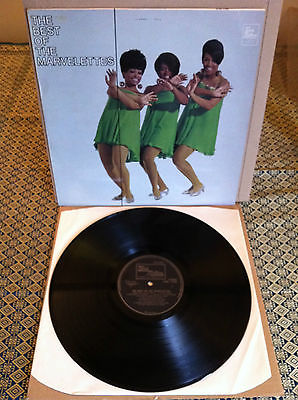
THE BEST OF THE MARVELETTES TAMLA MOTOWN STML 11258 A1/B1 NM
£
30
$
40


Favourite Auctions
To save auctions to your favourites, please login
If you don't have an account, please register
Description
THE BEST OF THE MARVELETTES TAMLA MOTOWN STML 11258 A1/B1 NM
VINYL ALBUM GRADING/CONDITION
Guidelines for assessing the grading / condition of used records (based on Goldmine Grading for Records)
MINT (M): Perfect! This record looks like it has just left the manufacturer, with NO flaws what so ever. It looks as though it had never been handled. No scuffs or scratches, blotches or stains. No stickers address labels, writing on the covers or labels. No tears or seam splits. No wear to the cover or record period! Age of the record has nothing to do with it.
NEAR MINT or NM, M- : this record appears virtually flawless A very minor scuff and very little else can appear on the vinyl. It should play without any noise over the flaw. The flaw is very hard to see. The cover looks as close to perfect with only minor signs of wear and or age. Minor impressions to the cover (due to the outer edge of the vinyl resting inside) may be acceptable, however the artwork is be as close to perfect as can be.
EXCELLENT or EX or VG++ : minor scuffs which are only slightly visible. There may be more than a few scuffs and NO Scratches COVER: Artwork is still as close to perfect as can be. Some impression to the cover (minor outer ring wear) but no ink wear! Some slight creases to the corners, but not wrinkled and obtrusive to the eye. The corners can show white (where the artwork pasted slick was) meaning, slight wear. No seam splits or writing on the cover or taped repairs can make this grade.
VERY GOOD PLUS or VG+ record shows wear, surface scuffs. The vinyl still has a great luster, but the flaws will be noticeable to the naked eye. If the flaws don't cause any surface noise, the vinyl can still make the VG+ grade. COVERS: A virtually clean cover, but may have small writing on it.The artwork looks clean with slightly more aging. The back of the cover usually gives away the age of the cover. Flat white paper will be somewhat yellow yet no stains or mildew from water damage. Some minor wear to the seams or spine, but no tears or holes popping through. The corners will be slightly dog eared yet no crackly bends, defacing the artwork. In essence, a VG+ cover should have no more than 3 flaws mentioned.
VERY GOOD or VG: this record is a record that is good enough. They are not really going to look very good, but it will STILL play very good. there will almost always be some surface noise when they are played. The Dynamics should still be excellent, overpowering the surface noise. A VG record will appear well have been played but still have some luster. VG covers will look worn, used. There may be some seam splitting . There will be some ring wear, where the ink has begun to wear off. Giving the cover a look of snow falling. If the artwork looks snowy all over, it is less than VG condition. There may be some writing on the cover (still, no Large letters in magic marker). It will look aged and more yellowish due to contamination's in the air (sometimes looking like cigarette smoke). Still it should be decent.
GOOD or G A good record will look very well played, dull, grayish and possibly abused. However a Good record should still play. It will have distractingsurface noise. Such as crackle that is continuous or some hiss. Will also have some loss of dynamics caused from grooves being worn. It should play without any skips or any obtrusively loud pops or repeated clicks, caused by deep scratches. Good means that it will play with some form of decency, so one can still enjoy the music even though you can still hear noise caused from the wear. A Good cover will have just about everything wrong with it. It will have seam splits (possibly taped repaired, but only with scotch tape. No duct tape or masking tape repairs. These are big turn offs. May have magic marker writing on the cover but still if they are in huge letters, it is a big turn off.In essence, the cover will looked virtually trashed, but some artwork will still be noticed. If the artwork is worn, it is POOR and the cover is worthless.
The Marvelettes
From Wikipedia, the free encyclopedia Jump to: navigation, search The MarvelettesThe Marvelettes in a 1963 promotional photo. Clockwise from top left, Gladys Horton, Katherine Anderson, Georgeanna Tillman, and Wanda Young Background information Also known as The Casinyets, The Marvels, The Darnells Origin Inkster, Michigan, U.S. Genres R&B, rock and roll, doo-wop, pop, soul Years active 1960–1970 Labels Tamla, Motown
Past members Gladys Horton
Katherine Anderson
Georgeanna Tillman
Wanda Rogers
Ann Bogan
Juanita Cowart
Georgia Dobbins, writer of Please Mr. Postman.
The Marvelettes were an all-girl group who achieved popularity in the early to mid-1960s. They consisted of schoolmates Gladys Horton, Katherine Anderson (née Schnaffer), Georgeanna Tillman (née Gordon), Juanita Cowart (later Juanita Cowart Motley) and Georgia Dobbins, who was replaced by Wanda Young (née Rogers) prior to the group signing their first deal. The group was the first major successful act of Motown Records after The Miracles and were its first significant successful girl group on the label's early years after the release of the number-one single, "Please Mr. Postman", one of the first number-one singles recorded by an all-female vocal group and the first by a Motown recording act.
Founded in 1960 while the group's founding members performed together at their glee club at Inkster High School in Inkster, Michigan, they eventually were signed to Motown Records' Tamla label in 1961. Some of the group's early hits were written by band members and some of Motown's rising singer-songwriters such as Smokey Robinson and Marvin Gaye, who played drums on a majority of their early recordings. Despite their early successes, the group was eclipsed in popularity by groups like The Supremes, with whom they shared an intense rivalry and struggled with issues of dismal promotion from Motown, illnesses and mental breakdowns, with Cowart the first to leave in 1963, followed by Georgeanna Tillman two years later and Gladys Horton two years after that. Nevertheless, they managed a major comeback in 1966 with "Don't Mess with Bill", followed by a few smaller follow-up hits.
The group ceased performing together in 1969 and, following the release of The Return of the Marvelettes in 1970, featuring only Wanda Rogers, the group disbanded for good, with both Rogers and Katherine Anderson leaving the music business.
The group has received several honors, including the Vocal Group Hall of Fame and the Pioneer Award from the Rhythm and Blues Foundation. In 2005, two of the group's most successful recordings, "Please Mr. Postman" and "Don't Mess with Bill" earned million-selling Gold singles from the RIAA. In 2012, the Marvelettes were nominated for 2013 induction to the Rock & Roll Hall of Fame.
Contents
- 1 History
- 1.1 Origins and initial success
- 1.2 The departure of Georgeanna Tillman and renewed success
- 1.3 Decline
- 1.4 Later Years
- 2 Legacy
- 3 Discography
- 3.1 Albums
- 3.2 Singles
- 4 Awards and recognition
- 5 References
- 6 External links
History
Origins and initial success
The group that would become the Marvelettes formed at Inkster High School in Inkster, Michigan, a suburb located west of Detroit, Michigan by fifteen-year-old glee club member Gladys Horton in the fall of 1960. Horton enlisted older glee club members Katherine Anderson, Georgeanna Tillman, Juanita Cowart and Georgia Dobbins, who was already a high school graduate, to join her.[1] The members struggled to come up with a name for their new act until one of the members jokingly took a stab at their own singing abilities saying "we can't sing yet." Horton altered the saying to "The Casinyets".
In 1961, the quintet, which had then changed her name to the Marvels, entered a talent show contest on the behest of their teacher and ended up finishing in fourth place. Though only the first three winners were offered a trip to audition for the fledging Motown label, two of the girls' school teachers advised that they be allowed to audition too. Upon auditioning for Motown executives including Brian Holland and Robert Bateman, they had a second audition with bigger staff including Smokey Robinson and the label president and founder, Berry Gordy, who while impressed with their vocal styles advised them to come back with their own composition. Returning to Inkster, Georgia Dobbins contacted a local musician named William Garrett, who had an unfinished blues composition titled "Please Mr. Postman"; Garrett allowed Dobbins to use it as long as he kept songwriting credits in case the song became a hit. Despite the fact that she had no previous songwriting experience, Dobbins took the song home and reshaped the song overnight to reflect the teenage sound of doo-wop.[2]
Prior to returning to Motown, Dobbins left the group due to her growing family and her father, who advised her not to continue her career in show business. Dobbins left Horton in full charge of the group. To replace her, Horton asked another Inkster graduate, Wanda Young, to replace Dobbins. When the group returned and performed their composition, Gordy agreed to work with the group but under the advice that they change their name. Gordy renamed them The Marvelettes and signed the act to Motown's Tamla division in July 1961. The following month, the group recorded "Please Mr. Postman", which was polished by Brian Holland and Robert Bateman, and another composition, "So Long Baby", sung by Wanda. Tamla issued "Please Mr. Postman" the following September. The song then made a slow but eventual climb to the top of the singles chart, reaching #1 that December. making them the first Motown act to have a number-one hit on the Hot 100.
To follow up on this success, Motown had the group record "Twistin' Postman" to take advantage of the twist dance craze and the re-release of Chubby Checker's "The Twist". The song eventually peaked at #34 on the pop chart in early 1962. Before the end of 1961, Tamla issued the first Marvelettes album, also named Please Mr. Postman, but it failed to chart. The group's next single, "Playboy", marked the second time one of their singles was written by a band member, this time by Gladys Horton. Like "Postman", the song was retooled by other writers and upon its released in early 1962, reached #7. A fourth hit, "Beechwood 4-5789", co-written by Marvin Gaye, reached #17. During 1962, two more albums would be issued by the band including The Marvelettes Sing and Playboy. Following the success of "Beechwood", R&B radio stations also frequently played the song's b-side, "Someday, Someway", which paid off sending the song to #8 on the R&B chart becoming their first double-sided hit.
Due to their success, the group had to leave school in order to perform for audiences and despite the promise of tutors to help with their schooling, they were never granted any. Due to their young ages and Horton being an orphaned ward of the courts, they eventually were taken in by Esther Gordy Edwards, who bussed them to Motortown Revue shows. After several successful Top 40 recordings, the group released the modest success, "Strange I Know", which peaked at #49. In early 1963, the group was shortened to a quartet when Juanita Cowart opted to leave the band citing a mental breakdown caused by stress from performing on the road and a mistake she made in describing the group's background during an appearance on American Bandstand. Carrying on as a quartet, the group issued one of Holland–Dozier–Holland's early compositions, "Locking Up My Heart", which peaked at #44. It was one of the first singles to feature Horton and Young in co-leads. The success of "Locking" was probably tested due to strong airplay by the song's B-side, the Young-led ballad "Forever", which also received a pop charting, peaking at #78. Following this, Berry Gordy composed and produced the single, "My Daddy Knows Best", but this led to their lowest charting at the time, #97.
The departure of Georgeanna Tillman and renewed success
By 1964, the majority of American vocal groups especially all female bands such as The Shirelles and The Ronettes started struggling with finding a hit after the arrival of British pop and rock acts. In the meantime, other Motown girl groups such as Martha and The Vandellas and The Supremes were starting to get promoted by Motown staff with the Vandellas becoming the top girl group of 1963. The following year, the Supremes took their place as the label's top primary female group after a succession of hit recordings that year, culminating in the release of their second album, Where Did Our Love Go, which Motown was able to promote successfully. Contrary to popular belief, the Marvelettes never received the song, "Where Did Our Love Go", which the Supremes later recorded as their first number-one hit, though Wanda Young-Rogers was to have said that she thought the song was "absolutely ridiculous".[3]
That year, the Marvelettes reached the top forty with the Norman Whitfield production, "Too Many Fish in the Sea", reaching #25 with the recording. By now, Motown had begun its charm school hiring choreographer Cholly Atkins and Maxine Powell to refine the label's acts. Atkins began polishing the Marvelettes' dance moves while Powell taught the group to be more graceful. telling them and every other Motown act that they would "perform in front of kings and queens". Meanwhile two of the Marvelettes got married: Georgeanna Tillman married longtime boyfriend Billy Gordon of The Contours and Wanda Young married her longtime boyfriend Bobby Rogers of The Miracles changing her name to Wanda Rogers. By the end of 1964, Georgeanna Tillman, a longtime sufferer of sickle cell anemia was diagnosed with lupus. By early 1965, struggling to keep up with their stringent recording sessions and touring schedules and her illnesses, a doctor of Tillman's advised her to leave performing for good. The rest of the Marvelettes carried on as a trio from then on.
In mid-1965, Wanda Rogers took over as lead vocalist, as Motown producers felt Rogers' voice was more suitable for this role than Horton's. With Rogers as lead, the group had a hit with "I'll Keep Holding On", which reached #34 while "Danger! Heartbreak Dead Ahead" settled for a #61 showing but was #11 on the R&B chart. Later in 1965, the group released the Smokey Robinson composition, "Don't Mess with Bill", which brought the group back to the top ten reaching #7 and becoming their second single to sell over a million copies. From then on, with Robinson mainly in charge, most of the Marvelettes singles would feature Rogers on lead. To enhance the fading vocal talents of the group in general, Gordy hired The Andantes to "smooth out" the group's rough edges. In 1966, they had a modest success with "You're the One" and by the end of that year, they reached the top 20 with the ballad "The Hunter Gets Captured by the Game", which was almost not released due to the song having a jazz influence. In 1967, the group recorded the Van McCoy composition, "When You're Young and in Love", which had been originally recorded by Ruby & the Romantics. The song reached #23 in the U.S. and peaked at #13 in the UK.
Decline
By 1967, Gladys Horton had reconsidered her involvement with the Marvelettes. After her first child, Sammie, was born with cerebral palsy, Horton decided to leave the group entirely, doing so before the release of the hit "My Baby Must Be a Magician". The song peaked at #17 and was noted for featuring The Temptations' Melvin Franklin providing the opening line. With Horton out, Harvey Fuqua introduced the group to Ann Bogan and they agreed on Bogan as Horton's replacement. However, by the time Bogan joined the group in 1968, most of the musicians of Motown's early years had left, mainly due to financial disputes with the label. The group struggled with recordings after the release of "Magician", with Motown offering little to no promotion. The 1968 singles "Here I Am Baby" and "Destination: Anywhere" were only modestly successful, peaking at #44 and #63 respectively. The release of their 1969 album, In Full Bloom, failed as did its only single, the Justine Washington remake of "That's How Heartaches Are Made".
Wanda Rogers substance abuse and alcoholism led to problems. Concert scheduling was difficult as she sometimes failed to turn up for performances. In 1970, Rogers recorded songs for the album, The Return of The Marvelettes, which was produced by Smokey Robinson and included covers of earlier Motown recordings. As this album featured no other Marvelettes, original member Katherine Anderson refused to participate in appearing on the cover of the album due to what she felt was Motown's disrespect towards her and the group. The album was only a modest hit, reaching #50 on the R&B album charts and featured no charted hit singles. Following this, the group went their disbanded with Katherine Anderson settling briefly as a staff writer for Motown. After Motown moved to Los Angeles in 1972, Anderson and Rogers left the business altogether returning to Michigan with Anderson settling in her hometown of Inkster while Rogers moved to Southfield, Michigan. Meanwhile, Gladys Horton had moved to Los Angeles where she raised her three sons.
Later Years
In January 1980, former Marvelette and original member Georgeanna Tillman died from complications of lupus, in her mother's house in Inkster, at the age of 36. Shortly afterwards, several of the former members filed suit against Motown, complaining of not receiving any royalties from their work.[3] In 1989, Gladys Horton tried to reunite the original Marvelettes after being offered a contract with Motorcity Records. Wanda Young was the only other Marvelette to agree to sing on the recording. Following this, Horton continued to perform, sometimes as "Gladys Horton of the Marvelettes". Due to a legal disagreement with Larry Marshak, who bought the Marvelettes' name from Motown after the label lost rights to the name, Horton would fight for years to retain ownership of the name.[4] Marshak had several groups billing themselves as "The Marvelettes", but the women billing themselves as the group members who portrayed themselves as the Marvelettes were much younger than the original lineup.[5]
By 2006, legislation had been launched in 33 states via The Truth In Music Act to prevent performers from using the name of a group that didn't have at least one original member, causing the groups who Marshak had hired as Marvelettes to bill themselves as "Tribute to the Marvelettes".[6] Both Horton and Katherine Anderson began fighting to get back ownership of the name and were in their final stages of having the name returned to them when Horton died from a stroke at a California nursing home in January 2011.[7] Following their exits from the Marvelettes, both Georgia Dobbins and Juanita Cowart remained in Inkster and settled into life outside the entertainment industry, with Cowart being active in her Inkster church choir. Wanda Rogers now lives with her daughter in Westland, Michigan while Katherine Anderson resides in Inkster and mentors several Detroit-area vocal groups.[3] Ann Bogan, the latter-day member of the group, now lives in Cleveland, Ohio and is a member of a gospel group. All the surviving members of the group were recently interviewed for an episode of their lives on the TV-One show, Unsung.
Legacy
In 2005, the group was awarded two gold plaques for their biggest hits, "Please Mr. Postman" and "Don't Mess with Bill" after the RIAA had certified the singles as million-sellers. The following year, Horton appeared on the PBS concert special, My Music Salute to Early Motown, along with other Motown stars from the label's early years. Some of the group's recordings were later sampled for songs by rap musicians, most notably Jay-Z's song, "Poppin' Tags", sampled the group's 1970 cover of Smokey Robinson's composition, "After All", from his 2002 album, The Blueprint 2: The Gift & The Curse.
In 1995, they were honored with the "Pioneer Award" at the Rhythm & Blues Foundation. In 2004, the group was inducted to the Vocal Group Hall of Fame. In 2006, Marc Taylor issued the biography, The Original Marvelettes: Motown's Mystery Girl Group. The group's story had been documented several years before in Goldmine magazine from a 1984 article.
In 2009, as part of Motown's 50th Anniversary celebrations, a new limited-edition triple-CD set on the group entitled The Marvelettes: Forever – The Complete Motown Albums Vol. 1 was released. This featured the group's first six albums, some of which had never been released on CD. The Marvelettes: Forever More – The Complete Motown Albums Vol. 2, which included their later albums and bonus material, was released in 2011.
In 2012 the Rock and Roll Hall of Fame nominated the Marvelettes for 2013 induction. They became eligible for induction in 1987.
Discography
Albums
Year Album Peak chart positions USPop US
R&B 1961 Please Mr. Postman — — 1962 The Marvelettes Sing (aka Smash Hits of '62) — — Playboy — — 1963 The Marvelous Marvelettes — — The Marvelettes Recorded Live On Stage — — 1966 The Marvelettes Greatest Hits 84 4 1967 The Marvelettes (Pink Album) 129 13 1968 Sophisticated Soul — 41 1969 In Full Bloom — — 1970 The Return of The Marvelettes — 50 1975 The Marvelettes Anthology — — Best of The Marvelettes — — "—" denotes releases that did not chart
Singles
Year Title Peak chart positions US Pop US R&B UK[8] 1961 "Please Mr. Postman" (Tamla 54046)"So Long Baby" 1 1 — "Twistin' Postman" (54054)
"I Want a Guy" 34 13 — 1962 "Playboy" (54060)
"All the Love I've Got" 7 4 — "Beechwood 4-5789" (54065) / 17 7 — "Someday, Someway" (54065) — 8 — "Strange I Know" (54072)
"Too Strong to Be Strung Along" 49 10 — 1963 "Locking Up My Heart" (54077) / 44 25 — "Forever" (54077) 44 24 — "My Daddy Knows Best" (54082)
"Tie a String Around Your Finger" 67 ** — "As Long as I Know He's Mine" (54088)
"Little Girl Blue" 47 ** — "Too Hurt to Cry, Too Much in Love to Say Goodbye" (as The Darnells) (Gordy 7024)
"Come on Home" 117 ** — 1964 "He's a Good Guy (Yes He Is)" (54091)
"Goddess of Love" 55 ** — "You're My Remedy" (54097)
"A Little Bit of Sympathy, a Little Bit of Love" 48 ** — "Too Many Fish in the Sea" (54105)
"A Need for Love" 25 15 — 1965 "I'll Keep Holding On" (54116)
"No Time for Tears" 34 11 — "Danger! Heartbreak Dead Ahead" (54120)
"Your Cheating Ways" 61 11 — 1966 "Don't Mess with Bill" (54126)
"Anything You Wanna Do" 7 3 — "You're the One" (54131)
"Paper Boy" 48 20 — 1967 "The Hunter Gets Captured by the Game" (54143)
"I Think I Can Change You" 13 2 — "When You're Young and in Love" (only UK charting single) (54150)
"The Day You Take One, You Have to Take the Other" 23 9 13 1968 "My Baby Must Be a Magician" (with Melvin Franklin, guest vocal) (54158)
"I Need Someone" 17 8 — "Here I am Baby" (54166)
"Keep Off, No Trespassing" 44 14 — "Destination: Anywhere" (54171) / 63 28 — "What's Easy for Two Is So Hard for One" (54171) 114 — — 1969 "I'm Gonna Hold on as Long as I Can" (54177)
"Don't Make Hurting Me a Habit" 76 — — "That's How Heartaches are Made" (54186)
"Rainy Mourning" 97 — — 1970 "Marionette" (54198)
"After All" — — — 1971 "A Breath-Taking Guy" (54213)
"You're the One for Me Bobby" — — — "—" denotes releases that did not chart
(** there was no Billboard R&B chart during this time.)
Awards and recognition
- 1995: The Rhythm & Blues Pioneer Award (Rhythm & Blues Foundation).
- 2004: Inducted into the Vocal Group Hall of Fame.
- 2005: RIAA-certified gold records for "Please Mr. Postman" and "Don't Mess with Bill".
- 2013: Nominated for the Rock & Roll Hall of Fame.
References
- Jump up ^ Warner, Jay (2006). American Singing Groups: A History from 1940s to Today (Hal Leonard) p. 421. ISBN 0-634-09978-7.
- Jump up ^ Warner (2006), p. 421.
- ^ Jump up to: a b c "Saying Goodbye to Gladys". Retrieved July 24, 2012.
- Jump up ^ "Warr page on the Marvelettes". Retrieved 2009-04-17.
- Jump up ^ Taylor, Marc (2004), The Original Marvelettes: Motown's Mystery Girl Group (Aloiv Publishing), p. 170–176. ISBN 0-9652328-5-9.
- Jump up ^ "Truth In Music Bill - Vocal Group Hall of Fame Foundation". Vocalgroup.org. Retrieved 2012-11-12.
- Jump up ^ McCollum, Brian (January 26, 2011). "One-time lead singer of Motown's Marvelettes dies at 66". Detroit Free Press (Detroit, Michigan: Gannett Newspapers). Retrieved 27 January 2011.
- Jump up ^ Roberts, David (2006). British Hit Singles & Albums (19th ed.). London: Guinness World Records Limited. p. 353. ISBN 1-904994-10-5.
^ Clemente, John (2000). Girl Groups—Fabulous Females That Rocked The World. Iola, Wisc. Krause Publications. pp. 276. ISBN 0-87341-816-6. ^ Clemente, John (2013). Girl Groups—Fabulous Females Who Rocked The World. Bloomington, IN Authorhouse Publications. pp. 623. ISBN 978-1-4772-7633-4 (sc); ISBN 978-1-4772-8128-4 (e).
External links
- The Marvelettes at AllMusic
- Book: The Marvelettes
- The Marvelettes interview by Pete Lewis, 'Blues & Soul'
- 'The Marvelettes' Vocal Group Hall of Fame Page
- (French)Gladys Horton, from the Marvelettes, passed away...
- v
- t
- e
- Gladys Horton
- Katherine Anderson
- Wanda Young
- Ann Bogan
- Georgeanna Tillman
- Wyanetta Cowart
- Georgia Dobbins
Albums
- Please Mr. Postman (1961)
- The Marvelettes Sing aka Smash Hits of '62 (1962)
- Playboy (1962)
- The Marvelous Marvelettes (1963)
- The Marvelettes Recorded Live on Stage (1963)
- The Marvelettes Greatest Hits (1966)
- The Marvelettes (1967)
- Sophisticated Soul (1968)
- In Full Bloom (1969)
- The Return of The Marvelettes (1970)
- The Marvelettes Anthology (1975)
- The Best of The Marvelettes (1975)
Singles
(US/UK Top 40)
- "Please Mr. Postman" (1961)
- "Twistin' Postman" (1961)
- "Playboy" (1962)
- "Beechwood 4-5789" (1962)
- "Too Many Fish in the Sea" (1965)
- "I'll Keep Holding On" (1965)
- "Don't Mess with Bill" (1966)
- "The Hunter Gets Captured by the Game" (1967)
- "When You're Young and in Love" (1967)
- "My Baby Must Be a Magician" (1968)
Categories
- Albums
- Songs
- Book:The Marvelettes
- African-American musical groups
- American female singers
- American girl groups
- American soul musical groups
- Doo-wop groups
- Musical groups established in 1960
- Musical groups disestablished in 1970
- Musical groups from Michigan
- Motown artists
- Northern soul musicians
price rating