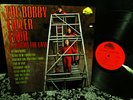
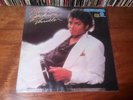
THE ALL STAR PERCUSSION ENSEMBLE LP 1983 1ST PRESS Harold Farberman MMG NM
$
100



Favourite Auctions
To save auctions to your favourites, please login
If you don't have an account, please register
Description
THE ALL STAR PERCUSSION ENSEMBLE Plays Bizet Beethoven Pachelbel And Berlioz LP
MMG 1983 D-MMG 115 - Original 1st Pressing
Recognized By Just About Every Hi-Fi Magazine Around The World As One Of The Most Prized Audiophile Recordings. Harold Faberman Conducting.
Incredible symphonic percussion masterpiece! Not easy to find in this condition. See detailed grading below. There’s tons of great quiet percussive moments. Having a very clean copy like this really helps enjoy the vinyl pressing as it was intended
Cover - STRONG VG+. Although closer to EX, I’m using Strong VG+ to be conservative. Very little edge wear mostly on spine & 1 spot on opening. Not much! Extremely light corner wear on the very tip right corner, & barely that. See photos. Really nice shape. (Thanks for the interest, I added 1 more pic of cover)
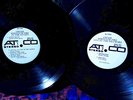
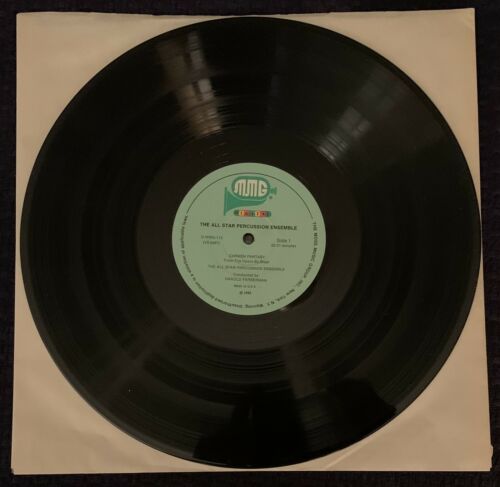
Vinyl EX to NM. A few light entirely inaudible marks that are sometimes left from an original poly inner sleeve. No spindle marks! Zero scratches! Played all the way through while listening carefully to grade vinyl. I do not use these grades lightly. I’m confident it was the 2nd time this was played! Has a very minor edge warp & a few crackles at very tip edge / beginning of side A only. All go away entirely after approximately 10 to 15 seconds. Accurate detailed grading. See feedback & buy w/ confidence. Super nice keeper copy!
See my other items. It will be packed with care & shipped as soon as payment is received. Offers welcome. More will be listed in the days/weeks to follow
(Review online) The recording quality is outstanding (honest, it is amazing audiophile quality) and the performance is breathtaking. I don't write many reviews but felt I should share the joy of this by writing a review. I had my attention brought to it by an audiphile listing that recomended it, and they were correct.
—
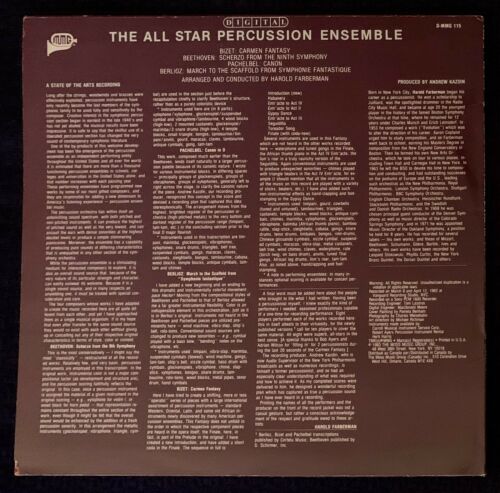
A STATE OF THE ARTS RECORDING
BIZET: CARMEN FANTASY
BEETHOVEN: SCHERZO FROM THE NINTH SYMPHONY
PACHELBEL: CANON
BERLIOZ: MARCH TO THE SCAFFOLD FROM SYMPHONIE FANTASTIQUE
ARRANGED AND CONDUCTED BY HAROLD FARBERMAN
Long after the strings, woodwinds and brasses were
effectively exploited, percussion instruments have
only recently become the last members of the sym-
phonic family to be used fully and sensitively by the
composer. Creative interest in the symphonic percus-
sion section began in earnest in the late 1940's and
has not yet abated; the musical results have been
impressive. It is safe to say that the skillful use of a
liberated percussion section has changed the very
sound of contemporary symphonic literature.
One of the by-products of this welcome develop-
ment has been the emergence of the percussion
ensemble as an independent performing entity
throughout the United States and all over the world.
It is estimated that there are more than a thousand
functioning percussion ensembles in sch0ols, col-
leges and universities in the United States alone, and
that number increases with each passing year.
These performing ensembles have programmed new
works by some of our most gifted composers, and
they are responsible for adding a new dimension to
America's listening experience
ble music.
The percussion orchestra has within itself an
astonishing sound spectrum, with both pitched and
non-pitched instruments. It can produce the highest
of pitched sound as well as the very lowest, and can
assault the ears with dense sonorities at the highest
decibel levels or produce a simple shimmering
pianissimo. Moreover, the ensemble has a capability
of producing pure sounds of differing characteristics
that is unequalled in any other section of the sym-
phony orchestra.
While the percussion ensemble is a stimulating
medium for interested composers to explore, it is
also an overall sound source that, because of the
very nature of its particular strength and character,
can easily outwear its welcome. Because it is a
single sound source, and in many respects an
unyielding one, it must be treated with special con-
sideration and care.
The four composers whose works I have adapted
to create the music recorded here are all quite dif-
ferent from each other, and yet I have approached
them as a single musical organism. It is my hope
that even after transfer to the same sound source
they would co-exist with each other without giving
up or cancelling out any of their respective original
characteristics in terms of style, color or content.
BEETHOVEN: Scherzo from the 9th Symphony
percussion ensem-
This is the most conservatively -I might say the
most "classically"
ed works. Relatively few, and very basic, percussion
instruments are employed in this transcription. In the
original work, instrumental color is not a major com-
positional factor (as development and structure are),
and the percussion scoring faithfully reflects the
original. In this case, once a percussion instrument
is assigned the material of a given instrument in the
original scoring- e.g., xylophone for violin I, or
wood block for horn pedal - that representation re-
mains constant throughout the entire section of the
work, even though it might be felt that the overall
sound would be enhanced by the addition of a fresh
restructured of all the record-
percussion sonority. In this arrangement the metallic
instruments (glockenspiel, vibraphone, triangle,
cymbal) are used in the section just before the
recapitulation chiefly to clarify Beethoven's structure,
rather than as a purely coloristic device.
• Instruments used here are (in 8 parts):
xylophone /xylophone, glockenspiel/suspended
cymbal and vibraphone/tambourine, 4 wood blocks
(high-low), 2 mounted castanets, glockenspiel/
marimba/3 snare drums (high-low), 4 temple
blocks, small triangle, bongos, tambourine/timpani/
anvils, gourd, maracas, claves, tambourine,
antique cymbals, gong, tam-tam.
PACHELBEL: Canon in D
This work, composed much earlier than the
Beethoven, lends itself naturally to a larger percussion
palette because of its canonic nature. I wrote
for various instrumental blocks, in differing spaces
- principally groups of glockenspiels, groups of
vibraphones, groups of xylophones, generally left to
right across the stage, to clarify the canonic nature
of the piece. Andrew Kazdin, our recording producer,
recognized this concept in the score and
devised a recording plan that captured this idea
stereophonically. The arrangement moves from the
highest, brightest register of the percussion orchestra
(high-pitched metals) to the very bottom and
darkest register of the percussion range (timpani,
tam-tam, etc.) in the concluding section prior to the
final D major flourish.
* Instruments used in this transcription are timpani,
marimba, glockenspiels, vibraphones,
xylophones, snare drums, triangles, bell tree,
suspended cymbals, gongs, maracas, claves,
castanets, sleighbells, bongos, tambourine, cabasa,
wood blocks, temple blocks, antique cymbals, tam-tam
and chimes.
BERLIOZ: March to the Scaffold from
"Symphonie fantastique"
I have added a new beginning and an ending to
this dramatic and instrumentally colorful movement:
pace Hector! Moving from the compositional styles of
Beethoven and Pachelbel to that of Berlioz allowed
me a far greater instrumental flexibility. Color is an
indispensible element in this orchestration, just as it
is in Berlioz's original. Instruments not heard in the
Beethoven and Pachelbel pieces are utilized prominently here
bell, roto-toms. Conventional sound sources are
changed to produce new sonorities – e.g., cymbal
played with a bass bow, "bending" notes on the
vibraphone, etc.
* Instruments used: timpani, vibra-slap, marimba,
suspended cymbals (bowed), wind machine, gongs,
tam-tam, ship's bell, sizzle cymbal, bass drum with
cymbals, glockenspiels, vibraphone, chime, slap-
stick, xylophones, bongos, snare drums, tam-
bourine, roto-toms, wood blocks, metal pipes, tenor
drum, hand cymbals.
wind machine, vibra-slap, ship's
BIZET: Carmen Fantasy
Here I have tried to create a shifting, more or less
"operatic" series of pieces with a large international
assortment of percussion instruments
Western, Oriental, Latin, and some old African
instruments newly discovered by many American
percussion ensembles. This Fantasy does not unfold in
the order in which the respective component pieces
are heard in the opera itself; the Finale, here, in
fact, is part of the Prelude in the original. I have
created a new Introduction, and have added a short
coda in the Finale. The sequence in full is:
standard
Introduction (new)
Habanera
Entr'acte to Act IV
Entr'acte to Act II
Gypsy Dance
Entr'acte to Act III
Seguidilla
Toreador Song
Finale (with coda-new)
Several instruments are used in this Fantasy
which are not heard in the other works recorded
here
the African thumb piano in the Act IV Entr'acte, the
lion's roar in a truly raunchy version of the
Seguidilla. Again conventional instruments are used
to produce unexpected sonorities - chimes played
with triangle beaters in the Act IV Entr'acte, for
example (I should mention that all the instruments in
all the music on this record are played with a variety
of sticks, beaters, etc.). I have also added such
non-instrumental effects as hand-clapping and foot-
stamping in the Gypsy Dance.
* Instruments used: timpani, gourd, cowbells
(tuned and untuned), tambourines, triangles,
castanets, temple blocks, wood blocks, antique cymbals,
chimes, marimba, xylophones, glockenspiels,
vibraphone, kalimba (African thumb piano), bamboo
rattle, slap-stick, sleighbells, cabasa, gongs, snare
drums, tenor drums, timbales, bongos, roto-drums,
Chinese glissando cymbals, sizzle cymbal, suspended
cymbals, maracas, vibra-slap, metal castanets,
bell tree, wind chimes, claves, waterphone, rute
(birch twig, on bass drum), anvils, tuned Thai
gongs, African log drums, lion's roar, tam-tam.
Also, as noted above, handclapping and foot-
stamping.
*A note to performing ensembles: in many in-
stances optional scoring is available for concert performances.
waterphone and tuned gongs in the Finale,
A final word must be added here about the people
who brought to life what I had written. Having been
a percussionist myself, I knew exactly the kind of
performers I needed: seasoned professionals capable
of a one-time-for-recording performance. Eight
players performed each of the works recorded here:
this in itself attests to their virtuosity, for the newly
published versions 1 call for ten players to cover the
same material. All eight were superb, all-stars in the
best sense. [A special thanks to Bob Ayers and
Adrian Wilcox for 'filling in' for 2 percussionists during
the last 26 seconds of the Carmen Fantasy.]
The recording producer, Andrew Kazdin, who is
now Audio Supervisor of the New York Philharmonic
broadcasts as well as numerous recordings, is
himself a former percussionist, and so had an
especially clear understanding of what was required
and how to achieve it. As my completed scores were
delivered to him, he designed a wonderful recording
plan which has captured as true a percussion sound
as I have ever heard in a recording.
Printing the names of all the performers and the
producer on the front of the record jacket was not a
casual gesture, but rather a conscious
acknowledgement of the respect and gratitude owed to these artists.
HAROLD FARBERMAN
1 Berlioz, Bizet and Pachelbel transcriptions
published by Cortelu Music; Beethoven published by
G. Schirmer, Inc.
PRODUCED BY ANDREW KAZDIN
Born in New York City, Hareld Farberman began his
career as a percussionist. He won a scholarship to
Juilliard, was the spotlighted drummer in the Radio
City Music Hall, and became at age 20 the youngest
player in the history of the famed Boston Symphony
Orchestra at that time, where he remained for 12
years under Charles Munch and Erich Leinsdorf. In
1953 he composed a work ("Evolution") which was
to alter the direction of his career. Aaron Copland
urged him to study composition, and so Farberman
went back to school, earning his Masters Degree in
composition from the New England Conservatory in
Boston. Then he formed his own New Arts Orchestra,
which he took on tour to various places, including Town
Hall and Carnegie Hall in New York. In
1963 he left the BSO to devote his time to composition
and conducting, and had outstanding successes
on the podiums of Europe and the U.S., leading
such orchestras as the New Philharmonia, Royal
Philharmonic, London Symphony Orchestra, Stuttgart
Philharmonic, BBC Symphony Orchestra,
English Chamber Orchestra, Hessischer Rundfunk,
Stockholm Philharmonic, and the Swedish
and Danish Radio Orchestras. In 1968 he was
chosen principal guest conductor of the Denver
Symphony as well as music director of the Colorado
Springs Symphony; and in 1971 he was appointed
Music Director of the Oakland Symphony, a position
he held for 8 years. He has recorded for several
labels
his own works, and those of Mozart,
Beethoven, Schumann, Glière, Bartók, Ives and
others. His own works have been recorded by
Leopold Stokowski, Phyllis Curtin, the New York
Brass Quintet, the Dorian Quintet and others.
Warning: All Rights Reserved. Unauthorized duplication is a violation of applicable laws.
Recorded on March 8 and April 12, 1982 at
Vanguard Recording Studio, NYC.
Recorded on a Sony PCM 1600 Recorder.
Recording Engineer: Tom Lazarus
Digital Engineer: MacDonald Moore
Cover Painting by Pamela Benham
Photography by Charles Weisehahn
Art direction by Michael Richman
Instruments made available by:
Carroll Musical Instrument Service Corp.
Robert Ayers Percussion Instrument Rental
Herb Harris
TMK(s)OMMG • Marca(s) Registrada(s) Printed in U.S.A.
O 1983 THE MOSS MUSÍC GROUP, INC.,
48 West 38th Street, New York, NY 10018
Distribué au Canada par/Distributed in Canada by
The Moss Music Group (Canada) Inc., 510 Coronation, Drive
West Hill, Ontario, Canada M1E 4X6
—
Tracklist:
A1 Carmen Fantasy
Composed By – Bizet
20:21
B1 Scherzo From The 9th Symphony
Composed By – Beethoven
7:20
B2 Canon In D
Composed By – Pachelbel
8:48
B3 March To The Scaffold From Symphonie Fantasique
Composed By – Berlioz
5:56
Companies, etc.
Recorded At – Vanguard Studios
Credits
Arranged By – Harold Farberman
Art Direction – Michael Richman
Artwork [Cover Painting] – Pamela Benham
Conductor – Harold Farberman
Engineer [Digital] – MacDonald Moore
Engineer [Recording] – Tom Lazarus
Musician – Abraham Marcus, Arnold Lang, Arthur Press, Bent Lylloff, Donald Miller, Everett Firth, John Soroka, Mickey Bookspan, Roland Kohloff, Walter Rosenberger
Photography By – Charles Weisehahn
Producer – Andrew Kazdin
Percussion instruments have only recently become the last members of the symphonic family to be used fully and sensitively by composers, long after strings, woodwinds and brasses have been effectively exploited. Creative interest in the symphonic percussion section began in earnest in the late 1940s and has not yet abated, with rather impressive musical results thus far achieved. It is safe to say that the skillful use of a liberated percussion section has changed the very sound of contemporary symphonic music. One of the by-products of this welcome development has been the emergence of the percussion ensemble as an independent performing entity throughout the US and all over the world. These ensembles have programmed new works by some of our most gifted composers and they are responsible for adding a new dimension to Americas listening experience. The four composers whose works have been adapted to create this program are all quite different from one another, yet, they have been approached as a single musical organism, with the hope that, even after transfer to the same sound source, they would coexist with one another without giving up or cancelling outany of their respective original characteristics of style, color, or content.
price rating