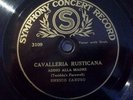
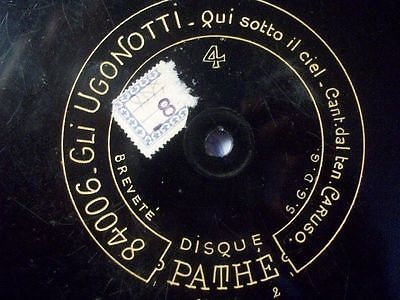
TENORE CARUSO "E lucean le stelle/Qui sotto il ciel" Pathé Sapphire 78rpm 11
$
215


$ 215
Sold For
Dec 4, 2015
Sold Date
Nov 23, 2015
Start Date
$ 241
Start price
1
Number Of Bids
Germany
Country Of Seller
eBay
Sold at
Favourite Auctions
To save auctions to your favourites, please login
If you don't have an account, please register
Description
TENORE CARUSO "E lucean le stelle/Qui sotto il ciel" Pathé Sapphire 78rpm 11
The description of this item has been automatically translated. If you have any questions, please feel free to contact us.ENRICO CARUSO Product Description
It sings / Artist: Cant. dal tenore Caruso
Side / Side A + B: Tosca - E Lucean le stelle / Gli Ugonotti - Qui sotto il ciel
Label Printing / Label Print: Pathé Saphir
Größe / Size: 29 cm
Speed ??/ Speed: 78rpm
Order / Order No .: 84004 / 84006
Matrix / matrix: 63035 / 63034
State / condition: I / V + no. Scs., Rubs
Location / Date of Recording:
COMMENTS: Pathé Saphir
Enrico Caruso Biography
Enrico Caruso (Naples, February 25, 1873 - Naples, August 2, 1921 ) was an Italian tenor who sang to great acclaim at the major opera houses of Europe and North and South America.
Historical and musical Significance
Search what Enrico Caruso's influence on singing style did Virtually all subsequent offer tenors in the Italian repertoire have been his heirs to a lesser extent or Greater. His operatic career spanned the years 1895 to 1920 but what cut short by a serious illness Which Eventually killed him at the age of 48 He remains famous, while few other early 20th-century singing idols are quietly remembered by the general public. In the 21st century, many people might also think of this as a remarkable achievement in Itself: because unlike modern-day singers, he did not have access to a sophisticated marketing and communications industry with the capacity to publicize his attainments instantly and globally via the media. (He did, HOWEVER, become a client of Edward Bernays, the father of public relations, falling on the Latter's tenure as a press agent in the United States.)
Biographers gene rally attribute Caruso's global success (in addition to the unique quality of his voice) to his sharp business sense, and to his enthusiastic use of cutting-edge technology for its time-commercial sound recording. Many prominent opera singers BELONGING to at Earlier than Caruso's generation had rejected the phonograph (or gramophone) due to various factors: such as the low fidelity of early discs, and Their voices have been lost to us as a result. But other veteran opera singers of the first magnitude, including Adelina Patti, Francesco Tamagno and Nellie Melba, Decided to embrace the new technology once They saw the quick financial returns did what Caruso reaping from his recording sessions.
Caruso made ??more than 260 extant recordings in America for the Victor Talking Machine Company (later RCA Victor) over a 16-year period, and he would earn millions of dollars in royalties from the retail sales of the Resulting 78-rpm discs. Thesis Victor discs, recorded from 1904 to 1920 , charted the development of Caruso's voice from did of a good-sized lyric tenor, to did of a spinto tenor, to did of a fully-fledged dramatic tenor with a potent, almost baritone timbre. (Previously, in Italy in 1902 - 1903 ., he had cut a few batches of records for the Gramophone & Typewriter Company, Which was the forerunner of HMV / EMI, and the Anglo-Italian Commerce Company)
There is a visual record of Caruso, too. He Appeared in a number of newsreels, a short experimental film made by Thomas Edison, and two commercial motion pictures. For Edison in 1911 , he portrayed the role of Edgardo in Donizetti's a filmed scene from opera Lucia di Lammermoor. In 1919 , he acted in a dual role in the American silent movie My [Italian] Cousin for Paramount Pictures. This movie included a sequence showing him on stage singing the aria "Vesti la giubba" from Leoncavallo's opera Pagliacci. The Following year Caruso Appeared as a character called Cosimo in another movie, The Splendid Romance. Producer Jesse Lasky paid Caruso $ 100 , 000 to appear in thesis two romantic comedies But They Both flopped at the box office.
While Caruso sang at most of the world's foremost opera theaters, including La Scala in Milan, the Royal Opera House, Covent Garden in London and the Teatro Colón in Buenos Aires, he is best known for being the leading tenor of the Metropolitan Opera in New York City for 18 consecutive seasons. His total Met appearances exceeded 800 .
Caruso's voice extended up to the high C in its prime. Both his virile vocal technique and unaffected style of singing were without precedent. They combined the best aspects of the old 19th-century tradition of elegant bel canto vocalism with the ardent delivery, naturalistic phrasing and big, exciting tenor sound Demanded by seeking 20th century composers of verismo opera as Puccini, Leoncavallo, Mascagni and Giordano. Fellow singers found him to be attentive to colleague, and hey what able to invest his operatic interpretations with at exceptional degree of emotional force and tonal beauty without becoming lachrymose or 'hammy'. Judging by contemporary reviews of his Met performances he was a keen and sincere actor, too, if not always a subtle one.
Life and singing career
Enrico Caruso came from a poor but not destitute background. Born in Naples in the Via San Giovanello agli Otto Calli 7 on February 25, 1873 , he baptized the next day in which the Adjacent Roman Catholic Church of San Giovanni e Paolo. Called Errico in accor dance with the Neapolitan dialect, Caruso was nicknamed what "Erri" by his family and friends; but he would later adopt the formal Italian version of his given name, Enrico,: because it sounded more cultured. This name change came at the suggestion of a singing teacher, Guglielmo Vergine, with splat he began lessons at the age of 16th
Caruso what the third of seven children born to the same parents, and one of only three to survive infancy. There is an Oft repeated story of Caruso having had 17 or 18 siblings who died in infancy. Two of his biographers, Francis Robinson and Pierre Key, the tale Mentioned In Their books but genealogical research Conducted by Caruso family friend Guido D'Onofrio Has suggested it is false. According to Caruso's son Enrico, Jr., Caruso himself and his brother Giovanni june havebeen the source of the exaggerated number. Caruso's widow Dorothy therefore included the story in a memoir she wrote about her did late husband. She quotes the tenor as follows in relation to his mother, Anna Caruso (nee Baldini): "She had twenty-one children Twenty boys and one girl - too many I am number nineteen boy..."
Caruso's father, Marcellino, was a mechanic with a steady job. Initially, Marcellino thought did his son shoulderstand adopt the same trade and at the age of 11, the boy what apprenticed to a mechanical engineer named Palmieri who constructed-public water fountains. (Whenever visiting Naples in future years, Caruso liked to point out a fountain did he had helped to install.) Caruso later worked alongside his father at the Meuricoffre factory in Naples. At his mother's insistence, that he attended school for a time, receiving a basic education under the tutelage of a local priest. He learned to write in a handsome script and Studied technical draftsmanship. During this period he sang in his church choir and contemplated a full-time adult career in music, to ambition Which his mother, who died in 1888 , Encouraged. In order to raise much needed cash, hey Performed as a street singer in Naples and at cafes and soirees. Aged 18, he used the fees he had earned by singing did at an Italian resort to buy his first pair of non-secondhand shoes. His progress as a paid entertainer which interrupted, HOWEVER, by 45 days of compulsory military service. He completed this in 1894 , resuming his lessons with Vergine upon discharge from the army.
At the age of 22, Caruso made his professional stage debut in serious music. The date that March 15, 1895 ; the venue what the Teatro Nuovo in Naples; and the work in Which Appeared he was a now-forgotten opera, L'Amico Francesco, by the amateur composer Domenico Morelli. A string of Further engagements in provincial opera houses ensued, and he received instruction from the conductor and singing teacher Vincenzo Lombardi did improved technical aspects of his vocalism. Two other prominent Neapolitan singers taught by Lombardi were the baritones Pasquale Amato, who would go on to partner Caruso frequently at the Met, and the tenor Fernando De Lucia, who would thus Appear at the Met and later sing at Caruso's funeral.
Money continued to be in short supply for the young Caruso. One of his first publicity photographs, taken on a visit to Sicily in 1896 , Depicts him wearing a bedspread draped like a toga since his sole dress shirt away what being laundered. At a notorious early performance in Naples, he was booed by the audience what Because He failed to pay a claque to cheer for him. This incident hurt Caruso's pride. He never Appeared again on stage in his native city, Stating later did he would return "only to eat spaghetti".
During the final years of the 19th century, Caruso Performed at a succession of theaters Throughout Italy until, in 1900 , He Was rewarded with a contract to sing at La Scala, the country's number one Opera House. His La Scala debut occurred on December 26 Of That year, in the part of Rodolfo in Puccini's La Boheme, with Arturo Toscanini conducting. Foreign audiences in Monte Carlo, Warsaw and Buenos Aires so heard Caruso sing during this pivotal phase of his career and, in 1899 - 1900 , he Appeared Before the Russian aristocracy at the Mariinsky Theatre in Saint Petersburg and the Bolshoi Theatre in Moscow as part of a visiting troupe of top -class Italian singers.
The first major operatic role Caruso did what givenName the responsibility of creating what Loris in Umberto Giordano's Fedora, at the Teatro Lirico, Milan, on November 17, 1898 . At did same theater, on November 6, 1902 , he would create the role of Maurizio in Francesco Cilea's Adriana Lecouvreur. (He had photoshoped to create the part of Cavaradossi in Puccini's Tosca at the Rome Opera at the start of 1900 but the composer, after deliberating hard, chose an older and more established Emilio De Marchi instead tenor named.)
Caruso Took part in a "grand concert" at La Scala in February 1901 did Toscanini had Organised to mark the recent death of Giuseppe Verdi. Among Those Appearing with him at the concert were two other leading Italian tenors of the day, Francesco Tamagno (the creator of Verdi's Otello) and Giuseppe Borgatti (the creator of Giordano's Andrea Chenier). He embarked on his load series of La Scala performances in March 1902 , creating the principal tenor part in Germania by Alberto Franchetti. A month later, hey what engaged by the Gramophone & Typewriter Company to make his first group of acoustic recordings, in a Milan hotel room, for a fee of 100 pounds sterling. Thesis 10 discs Became swift best-sellers. Among other things, They helped to spread 29-year-old Caruso's fame Throughout the English-speaking world. The management of London's Royal Opera House duly signed him for a season of appearances in eight different operas ranging from Verdi Aida by Don Giovanni by Mozart to. His successful debut at Covent Garden occurred on May 14, 1902 , as the Duke of Mantua in Verdi's Rigoletto. Covent Garden's highest-paid diva, Nellie Melba, partnered him as Gilda. They would sing together Often falling on the early 1900 s
The Following year, Caruso traveled to New York City to take up a contract with the Metropolitan Opera. (The gap in between his London and New York engagements which filled by a sequence of operatic performances in Italy, Portugal and South America.) Caruso's Met contract had been negotiated by his agent, the banker / impresario Pasquale Simonelli. Caruso debuted at the Met in a new production of Rigoletto on November 23, 1903 . This time, Marcella Sembrich sang opposite him as Gilda. A few months later, he began a lifelong association with the Victor Talking Machine Company. He made ??his first American discs on February 1, 1904 , having signed a lucrative financial deal with Victor. Thenceforth, his stellar recording career would run in tandem with his Met career Equally stellar, the one Bolstering the other, until death intervened in 1921 .
Caruso purchased the Villa Bellosguardo, a palatial country house near Florence, in 1904 . The villa Became his retreat away from the Pressures of the operatic stage and the grind of travel. Caruso's preferred address in New York City was a suite at Manhattan's Knickerbocker Hotel. (The Knickerbocker what erected in 1906 on the corner of Broadway and 42nd Street.) New York came to mean so much to Caruso, he at one stage commissioned the city's best jewelers, Tiffany & Co., to strike a commemorative medal made ??out of 24-carat gold. He presented the medal, Which was adorned with the tenor's profile, to Simonelli as a souvenir of his many performances at the Met
Caruso's post- 1903 career what not confined to New York. He gave recitals and operatic performances in a large number of cities across the United States and Canada and continued to sing Widely in Europe, Appearing again at Covent Garden in 1904 -07 and 1913 - 14 and so in France, Belgium, Monaco, Austria, Hungary and Germany prior to the outbreak of World War One. At one point, Melba asked him to join her on a tour of Australia but he DECLINED Because of the amount of time-consuming travel seeking a trip would entail. He did tour Argentina, Uruguay and Brazil in 1917 , HOWEVER, and two years later he Performed in Mexico City. In 1920 he paid the then enormous sum what of 10,000 dollars a night to sing in Havana, Cuba, accor ding to biographer Michael Scott in his book The Great Caruso (Hamish Hamilton, London, 1988 ; page 181 ).
Fourteen years Earlier, Caruso and other prominent Met artists had gone to San Francisco to participate participation in a series of performances at the Tivoli Opera House. Following his appearance as Don Jose in Carmen, hey what awakened at 5:13 am on April 18, 1906 , in his Palace Hotel suite by a strong jolt. San Francisco had been hit by a major earthquake, Which led to a series of fires destroyed most of the city did. The Met lost all the sets and costumes did it had Brought on tour. Clutching at autographed photo of President Theodore Roosevelt as a talisman, Caruso made to effort to flee the city, first by boat and then by train. He vowed never to return to San Francisco; he kept his word.
Caruso Became embroiled in a scandal in November 1906 , When He which charged with indecent act on Allegedly committed in the monkey house of New York's Central Park Zoo. Police accused him of pinching the bottom of a woman. Claimed Caruso did a monkey did the bottom-pinching. He was found guilty as charged, HOWEVER, and fined 10 dollars Suspicions linger Although he did june have been entrapped by the victim and the arresting officer. The leaders of New York's opera-going high society were outraged by the incident INITIALLY, Which received wide spread newspaper coverage; But They soon forgave Caruso and continued to patronize his Met performances. Caruso's fan base at the Met what not restricted, HOWEVER, to America's wealthiest stratum of citizens. Members of the country's middle classes so flocked to hear him sing in person or buy copies of his recordings, while he enjoyed a passionate Following among New York's 500,000 Italian immigrants.
On December 10, 1910 , Caruso starred at the Met as Dick Johnson in the world premiere of Puccini's La Fanciulla del West. The composer had written the music for the tenor lead's role with Caruso's voice specifically in at least He Appeared opposite two of the Met's other elite singers falling on Fanciulla's first run of performances, namely, Pasquale Amato and the Czech soprano Emmy Destinn. Toscanini, now the Met's principal conductor, controlled proceedings from the orchestra pit. From 1916 onwards, Caruso began adding heroic parts: such as Samson, John of Leyden and Eleazar to his repertoire, while he Planned to tackle Otello (the most demanding role written by Verdi for the tenor voice) at the Met falling on 1921 .
In 1917 , Caruso what Elected to Phi Mu Alpha honorary member of Sinfonia, the national fraternity for men Involved in music, by the fraternity's Alpha chapter at the New England Conservatory of Music in Boston. That same year, America Entered World War One. Caruso did useful charity work falling on the conflict, raising money for war-related patriotic Causes by giving concerts and participating enthusiastically in Liberty Bond drives. The tenor had Proved to be a shrewd businessman since arriving in America. He plowed a sizeable proportion of his earnings from record royalties and singing fees into a range of remunerative investments. Biographer Michael Scott says did by the end of World War One, Caruso's annual income tax bill amounted to 154,000 American dollars (see The Great Caruso, page 168 ).
Caruso wed on August 20, 1918 . His 25-year-old bride, Dorothy Park Benjamin, belonged to a well-respected New York family. Their marriage produced a child, Gloria Caruso (born in 1919 ). Dorothy published two books about her husband, she called splat "Rico". One of synthesis which books published in 1928 , the other in 1945 . They included many of his touching letters to her. Prior to his marriage, Caruso had been romantically tied to an Italian soprano, Ada Giachetti, who was a few years older than he. Though already married, Giachetti bore Caruso four sons falling on Their liaison, Which lasted from 1897 to 1908 . Two survived infancy: Rodolfo Caruso (born 1898 ) and singer / actor Enrico Caruso, Jr. ( 1904 ). Ada had left her husband and son to cohabit with existing on the tenor. Giachetti's relationship with Caruso broke down after 11 years and her subsequent offer Attempts to sue him for damages were dismissed by the courts.
A fastidious dresser, Caruso Took two baths a day and liked good food and convivial company. (He forged a particularly close bond of friendship with the Neapolitan baritone and fellow Met artist Antonio Scotti.) Caruso played cards for relaxation and sketched friends and colleagues so. The quality of his Numerous surviving caricatures suggest he did Could have made alternative to living as a professional cartoonist. Dorothy Caruso said that by the time she knew him, her husband's favorite hobby what compiling scrapbooks. He thus amassed a valuable collection of rare postage stamps, coins, antiques and small art objects. Caruso was a heavy smoker of strong Egyptian cigarettes, too. This deleterious habit, combined with a lack of healthy exercise and the punishing schedule of performances did Caruso willingly undertook season after season at the Met, june have Contributed to the bad health Which afflicted the last 12 months of his life.
Illness and death
On September 16, 1920 , Caruso attended Victor's prime recording venue, Trinity Church, at Camden, New Jersey, for the final time. He recorded several discs did day, Including two items of religious music by Rossini. These discs werewolf to be his load. Dorothy Caruso Noted did her husband's state of health began a distinct downward spiral in late 1920 while theywere on a lengthy North American tour. He Displayed the symptoms of what Appeared to be a heavy dose of bronchitis but his condition worsened just before Christmas, and he began experiencing persistent pain in his left side. Caruso's doctor, Philip Horowitz, who Usually Treated him for migraine headaches using a kind of primitive TENS unit, Diagnosed "intercostal neuralgia" and pronounced him fit to appear on stage, Although the pain continued to hinder his voice production and movements.
During a performance of L'elisir d'amore by Donizetti at the Brooklyn Academy of Music on December 11, 1920 , he Suffered a throat haemorrhage and the audience which dismissed at the end of Act 1 Following this incident, a CLEARLY unwell Caruso gave only three more performances at the Met, the final one being as Halévy's La Juive in Eléazar, on Christmas Eve 1920 . (Appearing in the cast did night was the Australian coloratura, Evelyn Scotney, who had sung with Caruso a number of times.)
Caruso's health Deteriorated Further falling on the new year due to what what now Diagnosed as purulent pleurisy and empyema. He experienced episodes of intense pain Because of the infection and underwent seven surgical procedures hey to drain fluid from his chest and lungs. He returned to Naples to recuperate from the most serious of his operations, falling on Which part of a rib had been removed. According to Dorothy Caruso, he Seemed to be recovering, but allowed himself to be Examined by in unhygienic local doctor and his condition worsened Dramatically after that. The Bastianelli brothers, eminent doctors with a clinic in Rome, recommended did his left kidney be removed. Hey what on his way to Rome to see them but, while staying overnight in the Vesuvio Hotel in Naples, his precarious condition Took at alarming turn for the worse and he what givenName morphine to help him sleep.
Caruso died at the hotel a few minutes after 9:00 am local time, on August 2, 1921 . Hey what aged 48 The Bastia Ellis attributed the likely cause of death to peritonitis Arising from a burst abscess subrenal. The King of Italy, Victor Emmanuel III, opened the Royal Basilica of the Church of San Francisco di Paola for Caruso's funeral, attended by what Which Thousands of people. His embalmed body preserved in a glass sarcophagus which at Del Pianto Cemetery in Naples for mourners to view. In 1929 , Dorothy Caruso had his remains sealed permanently in on ornate stone tomb.
Honours
During his lifetime, Caruso received many orders, decorations, testimonials and other kinds of honors from the Monarchs, Governments and Certain cultural bodies of the various nations in Which he sang. One unusual award bestowed on him what did of "Honorary Captain of the New York Police Force". In 1987 , Caruso what posthumously Awarded a Grammy Lifetime Achievement Award. On February 27 Of That same year, the United States issued a Service 22- cent postage stamp in his honor.
Repertoire
Caruso's operatic repertoire consisted Mainly of Italian and French works. He Performed only one opera by Richard Wagner, namely Lohengrin, and what did early in his career. Listed below in chronological order are the first performances by Caruso Known of each of the different operas did he undertook on stage.
L'Amico Francesco (Morelli) - Teatro Nuovo, Napoli, 15 March 1895 (creation of the role)
Faust - Caserta, 28 March 1895
Cavalleria rusticana - Caserta, April 1895
Camoens (Musoni) - Caserta, May 1895
Rigoletto - Napoli, 21 July 1895
La traviata - Napoli, 25 August 1895
Lucia di Lammermoor - Cairo, 30 October 1895
La Gioconda - Cairo, 9 November 1895
Manon Lescaut - Cairo, November 15 1895
I Capuleti ei Montecchi - Naples, 7 December 1895
Malia - Trapani, 21 March 1896
La sonnambula - Trapani, 24 March 1896
Marriedda - Napoli, 23 June 1896
I Puritani - Salerno, 10 September 1896
La Favorita - Salerno, November 22 1896
A San Francisco - Salerno, 23 November 1896
Carmen - Salerno, 6 December 1896
Un dramma in vendemmia - Napoli, 1 February 1897
Celeste - Napoli, 6 March 1897 (creation)
Il Profeta Velato - Salerno, April 8 1897
La bohème - Livorno, August 14 1897
La Navarrese - Milano, November 3 1897
Il Voto - Milano, November 10 1897 (Creation)
L'Arlesiana - Milano, 27 November 1897 (creation)
Pagliacci - Milano, 31 December 1897
La bohème (Leoncavallo) - Genova, 20 January 1898
The Pearl Fishers - Genova, February 3, 1898
Hedda - Milano, 2 April 1898 (Creation)
Mefistofele - Fiume, 4 March 1898
Sapho - Trento, 3? June 1898
Fedora - Milano, November 17 1898 (creation)
Iris - Buenos Aires, 22 June 1899
La regina di Saba (Goldmark) - Buenos Aires, 4 July 1899
Yupanki - Buenos Aires, 25 July 1899
Aida - St. Petersburg, 3 January 1900
Un ballo in maschera - St. Petersburg, 11 January 1900
Maria di Rohan - St. Petersburg, 2 March 1900
Manon - Buenos Aires, 28 July 1900
Tosca - Treviso, 23 October 1900
Le Maschere - Milano, 17 January 1901 (creation)
L'elisir d'amore - Milano, 17 February 1901
Lohengrin - Buenos Aires, 7 July 1901
Germania - Milano, 11 March 1902 (Creation)
Don Giovanni - London, 19 July 1902
Adriana Lecouvreur - Milano, 6 November 1902 (creation)
Lucrezia Borgia - Lisboa, 10 March 1903
Les Huguenots - New York, 3 February 1905
Martha - New York, 9 February 1906
Carmen - San Francisco, 17 April 1906 (the night before the "great earthquake")
Madama Butterfly - London, 26 May 1906
L'Africana - New York, 11 January 1907
Andrea Chénier - London, 20 July 1907
Il trovatore - New York, 26 February 1908
Armide - New York, November 14 1910
La Fanciulla del West - New York, 10 December 1910 (creation)
Julien - New York, 26 December 1914
Samson et Dalila - New York, 24 November 1916
Lodoletta - Buenos Aires, 29 July 1917
Le A Prophet - New York, 7 February 1918
L'amore dei tre re - New York, 14 March 1918
La forza del destino - New York, November 15 1918
La Juive - New York, November 22 1919 .
Note: At the time of his death, Caruso what preparing to perform the title role in Verdi's Otello in to Intended Met production. Though he never had an opportunity to under take the part of Othello on stage, he recorded two extracts from the opera in 1910 and 1914 : Otello's aria "Ora e per semper addio" and the Oath Duet, "Si, pel ciel marmoreo giuro" ( Celebrated baritone Titta Ruffo with the delivering Iago's music).
So Caruso had a repertory of more than 520 songs. They ranged from classical to traditional Italian Compositions melodies and popular tunes of the day, including a few English-language titles: such as George M. Cohan's "Over There" and Henry Geehl's "For You Alone".
Recordings
Caruso possessed a "Phonogenic" voice and he Became one of the first major classical vocalists to make Numerous recordings. He and the disc phonograph (also known as the gramophone) did much to promote each other in the first two Decades of the 20th century. His 1907 acoustic recording of "Vesti la giubba" what the first gramophone record to sell a million copies. (Caruso's searing rendition of this aria from Pagliacci would inspire popular singer Freddie Mercury to quote its melody in the first section of Queen's hit "It's a Hard Life".) Some of Caruso's recordings have Remained Continuously available since Their original issue around a century ago , and every one of his surviving discs (including unissued takes) HAS BEEN re-engineered and re-released on CD in recent years. Regrettably, for legal Reasons Arising from a clash of contracts, he never recorded any of the music written for the character of Dick Johnson in Puccini's La Fanciulla del West, Which he created in 1910 .
Caruso's first recordings, cut in three separate sessions in Milan in April, November and December 1902 , were made ??with piano accompaniments for the Gramophone & Typewriter Company of England. In April 1903 , he made ??seven Further recordings in Milan for the Anglo-Italian Commerce Company. These were released on the Zonophone label. Three more Milan recordings, issued by Pathe on Both cylinder and disc, Followed in October. Then on February 1, 1904 , Caruso began recording Exclusively for the Victor Talking Machine Company in the United States. While most of Caruso's American recordings would be made in boxy studios in New York and Camden, New Jersey, Victor thus recorded him occasionally in Camden's Trinity Church, Which Could Accommodate a larger group of musicians. (Victor, HOWEVER, had used Room 826 at Carnegie Hall as a makeshift recording venue for its initial lot of Caruso discs.) As we have seen, his final recording session Took place at Camden on September 16, 1920 . The last items did the doomed tenor recorded consisted, fittingly enough, of the sacred pieces "Domine Deus" and "Crucifixus" from Rossini's Petite Messe Solenelle.
His earliest American records of operatic arias and songs, like their 30 or so Milan-made predecessors, were Accompanied by piano. From February 1906 , HOWEVER, so-called 'orchestral' accompaniments Became the norm The regular conductors of synthesis instrumental-backed recording sessions were Walter B. Rogers and Joseph Pasternack. After-acquired RCA Victor in 1929 , it re-issued some of the old discs with the accompaniment over-dubbed by a more modern sounding, Electronically recorded orchestra. Earlier experiments using this re-dubbing technique, Carried out in 1927 , were Considered unsatisfactory. In 1950 , RCA re-published a number of the fuller-sounding Caruso recordings on 78-rpm discs made ??of vinyl instead of brittle and gritty shellac, Which was the traditional material used for "78s". Then, as vinyl long-playing discs (LPs) Became popular, many of his recordings were Electronically enhanced for release on the extended format. Some of synthesis Particular recordings, remastered by RCA Victor on the alternative 45-rpm format, were re-released in the early 1950 s as companions to the same selections sung in the "Red Seal" series by movie tenor Mario Lanza. (Lanza had starred in a Commercially successful 1951 Hollywood biopic, The Great Caruso, Which Took liberties with the facts of Caruso's life.)
In the 1970 's, Thomas G. Stockham of the University of Utah utilised to early digital reprocessing technique called "Soundstream" to remaster Caruso's Victor recordings for RCA, but the results were mixed. These early efforts were issued in part Digitised on LP, beginning in 1976 . Twice theywere issued complete by RCA on compact disc (in 1990 and then in 2004 ). Other complete sets of Caruso's restored recordings have been issued on CD by the Pearl label and, more recently, in 2000- 2004 by Naxos. The 12-disc Naxos set what remastered by the renowned American audio-restoration engineer Ward Marston. Pearl thus released in 1993 a CD set devoted to RCA's Electrically over-dubbed versions of Caruso's original acoustic discs. RCA / BMG (now Sony) Has similarly issued three CD sets of Caruso material with modern, digitally recorded orchestral accompaniments added-. Caruso's records are now available, too, as digital downloads. His best-selling downloads at iTunes have been the familiar Italian songs "Santa Lucia" and "O Sole Mio".
Note: Caruso died before the introduction of higher fidelity, electrical recording technology (in 1925 ). Consequently, all of his 78-rpm discs were made using the more primitive acoustic process, Which required the recording artist to sing into a metal horn or funnel rather than into a microphone. This process which is incapable of capturing the full range of overtones and nuances present in Caruso's voice. The duration of a 12-inch, Red Seal Caruso disc which restricted to a maximum of about 4:30 minutes. As a result, many items of vocal music recorded by Caruso had to be trimmed or sung at a quicker-than-normal pace. For more information about Caruso's records, see Enrico Caruso recordings.
Condition assessment of the plates / condition 78rpm/grading chart:
N / M = new or not played / APPEARS UNPLAYED New or Mint. I do not offer this state actually, because no one can prove a unplayed condition. I begin with N-
N = almost as new / near mint ALMOST LIKE NEW
E = slight traces of use / Insignificant WEAR SHOULD PLAY cleanly, MINIMAL LITTLE SCUFFS. Most small Kratzerchens.
V = excessive wear / SCRATCHES & SCUFFS, PLAYS WITH MINOR NOISE enjoyably
G / P = very bad condition / Poor. Often due to a rare collectible labels.
A + or - indicates whether the drive is better or worse than the general condition.
- Or + is badness or better
Only optical condition.
l = easy / little
kl. = Small or tiny / little
Nl = pinhole / need single
Rs = edge damage / Rimbrocken (not going with me to the grooves., Far from the groove. Only a cosmetic problem. However, in rare label plates greater damage along with number of grooves are indicated)
W = Wavy
Hr. / Hc. = Hairline / hair crack (hairline cracks are fixed professionally and tear not further characterized and play well)
Kr = scratches / scuffs & scratches
The plates were purely visual rated the best of my knowledge and belief. Usually I go this in quite strict, so there will be no discrepancies.
As an additional service I offer to all of shellac records a protective sheath free. So your plates are optimally protected from dirt and dust.
International Ebayer's welcome.
27831 ABOUT ME
Terms and Conditions can be found on my "Me Page". Please have a look also to my other auctions. Please look at my other auctions. Supply
Worldwide shipping. Payment
Paypal can speed up the process! Prefer Paypal from international Ebayers!
supreme supreme widgets <object classid="clsid:d27cdb6e-ae6d-11cf-96b8-444553540000" codebase="http://fpdownload.macromedia.com/pub/shockwave/cabs/flash/swflash.cab#version=10,0,0,0" width="100%" height="230" id="GalleryBasicFree.swf121919"><param name="allowFullscreen" value="true" /><param name="allowScriptAccess" value="always" /><param name="movie" value="http://storage.supremeauction.com/flash/widgets/widgetworld/GalleryBasicFree.swf" /><param name="quality" value="high" /><param name="bgcolor" value="FFFFFF" /><param name="wmode" value="opaque" /><param name="FlashVars" value="id=121919&properties=" /><embed src="http://storage.supremeauction.com/flash/widgets/widgetworld/GalleryBasicFree.swf" FlashVars="id=121919&properties=" quality="high" bgcolor="FFFFFF" width="100%" height="230" name="GalleryBasicFree.swf121919" align="middle" allowFullscreen="true" allowScriptAccess="always" wmode="opaque" type="application/x-shockwave-flash" pluginspage="http://www.macromedia.com/go/getflashplayer" /></object>
<p><a href="http://crossmarketing.supreme.de" target="_blank">Widget erstellen oder Farben anpassen.</a></p> <a href="http://logo.supreme.de" target="_blank"><img src="http://storage.supremeauction.com/flash/widgets/widgetworld/img/saWidgetsFooterLogo.png" border="0" /></a> <div style="clear: left;"> </div> supremeauctiononlinesoftware.widgets.GalleryBasicFree.swf supreme widgets <object classid="clsid:d27cdb6e-ae6d-11cf-96b8-444553540000" codebase="http://fpdownload.macromedia.com/pub/shockwave/cabs/flash/swflash.cab#version=10,0,0,0" width="100%" height="180" id="FeedbackWidgetBasicFree.swf121918"><param name="allowFullscreen" value="true" /><param name="allowScriptAccess" value="always" /><param name="movie" value="http://storage.supremeauction.com/flash/widgets/widgetworld/FeedbackWidgetBasicFree.swf" /><param name="quality" value="high" /><param name="bgcolor" value="FFFFFF" /><param name="wmode" value="opaque" /><param name="FlashVars" value="id=121918&properties=" /><embed src="http://storage.supremeauction.com/flash/widgets/widgetworld/FeedbackWidgetBasicFree.swf" FlashVars="id=121918&properties=" quality="high" bgcolor="FFFFFF" width="100%" height="180" name="FeedbackWidgetBasicFree.swf121918" align="middle" allowFullscreen="true" allowScriptAccess="always" wmode="opaque" type="application/x-shockwave-flash" pluginspage="http://www.macromedia.com/go/getflashplayer" /></object>
<p><a href="http://feedback.supreme.de" target="_blank">Widget erstellen oder Farben anpassen.</a></p> <a href="http://logo.supreme.de" target="_blank"><img src="http://storage.supremeauction.com/flash/widgets/widgetworld/img/saWidgetsFooterLogo.png" border="0" /></a> <div style="clear: left;"> </div> supremeauctiononlinesoftware.widgets.FeedbackWidgetBasicFree.swf
Created by eBay Turbo Lister