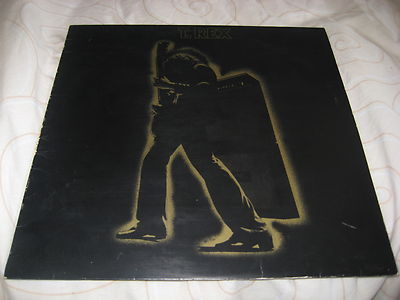
T. Rex Electric Warrior UK Vinyl LP 1971 Fly Records Marc Bolan
£
19
$
25


Favourite Auctions
To save auctions to your favourites, please login
If you don't have an account, please register
Description
T. Rex Electric Warrior UK Vinyl LP 1971 Fly Records Marc Bolan
T. Rex Electric Warrior UK Vinyl LP 1971 Fly Records Marc Bolan
Fly Records HIFLY6
A1 Mambo Sun 3:38
A2 Cosmic Dancer 4:27
A3 Jeepster 4:10
A4 Monolith 3:35
A5 Lean Woman Blues 3:00
B1 Get It On 4:25
B2 Planet Queen 3:11
B3 Girl 2:30
B4 The Motivator 3:59
B5 Life's A Gas 2:22
B6 Rip Off 3:39
Vinyl = EX
Sleeve = VG. Some storage/edge wear
T. Rex were a British rock band, formed in 1967 by singer/songwriter and guitarist Marc Bolan. The band formed as Tyrannosaurus Rex, releasing four folk albums under the name. Tony Visconti (their producer for several albums) claimed in a documentary on the band that he had taken to using the abbreviated term "T.Rex" as a shorthand, something that initially irritated Bolan, who gradually came around to the idea and officially shortened the band's name to "T.Rex" at roughly the same time they started having big hits (shortly after going electric).
In the 1970s, the band had reached success with glam rock hits like "Jeepster", "Get It On", "Ride a White Swan", "20th Century Boy", "Children of the Revolution", "Hot Love", "Telegram Sam", and "Metal Guru".
After earning success in the early and mid-1970s, the band broke up after Bolan was killed in a 1977 car accident.
As well as progressively shorter titles, Tyrannosaurus Rex's albums began to show higher production values, more accessible songwriting from Bolan, and experimentation with electric guitars and a true rock sound. The breakthrough was "King of the Rumbling Spires" (recorded with Took), which used a full rock band. The group's next album, T. Rex, continued the process of simplification by shortening the name, and completed the move to electric guitars. Visconti supposedly got fed up with writing the name out in full on studio chits and tapes and began to abbreviate it; when Bolan first noticed he was angry but later claimed the idea was his. The new sound was more pop-oriented, and the first single, "Ride a White Swan", reached number two in the UK in late 1970. In early 1971, T. Rex reached the top 20 of the UK albums chart.
"Ride a White Swan" was quickly followed by a second single, "Hot Love", which reached the top spot on the UK charts, and remained there for six weeks. A full band, which featured bassist Steve Currie and drummer Bill Legend, was formed to tour to growing audiences, as teenagers began replacing the hippies of old. After Chelita Secunda added two spots of glitter under Bolan's eyes before an appearance on Top of the Pops, the ensuing performance would often be viewed as the official birth of glam rock. After Bolan's display, glam rock would gain popularity in the UK and Europe during 1971–72. T. Rex's move to electric guitars coincided with Bolan's more overtly sexual lyrical style and image. The group's new image and sound outraged some of Bolan's older hippie fans, who branded him a "sell-out". Some of the lyrical content of Tyrannosaurus Rex remained, but the fairy tales about wizards and magic were now interspersed with sensuous grooves, replete with orgiastic moans and innuendo.
In September 1971, T. Rex released their second album Electric Warrior, which featured Currie and Legend. Often considered to be their best album, the chart-topping Electric Warrior brought much commercial success to the group; publicist BP Fallon coined the term "T. Rextasy" as a parallel to Beatlemania to describe the group's popularity. The album included T. Rex's best-known song, "Get It On", which hit number one in the UK. In January 1972 it became a top ten hit in the US, where the song was retitled "Bang a Gong (Get It On)" to distinguish it from a 1971 song by the group Chase. Along with David Bowie's early hits, "Get It On" was among the few British glam rock songs that were successful in the US. However, the album still recalled Bolan's acoustic roots with ballads such as "Cosmic Dancer" and the stark "Girl". Soon after, Bolan left Fly Records; after his contract had lapsed, the label released the album track "Jeepster" as a single without his permission. Bolan went to EMI, where he was given his own record label in the UK—T. Rex Records, the "T. Rex Wax Co.".
On 18 March 1972, T. Rex played two shows at the Empire Pool, Wembley, which were filmed by Ringo Starr and his crew for Apple Films. A large part of the second show was included on Bolan's own rock film Born to Boogie, while bits and pieces of the first show can be seen throughout the film's end-credits. Along with T. Rex and Starr, Born to Boogie also features Elton John, who jammed with the friends to create rocking studio versions of "Children of the Revolution" and "Tutti Frutti"; Elton John had appeared on TV with Bolan before, miming the piano part of "Get it On" on the 1971 Christmas edition of Top of the Pops.
T. Rex's third album The Slider was released in July 1972. The band's most successful album in the US, The Slider was not as successful as its predecessor in the UK, where it peaked at the fourth spot. During spring/summer 1972, Bolan's old label Fly released the chart-topping compilation album Bolan Boogie, a collection of singles, B-sides and LP tracks, which affected The Slider's sales. Two singles from The Slider, "Telegram Sam" and "Metal Guru", became number one hits in the UK. Born to Boogie premiered at the Oscar One cinema in London, in December 1972. The film received negative reviews from critics, while it was loved by fans.
price rating

![JAY-Z/KANYE WEST**WATCH THE THRONE [ADVISORY]**2 VINYL SET](https://www.popsike.info/php/thumbnail.php?url=https://www.popsike.pics/pix/20130412/380619154438.jpg)