Szeryng: Bach Sonatas/Partitas for Violin - DG SLPM 139 270/72 (3LP box, tulip)
$
425


Favourite Auctions
To save auctions to your favourites, please login
If you don't have an account, please register
Description
ITEM DESCRIPTION:
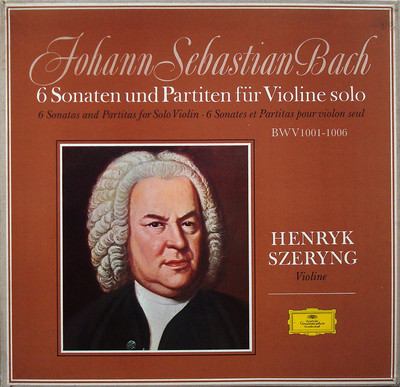
This handsome and now very rare 3 LP box set – a superb collector’s copy – from Deutsche Grammophon (SLPM 139 270/72, German pressing, tulip label – ED1, stereo, full-size 12-page booklet included) features Henryk Szeryng's Olympian readings of Bach's Sonatas & Partitas for Solo Violin BWV 1001-1006 – landmarks in the Bach discography and among the supreme statements on record of these remarkable masterpieces for unaccompanied violin.
Winner of the prestigious Grand Prix du Disque, Szeryng's set was recorded in the warm acoustics of the Théâtre Municipal, Vevey, France, from 8-20 July 1967 (producer: Vittorio Negri / engineer: A. Buczynski).
Included then are the following works:
Sonata No. 1 for Solo Violin in G minor BWV 1001
Partita No. 1 for Solo Violin in B minor BWV 1002
Sonata No. 2 for Solo Violin in A minor BWV 1003
Partita No. 2 for Solo Violin in D minor BWV 1004
Sonata No. 3 for Solo Violin in C Major BWV 1005
Partita No. 3 for Solo Violin in E Major BWV 1006
Szeryng's traversal received a mixed review from The Gramophone (see below), but – in my humble opinion – their critic on that occasion simply did not understand Szeryng’s approach. For me, his playing is imbued with a supreme sense of architecture and a penetrating imagination. Even if you have another favorite set, there are so many felicitous touches and moments of insight throughout Szeryng's cycle that it stands as one of the most majestic and highly individual accounts ever recorded.
Wrote the critic S.S. in his review for the October 1968 issue of The Gramophone:
“There are not many violinists in the world today who can play through all six of Bach's solo violin sonatas as cleanly and as accurately as this. Henryk Szeryng is a very accomplished violinist indeed. His articulation is precise; every note has its full value; his intonation is perfect; his tempi are all sensible. It is impossible to do other than admire him.
“And yet . . . : playing through this set, I cannot say that I was often aroused to anything more than detached admiration of Szeryng's performance. The perfection of it all has a certain coldness; no doubt he feels the music in some definite way, but he plays it with precious little of evident emotion. Do not mistake me: there is nothing I dislike more than a performance in which emotion is served up with a ladle. But I do feel that a performance as cool as this is scarcely persuasive of the worth of the music. Often the sonatas emerge like a technical exercise.
“Part of the trouble in movements that make that particular effect is that the phrase structure is not properly articulated: I don't mean the details of the phrasing itself (though that too is often indistinct), but the relationship of one phrase or group of phrases to the next—the ebb and flow of tensions, the sense that some bars or notes are climax points to which previous ones lead. The long successions of even notes in many of the fast movements need a clear sense of direction if they are to make musical sense.
“So much for the general; now to get down to the particular. The final Presto of Sonata No. 1 is an excellent example of a fast movement, in even notes, whose structural logic is not made apparent; the finale of Sonata No. 2, though very clean and precise, is another. The opening slow movements of the three sonatas are all finely played, but very coldly; so too are the third movements, which I have always imagined were designed to be lyrical and eloquent as relief after the strains of the preceding fugues. Mr Szeryng's handling of the fugues is technically very mpressive with all those elaborate multiple stops well-tuned and attacked with the minimum of incidental bow noise—and he gives due attention to the often difficult question of the various ways a multiple stop has to be attacked, so that a lower or middle voice can sometimes proceed with the contrapuntal argument. I was not entirely happy about the fugue of Sonata No. 2 (which he plays with much more legato than I should have thought the text could justify): its broad shape does not come across. Nor, more crucially, does that of Sonata No. 3, done in a very solid, four-square fashion. This has been said to be the longest of all Bach's fugues, but a performance of it ought not to emphasise the point.
“In the Partitas he does not relax his severe manner. These are lighter works, in general—less intense, less fully argued, based on dance rhythms. Here only a few of them have any sense of the dance. In Partita No. 1, for example, the Allemande lacks nervous energy, the Corrente is left virtually unphrased, the Bourree is fierce in attack. And it is odd to take the Double (or variation) of the Sarabande much faster than the Sarabande itself—the layout of the Double looks to me like a strong piece of evidence that the Sarabande itself needs to have a steady sense of movement (and Grumiaux, on the Philips records listed above, makes it work well that way). In the Sarabande of No. 2, however, a note of passion creeps into Szeryng's playing. But it creeps out again. It is back, however, for parts of the great Chaconne, which starts with a touch of real drama and intensity. There are some good things here, and sensitive touches—the veiled tone at the beginning of the D major section, the tension at the end of it. In this partita the Corrente is marred by a failure to observe the convention demanding that dotted rhythms be played to match the prevailing triplet rhythm—the effect is jerky and uneven in a way I can't believe Bach intended.
“Unless you value evenness of tone and strength of technique above all else, the new issue does not affect the recommendation made previously in these columns. The Grurniaux recording dates back six years, but sounds well; his tone is less even than Szeryng's, and there are one or two places where he seems to be hurrying. But the whole thing has warmth and shape. In the fast movements you feel the inter-relationship of phrases, the way that each grows out of the one before and stands in a 'necessary and sufficient' relationship to it; you sense the broad tensions and stresses of the music, and its natural buoyancy. And Grumiaux finds a simple, genuine expression in the slow movements. Nothing is superimposed on the music; there is an unforced eloquence about his playing of it. His performances are very much preferable to these comparatively soulless ones.
“The new set comes in a box; with a booklet giving notes on the sonatas and on Mr Szeryng. A word of warning against the 'historical' note. One of its gems is "If we regard the introductory Adagio and the Fugue of each Suite as a single move ment, following the example of the French overture . . . we recognize the threemovement ground plan of the Italian concerto"—which ignores first that the opening movements are utterly unlike French overtures, second that Italian concertos did not start with French overtures but were in concerto form, and third that the three sonatas need no more explanation other than that they fall into the extremely common Italian four-movement slow / fast / slow / fast pattern. The recording itself is excellent.”
Incidentally, the box front carries the portrait of Bach executed by E.G. Hausmann.
An added bonus is the excellent 14-page booklet, with outstanding notes on the music by Günter Kleinen, a fine appreciation of Szeryng's artistry, two musical illustrations, and a strking black and white portrait of Szeryng. All texts are in provided in German, English, and French.
CONDITION – PLEASE READ VERY CAREFULLY:
The gradations of condition I use are as follows: MINT, Near-Mint, Excellent, Very Good, Good, Fair, Poor.
The condition of the heavy cloth box box is VERY GOOD. There is slight bit of bowing to the top edge, as well as discoloration and wear along the egdes in general. There is also minor discoloration to the box back. However, there are no corner breaks, seamsplits, or owners' markings and the box remains solid, bright, and attractive – a very good collector's copy.
The condition of the full-size 12-page booklet is EXCELLENT. There is slight wear at corners, but really that is all. Otherwise, all is bright, crisp, and highly attractive – a fine collector’s copy.
The condition of the 3 LPs is EXCELLENT throughout. Visually, there are a few spindle trails. In terms of sound, although surfaces are not absolutely silent, really these are fine copies and playback is superb. If you must have flawless or near-MINT copies, then please do not buy this set. Overall, these are excellent collector's copies.
PLEASE NOTE:
The images I've provided are of the actual item you are potentially bidding on - these are not stock images or images I've taken from other sites. Bid with confidence!
PAYMENT:
Payment by PayPal is greatly preferred. Payment should be made within 5 days.
SHIPPING:
Shipping is free to anywhere in the world; this is true regardless of the number of LPs you buy, be it 1 or a 100. All LPs will be sent via standard airmail (7-10 days delivery). Note: There is no tracking number provided with standard airmail. Should you wish to have your item(s) sent via certified airmail (i.e., with a tracking number), please contact me. The fee for this $5.00 USD.
FEEDBACK:
I will promptly leave feedback for all buyers. Please do not leave negative, or even neutral, feedback without first giving me an opportunity to resolve any dissatisfaction you might have with an item or transaction. I do understand that, on occasion, a buyer might believe the item description to be inaccurate or that a buyer may be disappointed in some other way regarding the sale. I promise I will do my very best to resolve any unhappiness you've experienced in your buying experience with me to your complete satisfaction. Thank you.
REFUNDS:
Returns are honored, and any buyer you makes a return will be refunded in full. Please contact me before making a return.
Please see my other classical LP and CD auctions, and feel free to write with any questions, I'll be glad to help.
price rating