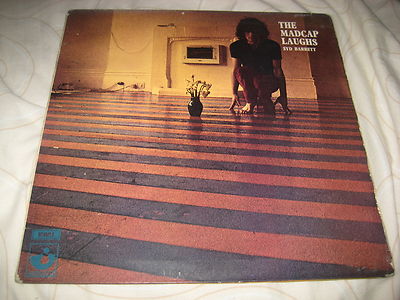
Syd Barrett The Madcap Laughs UK Vinyl LP 1970 Harvest No Boxed EMI Label Floyd
£
20
$
27


Favourite Auctions
To save auctions to your favourites, please login
If you don't have an account, please register
Description
Syd Barrett The Madcap Laughs
UK Vinyl LP 1970 Harvest Gatefold Laminated sleeve
ex Pink Floyd
Matrix Numbers SHVL745 A -2G + SHVL745 B -2G
Syd Barrett The Madcap Laughs
UK Vinyl LP 1970 Harvest laminated sleeve Gatefold
ex Pink Floyd
Harvest SHVL 765
A1 Terrapin 5:00
A2 No Good Trying 3:26
A3 Love You 2:25
A4 No Man's Land 3:50
A5 Dark Globe 2:10
A6 Here I Go 3:13
B1 Octopus 3:45
B2 Golden Hair 1:56
B3 Long Gone 2:47
B4 She Took A Long Cold Look
B5 Feel
B6 If It's In You
B7 Late Night 3:12
Vinyl = Good. Some scratching/marking
Sleeve = Fair. Some ring/storage wear. Moderate wear in one corner. Taped up along bottom.
when opened up there is damage to bottom right and left hand corners INSIDE (on the FRONT outside it looks OK but can be seen on the back outside)
No boxed EMI Logo on label
Matrix number
SHVL 765 A-2G 1A +
SHVL 765 B-2G 1A (we think it is 1A but quite hard to read)
Roger Keith "Syd" Barrett, was an English singer-songwriter, guitarist and painter, best remembered as a founder member of the band Pink Floyd. He was the lead vocalist, guitarist and primary songwriter during the band's psychedelic years, providing major musical and stylistic direction in their early work, including their name. He left the group in 1968 amid speculations of mental illness exacerbated by drug use, and was briefly hospitalised.
Besides being a pioneer in psychedelic rock with his expressive guitar playing and imaginative compositions, Barrett was also a pioneer in the space rock and psychedelic folk genres. He was active in music for only about seven years, recording four singles, the debut album (and contributed to the second one), plus several unreleased songs with Pink Floyd; and a single and two albums (plus a third one of unreleased tracks/alternate takes), as a solo musician, before going into self-imposed seclusion lasting more than thirty years.
In his post-musician life, he continued with his painting and dedicated himself to gardening, never to return to the public eye. He died in 2006. A number of biographies have been written about him since the 1980s, and Pink Floyd wrote and recorded several tributes to him after he left, most notably the 1975 album Wish You Were Here.
After leaving Pink Floyd, Barrett distanced himself from the public eye. At the behest of EMI and Harvest Records, he embarked on a brief solo career, releasing two solo albums, The Madcap Laughs and Barrett. Most of the compositions on both albums date from Barrett's most productive period of songwriting, late 1966 to mid-1967, and it is believed that he wrote few new songs after he left Pink Floyd.
The first album, The Madcap Laughs, was recorded in two sessions, both at Abbey Road Studios: a few tentative sessions took place between May and June 1968 (produced by Peter Jenner), while the bulk of the album was recorded between April and July 1969. The record was produced first by Malcolm Jones, a young EMI executive, and then by David Gilmour and Roger Waters. In his book The Making of the Madcap Laughs, Jones states that "when Dave came to me and said that Syd wanted him and Roger to do the remaining parts of the album, I acquiesced." A few tracks on the album feature overdubs by members of the band Soft Machine. Barrett also played guitar on the sessions for Soft Machine founder Kevin Ayers' debut LP Joy of a Toy, although his performance on "Religious Experience" was not released until the album was reissued in 2003.
The second album, Barrett, was recorded more sporadically than the first, with sessions taking place between February and July 1970. The album was produced by David Gilmour and Richard Wright, featured Gilmour on bass guitar, Wright on keyboard and Humble Pie drummer Jerry Shirley.
Despite the numerous recording dates for his two solo albums, Barrett undertook very little musical activity between 1968 and 1972 outside the studio. On 24 February 1970, he appeared on John Peel's BBC radio programme Top Gear playing five songs—only one of which had been previously released. Three would be re-recorded for the Barrett album, while the song "Two of a Kind" was a one-off performance (the song appears on the 2001 compilation The Best of Syd Barrett: Wouldn't You Miss Me?) with the lyrics and composition having since been credited to Richard Wright. Barrett was accompanied on this session by David Gilmour and Jerry Shirley who played bass and percussion, respectively.
Gilmour and Shirley also backed Barrett for his one and only live concert during this period. The gig took place on 6 June 1970 at the Olympia Exhibition Hall, London, and was part of a Music and Fashion Festival. The trio performed four songs, playing for less than half an hour, and because of poor mixing, the vocals were inaudible until part-way through the last number. At the end of the fourth song, Barrett unexpectedly but politely put down his guitar and walked off the stage.
Barrett made one last appearance on BBC Radio, recording three songs at their studios on 16 February 1971. All three came from the Barrett album, and were presumably aired to encourage people to buy the record. After this session, he took a hiatus from his music career that lasted more than a year, although in an extensive interview with Mick Rock and Rolling Stone in December, he discussed himself at length, showed off his new 12-string guitar, talked about touring with Jimi Hendrix, and stated that he was frustrated in terms of his musical work because of his inability to find anyone good to play with.
price rating


