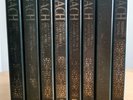
Susanne Lautenbacher Bach Sonatas Partitas Violin Vinyl 3-LP Record Box Set VG+
$
178




Favourite Auctions
To save auctions to your favourites, please login
If you don't have an account, please register
Description
Susanne Lautenbacher Bach 3 Sonatas Partitas Violin Vinyl 3-LP Record Box Set VG+
Record Grade per Goldmine Standard: VG+
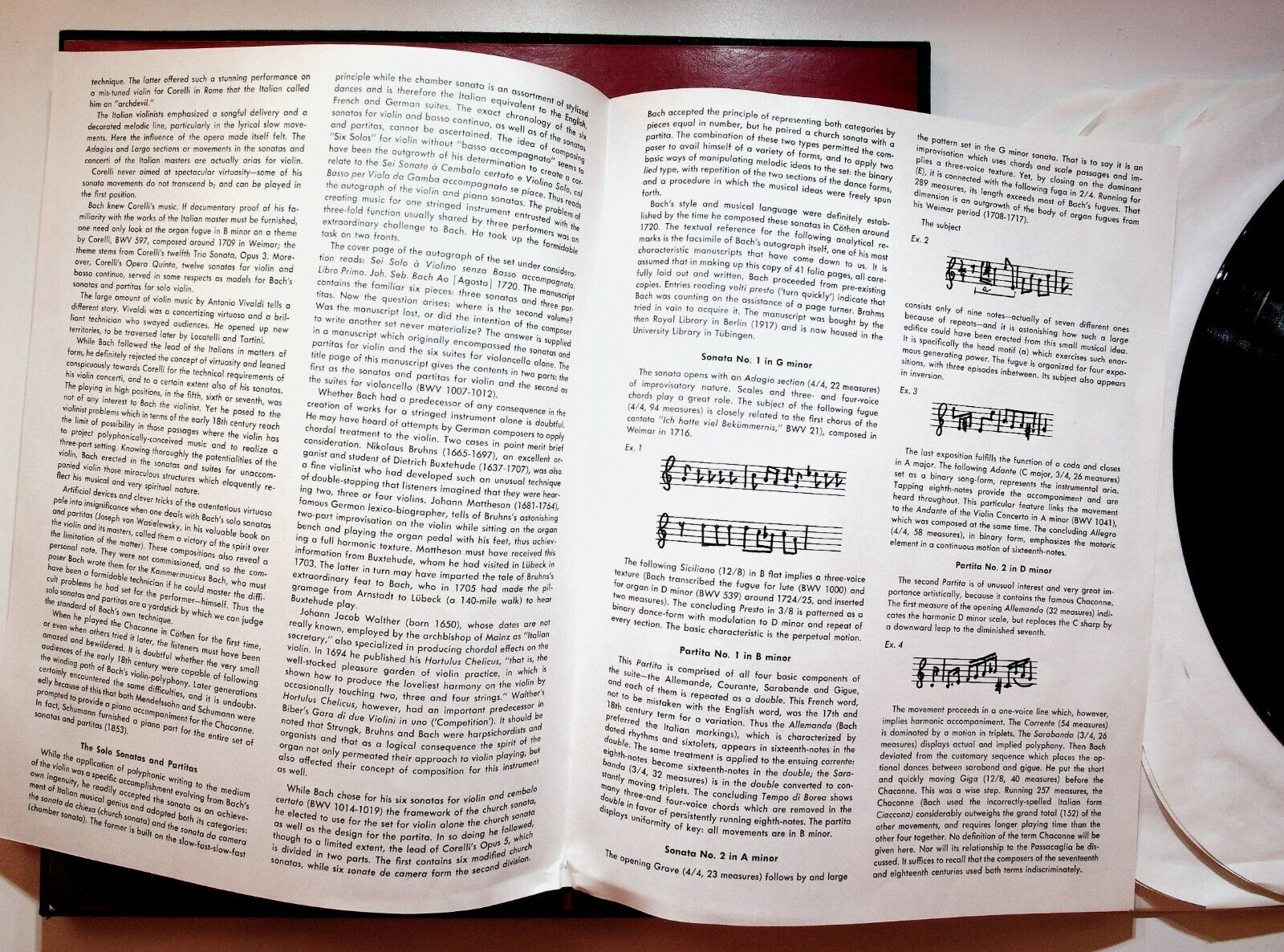
3 Sonatas and 3 Partitas for Violin Unaccompanied (Complete) S-1001-6 Susanne Lautenbacher Violinist SVBX 526 3 RECORDS Susanne Lautenbacher comes from a family of Augsburg musi- cians. She completed her studies at the Academy of Music in Munich under Professor K. Freund, with honors for outstanding performance. Shortly afterwards she won highest prize of the International Radio Contest in Munich in 1955. After further studies with Professor H. Szeryng the artist appeared more and more often in international concert halls and was guest soloist in Belgium, France, England, Holland, Italy, Sweden, Spain, Poland, Algeria, Morocco, etc. In 1965 she was granted a Professorship at the Music Conservatory in Stuttgart. Many of her concert p' r- formances have been recorded. Miss Lautenbacher plays a Stradivarius Violin. Bach and the Violin The average concert-goer and musical amateur thinks of Bach as the creator of hundreds of larger and smaller works for key- board instruments—for the harpsichord, the delicate clavi- chord, and for the organ, which Mozart called the king of instruments and Berlioz regarded as the pope of the instru- mental world. Every Saint has his identifying material object, one recognized as appropriate to his particular mission, e.g. the key for St. Peter, the sword for St. Paul and the book (and the lion) for St. Jerome. The organ seems to be the one attributed to Johann Sebastian Bach in the popular image. Fanciful people may imagine Johann Sebastian Bach playing the clavichord in a modest room of his official residence in the St. Thomas School in Leipzig while his wife, Anna Magdelena, and some of the children listen. Others may visualize the re- spected Thomas Cantor sitting at the organ of St. Thomas church, engaged in tremendous improvization while awe- struck sons and pupils try to follow the master through the thicket of contrapuntal complexities he could develop out of a small musical idea. Yet Bach the unique organist and harpsichord virtuoso was also a fine violinist. He loved to play viola as well. His achieve- ments as a violinist are outshone by other activities of his career, but violin playing secured for him a livelihood for a number of years, and it was during this period that a handsome assort- ment of great violin music—sonatas, suites and concertos—came into being. As an instrumentalist as well as a composer Bach was a self- made man. His innate gifts quickly enabled him to acquire a certain proficiency on the keyboard and violin and to arrive at an acceptable technical standard early. This stood him in good stead when he applied for admission as a chorister at St. Michael's School at Luneburg in 1700. He lost his beautiful voice soon, but he succeeded in building up a fine reputation as a violinist, which earned him in 1703 his first salaried position as a "Hofmusicus" to Johann Ernst, the younger brother of the reigning Duke Wilhelm Ernst of Weimar. He did not remain long in this post and accepted an organist position in Arnstadt in the following year. We find him in 1708 again in Weimar, but this time in a twofold capacity: as a court organist and Kammermusicus. The latter function entailed services in the kapelle as a cembalist (harpsichordist) and violinist. He was later promoted to concert master and it was in this capacity that he felt obliged to familiarize himself with Italian violin literature in order to live up to the responsibilities of his position (which he held for eight years). In 1717 Bach entered the service of Prince Leopold von Anhalt in Cothen. His official position was that of the Kapell- meister and director of the 'Kammermusik.' it was his duty to take notice of contemporary Italian production. The inclusion of Italian works, which filled the purpose and needs of the day, proved to be of historic importance in the long run, because these works served as models for Bach's own works. Bach and the Italian School The 18th century was the golden age of Italian music. It was not only an era which established the importance worldwide of the Italian opera, but also witnessed Italy's extraordinary achievements in the realm of instrumental music. Violin playing and ensemble music received strong impetus from the splendid products of the Italian instrument-makers—the extraordinary families of Amati, Guarnieri and Stradivari in Cremona. The 18th century saw the performing and creative activities of Arcangelo Corelli, Antonio Vivaldi, Pietro Locatelli, Francesco Veracini, and Giuseppe Tartini. There were also outstanding violinists in Austria and Germany around the end of the 17th century. They developed a sophisticated performance practice by favoring the scordatura technique, i.e. the abnormal or mis-tuning of the strings, which gave the player the possi- bility of producing chords otherwise impossible to produce on a normally-tuned fiddle in fifths. Heinrich von Biber (1644-1704) and Nicolaus Adam Strungk (1640-1700) specialized in this...
LP620
price rating


![John Lee Hooker - Anthology [Used Vinyl LP] Gatefold LP Jacket, 180 Gram, UK - I](https://www.popsike.info/php/thumbnail.php?url=https://www.popsike.pics/pix/20250403/405720504240.jpg)