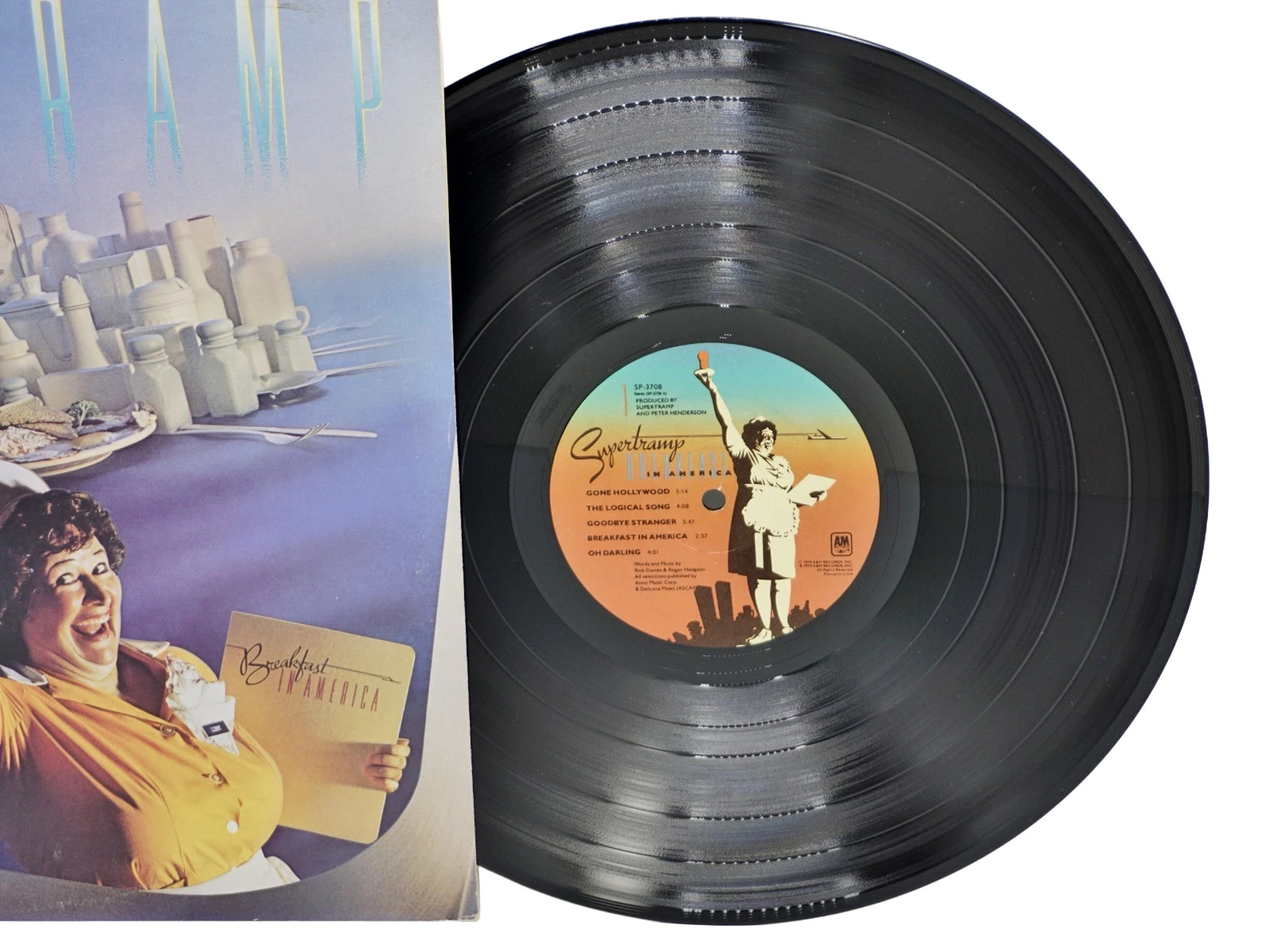
Supertramp Breakfast in America 1979 A&M Records 1st Monarch Press Vinyl NM
$
60




Favourite Auctions
To save auctions to your favourites, please login
If you don't have an account, please register
Description
Welcome to Classic Cadillac Records! I visually grade all my records as accurately as possible and will never grade anything above Near Mint unless it's still sealed. Please note that a visual grade can differ from a play grade, and am happy to spot check a record upon request. All orders are shipped within 1 business day (usually sooner) and packed with extra care to ensure fast, safe arrival. Please look closely at all pictures, read all relevant details and ask any questions you may have before buying. I offer a full 30-day return policy on everything I sell, so buy with confidence! 20% restocking fee charged on items returned for reasons other than it not working properly. Thanks for looking!
Breakfast in America Studio album by Supertramp Released 16 March 1979 Recorded May–December 1978 Studio The Village Recorder (Studio B) (Los Angeles) Genres
- Progressive pop
- art rock
- soft rock
- Peter Henderson
- Supertramp
(1977) Breakfast in America
(1979) Paris
(1980) Singles from Breakfast in America
- "The Logical Song"
Released: March 1979 - "Breakfast in America"
Released: June 1979 - "Goodbye Stranger"
Released: July 1979 - "Take the Long Way Home"
Released: October 1979
Breakfast in America is the sixth studio album by the British rock band Supertramp, released on 16 March 1979, by A&M Records. It was recorded from May to December 1978 at The Village Recorder in Los Angeles. It spawned three US Billboard Hot 100 hit singles: "The Logical Song" (No. 6), "Goodbye Stranger" (No. 15), and "Take the Long Way Home" (No. 10). In the UK, "The Logical Song" and the title track were both top 10 hits, the only two the group had in their native country.
At the 22nd Annual Grammy Awards in 1980, Breakfast in America won two awards for Best Album Package and Best Engineered Non-Classical Recording, as well as nominations for Album of the Year and Best Pop Performance by a Duo or Group with Vocals. It became Supertramp's best-selling album, being certified 4× Platinum by the Recording Industry Association of America (RIAA) for more than four million copies sold in the US, where it was No. 1 on the Billboard 200 for six weeks.
Background
As with Even in the Quietest Moments..., Rick Davies and Roger Hodgson wrote most of their songs separately but conceived the theme for the album jointly. Their original concept was for an album of songs about the relationship and conflicting ideals between Davies and Hodgson themselves, to be titled Hello Stranger. Hodgson explained: "We realized that a few of the songs really lent themselves to two people talking to each other and at each other. I could be putting down his way of thinking and he could be challenging my way of seeing life [...] Our ways of life are so different, but I love him. That contrast is what makes the world go 'round and what makes Supertramp go 'round. His beliefs are a challenge to mine and my beliefs are a challenge to his."
This idea was eventually scrapped in favour of an album of "fun" songs, and though Davies initially wanted to keep the title Hello Stranger, he was convinced by Hodgson to change it to Breakfast in America. Hodgson commented later: "We chose the title because it was a fun title. It suited the fun feeling of the album." Due to the title and the explicit satirising of American culture in the cover and three of the songs ("Gone Hollywood", "Breakfast in America" and "Child of Vision"), many listeners interpreted the album as a whole as being a satire of the United States. Supertramp's members have all insisted that the repeated references to US culture are purely coincidental and that no such thematic satire was intended. Hodgson has described the misconception as a parallel to how Crime of the Century (1974) is often misinterpreted as being a concept album.
"Gone Hollywood" is the opening track of Breakfast in America. Written by Rick Davies, the song tells about a person who moves to Los Angeles in hopes of becoming a movie star, but finds it far more difficult than he imagined. He struggles and becomes frustrated, until he ultimately gets his break and becomes "the talk of the Boulevard". The lyrics were originally more bleak, but under pressure from the other band members, Davies rewrote them to be more optimistic and commercially appealing. Billboard writer David Farrell felt that, other than Davies' lead vocal, the song sounds like a Queen song.
"Child of Vision" is the closing track. Much like "The Logical Song", it uses a Wurlitzer electric piano as the main instrument. After the lyrical part, the song goes into a long solo played on the grand piano alongside the original melody on the Wurlitzer. The track fades out with a short saxophone solo by John Helliwell. Roger Hodgson has said that the song was written to be an equivalent to "Gone Hollywood", looking at how Americans live, though he confessed that he had only a limited familiarity with US culture at the time of writing. He also said there is a slight possibility that he subconsciously had Rick Davies in mind while writing the lyrics.
Each song was credited to a single musician on the inner sleeve, but on the central vinyl label was printed "Words and Music by Roger Hodgson & Rick Davies", combining the two and confusing the issue of composition credit. Roger Hodgson's management has described "The Logical Song", "Breakfast in America", "Take the Long Way Home", "Lord Is It Mine" and "Child of Vision" as "Roger's songs"; however, this apparently does not mean he necessarily wrote them by himself, for Hodgson has credited Davies with writing the vocal harmony on "The Logical Song". Davies has referred to "The five songs that I did on Breakfast", but has not specified which ones.
Critical reception
Retrospective professional reviews Review scores Source Rating AllMusic Christgau's Record Guide C+ Encyclopedia of Popular Music The Great Rock Discography 7/10 Mojo Record Collector The Rolling Stone Album Guide Smash Hits 8/10 Sputnikmusic 3/5 UncutIn a positive review for Rolling Stone magazine, music critic Stephen Holden viewed Breakfast in America as an improvement over the "swatches of meandering, Genesis-like esoterica" on Supertramp's previous albums, and called it "a textbook-perfect album of post-Beatles, keyboard-centered English art rock that strikes the shrewdest possible balance between quasi-symphonic classicism and rock & roll ... the songs here are extraordinarily melodic and concisely structured, reflecting these musicians' saturation in American pop since their move to Los Angeles in 1977." Village Voice critic Robert Christgau was less impressed, saying that the "hooky album" evokes "random grunts of pleasure" but lacks emotional substance because of "glib" lyrics and no "vocal personality (as opposed to accurate singing) and rhythmic thrust (as opposed to a beat)".
Colin Larkin, writing in the Encyclopedia of Popular Music (2006), said that the "faultless" album "elevated" Supertramp to "rock's first division".
In a retrospective review for AllMusic, Stephen Thomas Erlewine praised the album's "tightly written, catchy, well-constructed pop songs" and described it as the band's "high-water mark". John Doran of BBC Music said that the songwriting has an "unbeatable quality" and asserted that "any of the ten tracks could have been hit singles". Sputnikmusic's Tyler Fisher said that its singles are mostly the highlights because of their "catchy hooks", and found the ballads "absolutely terrible". Rob Sheffield, writing in The Rolling Stone Album Guide (2004), also felt that its "nice moments" were the highlights, including "the jolly 'Take the Long Way Home,' the adjectively crazed 'Logical Song,' [and] 'Goodbye Stranger.'" William Pinfold of Record Collector considered the album "a classic example of flawlessly-played and -produced late 70s transatlantic soft rock".
Accolades
In the 1987 edition of The World Critics List, music historian Joel Whitburn ranked Breakfast in America the fourth-greatest album of all time. In the 1994 edition of The Guinness All Time Top 1000 Albums, Breakfast in America was voted No. 207 in the all-time greatest rock and pop albums, and it was voted the 69th-greatest British rock album of all time in a 2006 Classic Rock industry poll. Triple M listeners voted the album No. 43 in the "100 Greatest Albums of All Time". Recognising the band's disfavour among music critics during their career, Q magazine ranked Breakfast in America second on its "Records it's OK to Love" list in 2006. In 2000 it was voted No. 294 in Colin Larkin's All Time Top 1000 Albums.
"The Logical Song" won the 1979 Ivor Novello Award for "Best Song Musically and Lyrically".
Track listing
All tracks are written by Rick Davies or Roger Hodgson. Listed below are the respective writers.
Side one No. Title Writer(s) Lead vocals Length 1. "Gone Hollywood" Davies Davies and Hodgson 5:19 2. "The Logical Song" Hodgson Hodgson 4:07 3. "Goodbye Stranger" Davies Davies 5:46 4. "Breakfast in America" Hodgson Hodgson 2:37 5. "Oh Darling" Davies Davies 3:43 Total length: 21:32 Side two No. Title Writer(s) Lead vocals Length 6. "Take the Long Way Home" Hodgson Hodgson 5:08 7. "Lord Is It Mine" Hodgson Hodgson 4:08 8. "Just Another Nervous Wreck" Davies Davies 4:22 9. "Casual Conversations" Davies Davies 2:56 10. "Child of Vision" Hodgson Hodgson and Davies 7:24 Total length: 23:58 45:30price rating