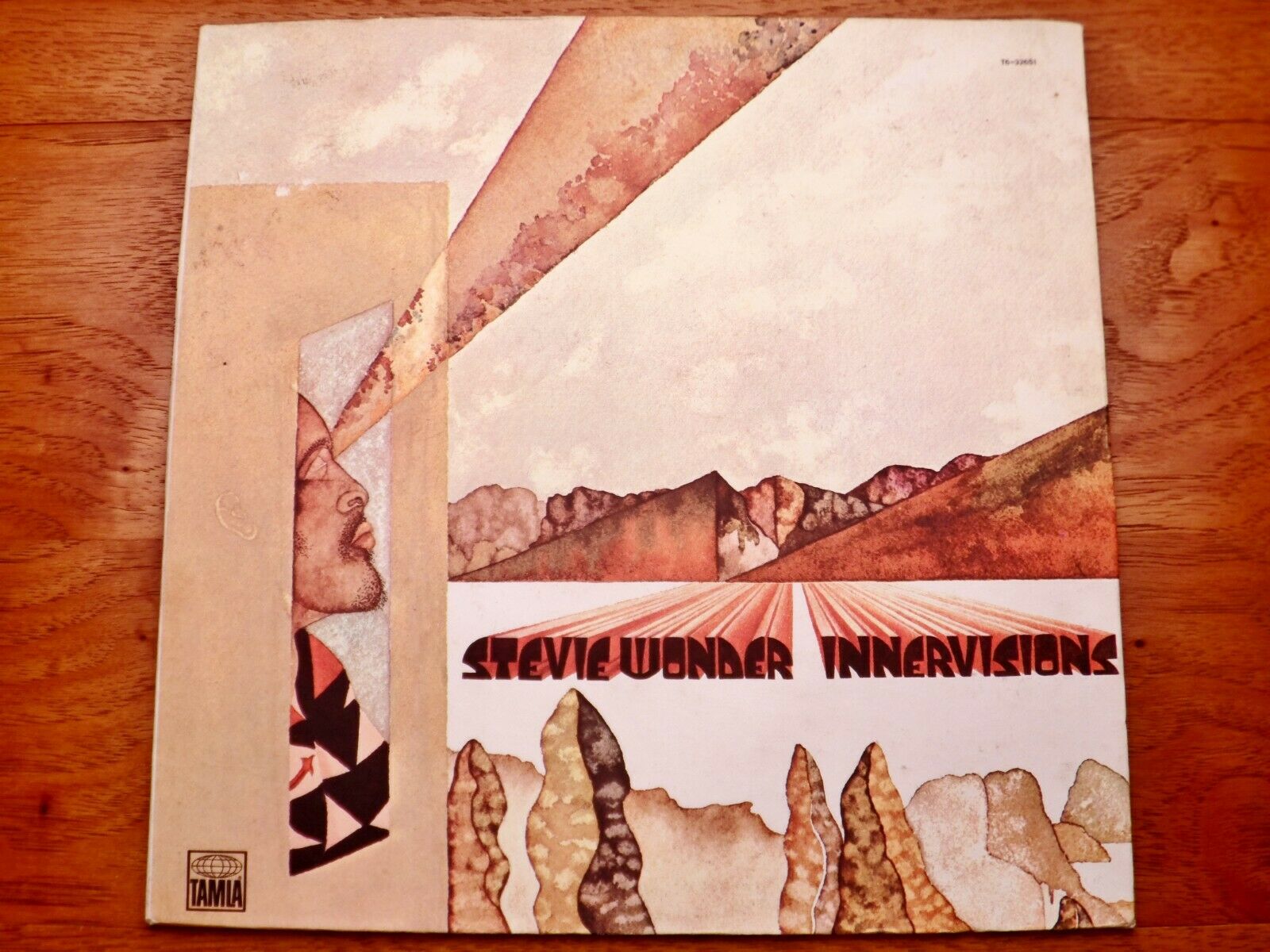
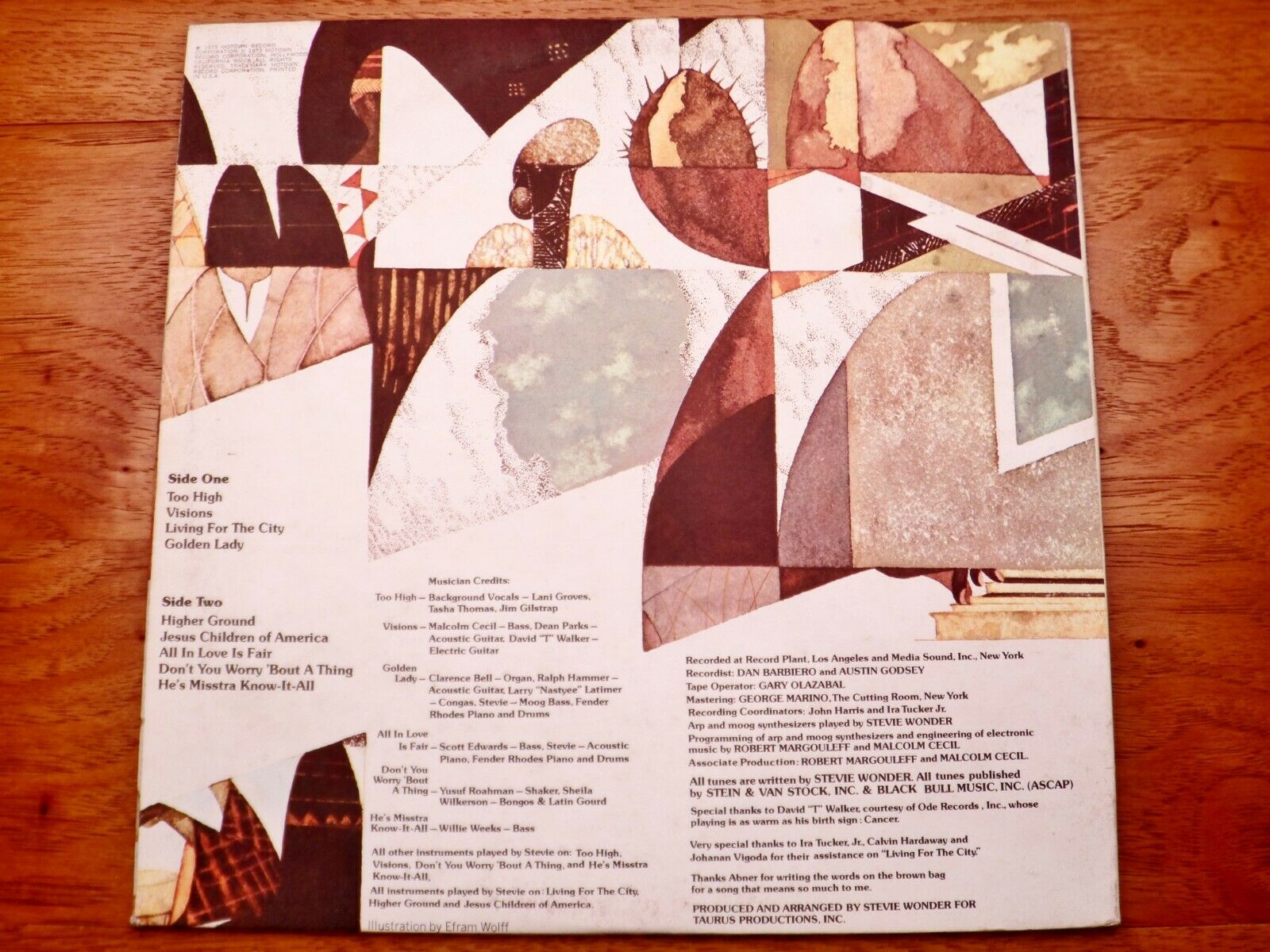
Stevie Wonder ? Innervisions ? Rare EX Tamla Records Press Vinyl LP Gatefold ????
$
30



Favourite Auctions
To save auctions to your favourites, please login
If you don't have an account, please register
Description
Welcome to Classic Cadillac Records! My goal is to provide each and every customer with the best possible buying experience, no matter the size of the order. Unlike most sellers, I advertise all my items clearly and in as much detail as possible, without shouting at you in all caps. I take multiple high quality pictures and never use stock photos, so you know exactly what you?re buying. I take great pride in my work and go the extra mile, which can clearly be seen in my listings compared to other sellers that put minimal effort into theirs. I visually grade all my records as accurately as possible and will never grade anything above Near Mint unless it?s still sealed. Please note that a visual grade can differ from a play grade, and am happy to spot check a record upon request. All orders are shipped within 1 business day (usually sooner) and packed with extra care to ensure fast, safe arrival. I combine shipping on multiple orders to save you money and gladly ship worldwide. Please look closely at all pictures, read all relevant details and ask any questions you may have before buying. I offer a full 30-day return policy on everything I sell, so buy with confidence! And most importantly, thanks for looking!
Innervisions Studio album by Stevie Wonder Released August 3, 1973 Recorded 1973 Studio The Record Plant
(Los Angeles, California)
Media Sound Studios
(New York City, New York) Genre
- Soul
- funk
- rock
- jazz[1]
Robert Margouleff (assoc)
Malcolm Cecil (assoc) Stevie Wonder chronology Talking Book
(1972) Innervisions
(1973) Fulfillingness' First Finale
(1974) Singles from Innervisions
- "Higher Ground"
Released: July 1973 - "Living for the City"
Released: November 1973 - "Don't You Worry 'bout a Thing"
Released: March 1974 - "He's Misstra Know-It-All"
Released: July 1974 (UK)
Innervisions is the sixteenth studio album by American singer, songwriter and musician Stevie Wonder, released August 3, 1973, on the Tamla label for Motown Records, a landmark recording of his "classic period". It is also regarded as Wonder's transition from Little Stevie Wonder and romantic ballads to a more musically mature, conscious and grown-up artist. With Wonder being the first artist to experiment with the ARP synthesizer on a large scale, Innervisions became hugely influential on the subsequent future of commercial black music.
As with many of Wonder's albums, the lyrics, composition and production of Innervisions are almost entirely his own work, with the ARP used prominently throughout the album. The instrument was a common motif among musicians of the time because of its ability to construct a complete sound environment. Wonder also played all or virtually all instruments on six of the album's nine tracks, making most of Innervisions a representative one-man band.
The nine tracks of Innervisions encompass a wide range of themes and issues: from drug abuse in "Too High", through inequality and systemic racism in "Living for the City", to love in the ballads "All in Love Is Fair" and "Golden Lady". The album's closer, "He's Misstra Know-It-All", is a scathing attack on then-US President Richard Nixon, similar to Wonder's song a year later, "You Haven't Done Nothin'". "Living for the City" was one of the first soul music songs to deal explicitly with systemic racism and to use everyday sounds of the street such as traffic, voices and sirens, which were combined with the music recorded in the studio.
Innervisions peaked at number four on the Billboard Top LPs & Tapes and number one on the Billboard Soul LPs. At the 16th Grammy Awards, it won Album of the Year and Best Engineered Non-Classical Recording, while "Living for the City" won Best R&B Song. Innervisions is widely considered by fans, critics, and colleagues to be one of Wonder's finest works and one of the greatest albums ever made. It was ranked number 23 on Rolling Stone's list of The 500 Greatest Albums of All Time, and re-ranked number 24 in the 2012 book version. In 1999, Innervisions was inducted into the Grammy Hall of Fame.
Post-release car accident
Three days after the commercial release of Innervisions, on August 6, 1973, Wonder played a concert in Greenville, South Carolina. While on the way back, just outside Durham, North Carolina, Wonder was asleep in the front seat of a car being driven by his friend, John Harris, when they were snaking along the road, behind a truck loaded high with logs. Suddenly the trucker jammed on his brakes, and the two vehicles collided. Logs went flying, and one smashed through the wind shield, sailing squarely into Stevie Wonder's forehead. He was bloody and unconscious when he was pulled from the wrecked car. For four days he lay in a coma caused by severe brain contusion, causing media attention and the preoccupation of relatives, friends and fans.
It was his friend and tour director Ira Tucker who first elicited some response from him:
... I remember when I got to the hospital in Winston-Salem. Man, I couldn't even recognize him. His head was swollen up about five times normal size. And nobody could get through to him. I knew that he likes to listen to music really loud and I thought maybe if I shouted in his ear it might reach him. The doctor told me to go ahead and try, it couldn't hurt him. The first time I didn't get any response, but the next day I went back and I got right down in his ear and sang 'Higher Ground'. His hand was resting on my arm and after a while his fingers started going in time with the song. I said yeah, yeah!! This dude is going to make it!
—?Ira TuckerWonder's climb back to health was still very long and slow. When he regained consciousness, he discovered that he had lost his sense of smell (which he later largely recovered). He was deeply afraid that he might have lost his musical faculty, too.
... We brought one of his instruments—I think it was the clavinet—to the hospital. For a while, Stevie just looked at it, or didn't do anything with it. You could see he was afraid to touch it, because he didn't know if he still had it in him—he didn't know if he could still play. And then, when he finally did touch it ... man, you could just see the happiness spreading all over him. I'll never forget that.
—?Ira TuckerStill, Wonder had to take medication for a year, tired easily, and suffered severe headaches. The August 6 accident particularly changed his way of thinking. His deep faith and spiritual vision made him doubt that it was "an accident.” He stated, "You can never change anything that has already happened. Everything is the way it's supposed to be.... Everything that ever happened to me is the way it is supposed to have been." Wonder also commented when he was interviewed by The New York Times that "the accident opened my ears up to many things around me. Naturally, life is just more important to me now ... and what I do with my life." Confirming Stevie's belief in destiny, Michael Sembello, Wonder's lead guitarist at the time, said:
... Well, I think he'd always had some awareness of the spiritual side of life. But the accident really brought it to the surface. Like now I know he really sees and uses every concert as the spiritual opportunity it is, to reach people.... The accident made him recognize God, it changed him a lot. Sometimes he'd just drift off in conversation, he'd just ... be some place else. He got really intense after the accident, his ESP got really strong.
—?Michael Sembello... I would like to believe in reincarnation. I would like to believe that there is another life. I think that sometimes your consciousness can happen on this earth a second time around. For me, I wrote Higher Ground even before the accident. But something must have been telling me that something was going to happen to make me aware of a lot of things and to get myself together. This is like my second chance for life, to do something or to do more, and to value the fact that I am alive.
—?Stevie WonderBefore the accident, Wonder had been scheduled to do a five-week, 20-city tour between March and April 1974. It was postponed, with the exception of one date in Madison Square Garden in late March. That concert began with Stevie pointing to his scarred forehead, looking up, grinning, and giving "thanks to God that I'm alive.” 21,000 people in the crowd roared with applause, and as a Post critic noted, "it was hard not to be thrilled."
Critical reception
Professional ratings Review scores Source Rating AllMusic The Austin Chronicle Christgau's Record Guide A Creem B+ Encyclopedia of Popular Music The Great Rock Discography 10/10 Los Angeles Times MusicHound 5/5 The Rolling Stone Album Guide Slant MagazineAs with both Music of My Mind and Talking Book the previous year, Innervisions was received warmly by music critics. Wonder's versatile musical skills were praised by critics. Billboard published that "the liner credits Stevie with playing all the instruments on seven of the nine tunes. So in essence this is a one-man band situation and it works. His skill on drums, piano, bass, and ARP synthesizers are outstanding, and all the tracks work within the thematic framework." The New York Times wrote, "Stevie identifies himself as a gang and a genius, producing, composing, arranging, singing, and, on several tracks, playing all the accompanying instruments. But Stevie Wonder, you see and want to know more. At the center of his music is the sound of what is real. Vocally, he remains inventive and unafraid, he sings all the things he hears: rock, folk, and all forms of Black music. The sum total of these varying components is an awesome knowledge, consumed and then shared by an artist who is free enough to do both."
Many others also praised the variety of musical styles and themes present in the album. One reviewer from Playboy wrote, "Stevie Wonder's Innervisions is a beautiful fusion of the lyric and the didactic, telling us about the blind world that Stevie inhabits with a depth of musical insight that is awesome. It's a view that's basically optimistic, a constant search for the 'Higher Ground', but the path is full of snares: dope ('Too High'), lies ('Jesus Children of America') and the starkly rendered poison of the city ('Living for the City'). Wonder seems to say that all people delude themselves but have to be well to pay their dues and existentially accept the present. 'Today's not yesterday,/And all things have an ending' is the way he puts it in 'Visions,' the key tune of the album—pretty yet serious, harmonically vivid. There's a lot of varied music here—Latin, reggae, even a nod to Johnny Mathis ('All in Love is Fair')—but it's all Stevie, unmistakably."
Some reviewers were less enthusiastic. Jon Tiven from Circus argued that there was a lack of memorable material: "Just when Stevie had some momentum going, he went and put together a concept album of homogeneous music and rather typical lyrics. Unlike his last two albums, there are no real low spots on this album, which I suppose is an improvement, but there are no songs on Innervisions which are truly outstanding either. There's no 'Superstition,' no 'I Believe (When I Fall in Love It Will Be Forever).' By constructing a solid ground from which to work, Stevie has lowered the ceiling, and put a damper on his talents."
Musicians also showed consummate respect for the achievements of the album, with Roberta Flack saying to Newsweek that "It's the most sensitive of our decade ... it has tapped the pulse of the people."
Innervisions won Grammy Awards for Album of the Year and Best Engineered Non-Classical Recording in 1974, while "Living for the City" won the Grammy for Best R&B Song.
Commercial performance
After Talking Book hit the top 5 of the Billboard albums chart in early 1973 and achieved steady sales during the rest of the year, Innervisions became another considerable hit in the charts. The album debuted on the Billboard albums chart on August 18, 1973, at number 85, then climbed up weekly to number 22, number 14, number nine, number six until reaching its peak position of number four on September 15. The album remained inside the top 20 until the end of the year and remained inside the top 200 during the whole calendar year of 1975. It was also Wonder's second consecutive soul album to top the Black Albums chart where it remained for two weeks. (In the Cashbox chart, Innervisions reached number one near the end of the year.) In the UK the album also achieved success, and became Stevie Wonder's first album ever to reach the UK top 10, peaking at number eight.
Three hit singles were issued from the album. "Higher Ground", released some weeks before Innervisions, reached number four on the singles chart in late October 1973 (it was also a number one on the Cashbox singles chart). "Living for the City" was released immediately and reached number eight in early January 1974. Both singles reached number one on the R&B chart. Finally, "Don't You Worry 'bout a Thing" was released in March, reaching number 16 in early June, and also peaked at number two on the R&B charts. In the UK, "Higher Ground" and "Living for the City" were released as singles but achieved modest success, reaching only numbers 29 and 15, respectively. Only a third single issued there, "He's Misstra Know-It-All", managed to reach the top 10, peaking at number eight on the UK Singles Chart.
"All in Love Is Fair" was later a hit for Barbra Streisand, who recorded it and released it as a single in 1974.
Legacy
Innervisions has been considered by many fans, critics, and colleagues to be one of Stevie Wonder's finest works and one of the greatest albums ever made.[8] The album was revisited countless times in different lists of the greatest albums of all time. In his Rock & Roll Review: A Guide to Good Rock (1991), Bill Shapiro wrote "This recording represents the pinnacle of a very important artist's career, and of his physically blind, but nonetheless extraordinary humane vision. For all intents and purposes, and for all of its richness and variety of texture, it is essentially all Stevie Wonder. He personally created and arranged every sound heard. His canvas stretches from the tough realities of ghetto streets to the transcendent joy of spiritual acceptance, each rendered with an original, unique musical palette. The feel is a little more jazz than funk, the result is simply glorious pop music – uplifting sound and message."
In 2001, VH1 named it the 31st greatest album of all time with the following statement: "The whole message of this album seems to be caution – Wonder seems to be warning the black community to be aware of their own plight, strive for improvement, and take matters into their own hands. But this is all against the backdrop of the harsh social realities of America circa 1973, and nowhere does this conflict hit home more than in Wonder's magnum opus, 'Living for the City', a raw piece of modern blues on which Wonder played every instrument. The message of urban struggle resonates even more strongly now than it did thirty years ago, proving that the 'inner-visions' of this LP were visionary as well."
It was voted number 143 in the third edition of Colin Larkin's All Time Top 1000 Albums (2000).
In 2003, the album was ranked number 23 on Rolling Stone magazine's list of the 500 greatest albums of all time, and re-ranked number 24 in the 2012 book version.[9] The magazine wrote in that occasion:
... Stevie Wonder may be blind, but he reads the national landscape, particularly regarding black America, with penetrating insight on Innervisions, the peak of his 1972-73 run of albums–including Music of My Mind and Talking Book. Fusing social realism with spiritual idealism, Wonder brings expressive color and irresistible funk to his synth-based keyboards on "Too High" (a cautionary anti-drug song) and "Higher Ground" (which echoes Martin Luther King Jr.'s message of transcendence). The album's centerpiece is "Living for the City", a cinematic depiction of exploitation and injustice.
—?Rolling StoneAs further evidence of the album's classic status, Innervisions was re-released in the UK on September 15, 2008, to coincide with Wonder's critically acclaimed autumn 2008 European tour.
Track listing
All songs written, produced, and arranged by Stevie Wonder.
Side one
- "Too High" – 4:36
- Stevie Wonder – lead vocal, Fender Rhodes electric piano, harmonica, drums, Moog bass
- Lani Groves, Tasha Thomas, & Jim Gilstrap – background vocals
- "Visions" – 5:23
- Stevie Wonder – lead vocal, Fender Rhodes electric piano
- Malcolm Cecil – upright bass
- Dean Parks – acoustic guitar
- David T. Walker – electric guitar
- "Living for the City" – 7:22
- Stevie Wonder – lead vocal, background vocals, Fender Rhodes electric piano, drums, Moog bass, T.O.N.T.O. synthesizer, handclaps
- "Golden Lady" – 4:40
- Stevie Wonder – lead vocal, piano, Fender Rhodes electric piano, drums, Moog bass, T.O.N.T.O. synthesizer
- Clarence Bell – Hammond organ
- Ralph Hammer – acoustic guitar
- Larry "Nastyee" Latimer – congas
Side two
- "Higher Ground" – 3:42
- Stevie Wonder – lead vocal, Hohner clavinet, drums, Moog bass, tambourine, handclaps
- "Jesus Children of America" – 4:10
- Stevie Wonder – lead vocal, background vocal, Fender Rhodes electric piano, Hohner clavinet, handclaps, tambourine, handclapping, drums, Moog bass
- "All in Love Is Fair" – 3:41
- Stevie Wonder – lead vocal, piano, Fender Rhodes electric piano, drums
- Scott Edwards – electric bass
- "Don't You Worry 'bout a Thing" – 4:44
- Stevie Wonder – lead vocal, background vocal, piano, drums, Moog bass
- Yusuf Roahman – shaker
- Sheila Wilkerson – bongos, Latin gourd
- "He's Misstra Know-It-All" – 5:35
- Stevie Wonder – lead vocal, background vocal, piano, drums, handclaps, T.O.N.T.O. synthesizer, congas
- Willie Weeks – electric bass
price rating