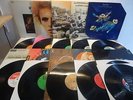
Small Faces Ogden's Nut Gone Flake UK Immediate IMSP 012 First Press EX/EX
$
100


Favourite Auctions
To save auctions to your favourites, please login
If you don't have an account, please register
Description
Small Faces – Ogdens' Nut Gone Flake Label: Immediate – IMSP 012 Format: Vinyl, LP, Album, Stereo Country: UK Released: Jun 1968 Genre: Rock Style: Pop Rock, Psychedelic Rock, Mod Ogdens' Nut Gone Flake A1 Ogdens' Nut Gone Flake A2 Afterglow A3 Long Agos And Worlds Apart A4 Rene A5 Song Of A Baker A6 Lazy Sunday Happiness Stan B1 Happiness Stan B2 Rollin' Over B3 The Hungry Intruder B4 The Journey B5 Mad John B6 Happydaystoytown Engineer [Knobs] – Glyn Johns Producer – Ronnie Lane, Steve Marriott Voice [Loony Links] – Stan (The Man) Unwin* Written-By – McLagan* (tracks: A1, A3, B4, B6), Jones* (tracks: A1, B6), Lane* (tracks: A1, A2, A4 to B6), Marriott* (tracks: A1, A4 to B6), Marriot* (tracks: A2) Lilac Immediate labels with the writing credits separate from the track titles. Released in a circular sleeve that folds open into five panels. EMI pressed KT tax stamp on label
Ogdens' Nut Gone Flake is the third studio album, and only concept album by the English rock band Small Faces. Released on 24 May 1968,[2] the LP peaked at number one in the UK on the Record Retailer LPs Chart, where it remained for six weeks.[3] It became the group's final studio album during their original incarnation (and the last album to contain solely new material until the release of reunion album Playmates in 1977). The album title and distinctive packaging design was a parody of Ogden's Nut-brown Flake, a brand of tinned tobacco that was produced in Liverpool from 1899 by Thomas Ogden.[4][5]
Background Side one of the album showcases a variety of musical styles. The opening title track is an instrumental re-working of "I've Got Mine", a failed single from 1965. This recording uses a Hammond Organ treated with wah-wah pedal and orchestral flourishes from a string section led by David McCallum Senior (the father of The Man from U.N.C.L.E. star David McCallum.)[citation needed]. An eclectic selection of tracks follow; the proto-Hard rock of "Song of a Baker";[note 1] the psychedelic ballad "Long Agos And Worlds Apart"; cockney knees-up songs "Lazy Sunday" and "Rene" (the latter featuring a lengthy psychedelic jam as its coda); and the intense, soul-influenced ballad "Afterglow"[5] (titled "Afterglow of Your Love" on the subsequent single and some compilations). The single version of "Afterglow" - released in March 1969 a year after it was recorded and immediately after the group's disbandment was officially announced - was presented in a radically-different mix that eschewed the LP version's acoustic opening, altered the song's tempo and extended the instrumental coda.
Side two of the LP is based on an original fairy tale concept about a boy called Happiness Stan, consisting of a musical suite of six songs interlinked with narration provided by comic monologuist and performer Stanley Unwin in his unique, nonsensical private language of "Unwinese". Unwin was not the band's first choice for narrator, however – originally they approached the popular but mercurial absurdist comedian Spike Milligan to narrate the piece, but negotiations with Milligan floundered early and the more affable and amenable Unwin stepped in to everyone's eventual satisfaction. Unwin spent time observing the band at work and at play in the studio, and picking up on the private, coded language they used amongst themselves, he incorporated it alongside contemporary slang into his inventive and surreal narrative.[5]
The fairy tale follows Happiness Stan in his quest to find the 'missing' half of the moon, after seeing the moon at half-phase in the sky one night and misinterpreting the physics involved. Along the way, he saves a fly from starvation, and in gratitude the insect tells him of a wise man who can answer his question and also tell him the philosophy of life itself. Conveniently possessed of magic powers, Stan intones, "If all the flies were one fly, what a great enormous fly-follolloper that would bold!" and the fly duly grows to gigantic proportions. Seated on the giant fly's back, Stan undertakes a psychedelic journey to the cave of Mad John the Hermit, who explains that the moon's disappearance is only temporary, and demonstrates by pointing out that Stan has spent so long on his quest that the moon is now full again. He then sings Stan a cheerful song about the meaning of life.[5]
The concept for side two of the album was conceived during a boating trip on the river Thames that the band undertook to relax and recuperate after a disastrous January 1968 tour of Australia and New Zealand, when bassist/vocalist Ronnie Lane noted in a moment of relaxed contemplation that the half-phase moon in the sky appeared to have had half of its surface removed. Lane and vocalist/guitarist Steve Marriott then conceived the idea of an uncomplicated and unworldly character called Happiness Stan embarking upon a naive but heroic quest to recover this supposed 'missing' half of the moon, but discovering the secret of happiness and 'the meaning of life itself' instead. The character of 'Happiness Stan' was reportedly named after Lane's older brother Stanley, rather than after Stanley Unwin. 'Happiness', meanwhile, was a promotional keyword of the Immediate record label, with their 'Happy to be part of the industry of human happiness' slogan.
Recording The recording of Ogdens' Nut Gone Flake spanned approximately five months, with most of the work done in spring 1968 at Olympic Studios in Barnes, London. The earliest recording that may have been aimed toward inclusion on the album was a track entitled "Call It Something Nice", recorded on 21 October 1967 at Olympic. The song itself was an uncharacteristically slow and heavy number with a doleful, contemplative lyric that presaged the group's eventual move toward the harder, more rock-oriented sound of later songs like "Wham Bam Thank You Ma'am" and Steve Marriott's work with his next group, Humble Pie. The track did not ultimately appear on the album, however, eventually only seeing release on the posthumous compilation The Autumn Stone more than two years later in November 1969.
Recording continued through the remainder of 1967, with a session in November that yielded the outwardly more whimsical "I Feel Much Better" (which saw prompt release in December as the b-side of the band's "Tin Soldier" UK single), and another session in December backing Immediate labelmate P.P. Arnold on her solo single, the Marriott/Lane song "(If You Think You're) Groovy". Other versions of the track were cut, including the Small Faces' own take with Steve Marriott on solo lead vocal which was earmarked for their forthcoming album, but this version was ultimately left unreleased and is now considered to be lost.
After the group returned from their ill-fated tour of Oceania with the Who in January 1968, recording sessions for the album began in earnest through February and March at Olympic, with Glyn Johns at the recording desk. Recording began on two tracks intended for a future single, but ultimately not released in this format: another Marriott/Lane original, "Rollin' Over" (initially titled "Bun in the Oven") was the projected A-side, with a cover version of "Every Little Bit Hurts", as the B-side. Written by Ed Cobb and made famous by Brenda Holloway, the latter track - a slow, soulful ballad - features Marriott on piano instead of his usual guitar, and Ian McLagan on Hammond organ. This track was not released at the time and did not officially appear until the early 1990s, although a longer live version would appear on The Autumn Stone in 1969. "Rollin' Over" - another heavy rock workout - would be worked on further however, with Marriott tracking two attempts at a new lead vocal - one take appearing on the mono single release and the other on the stereo album release. Marriott also duets with himself on the verses, singing both harmonies. The mono version of "Rollin' Over" would later be released as the b-side of the "Lazy Sunday" single in the UK, while the stereo version found itself incorporated into the musical suite on side two of the LP.
At some point during the sessions the group also cut a cover version of the Ronettes' "Be My Baby" - a track which, in contemporary interviews in the UK music press preceding the LP's release, was declared by Marriott to be included on side one. Although an early version of the LP that included this track was alleged to exist in acetate form, by the time of the LP's release in May the track had been excised and remained unreleased. Like the band's own version of "If You Think You're Groovy", it is now thought to be lost. One of the few songs not recorded at Olympic Studios for the LP was the track "The Journey", recorded at Trident Studios in London in February (with Ronnie Lane and Steve Marriott switching their usual instruments to play guitar and bass, respectively). Album sessions wrapped on 3 April (two days before the release of the "Lazy Sunday" / "Rollin' Over" single) at Olympic with the recording of "Mad John", and the out-take "A Collibosher" (which was again later released on the posthumous compilation The Autumn Stone). As was usual for Immediate label recordings at this time, other artists on the label's roster such as P.P. Arnold, Billy Nicholls, flautist Lyn Dobson and numerous other session players made uncredited vocal and musical contributions to the album.
Mixing of the album was completed by Marriott and Lane through April and May at Trident Studios, with the LP arriving in record shops on 24 May 1968. The 5 April release of "Lazy Sunday" as the album's lead single, meanwhile, had come as a surprise to the band who had not been consulted over the choice, and Marriott in particular was displeased by it at a time when he wanted the group to be taken more seriously as musicians. He later claimed that had he been consulted, he would have chosen "Afterglow" to continue in the less frivolous vein of their previous hit "Tin Soldier". Despite Marriott's displeasure, the band and P.P. Arnold appeared in session on BBC Radio One's Top Gear show in April to dutifully promote their new single and the forthcoming album. They performed a version of Lazy Sunday alongside three otherwise unreleased cover versions: a new performance of "Every Little Bit Hurts", an instrumental cover version of the Temptations' "Get Ready", and an intense, rock-oriented cover of Tim Hardin's "If I Were A Carpenter" (with the exception of "Get Ready" the session was later officially released on a Small Faces BBC Sessions collection in the year 2000). In late May after the album's release, the Small Faces recorded another similarly intense (but more downbeat) cover of Hardin's "Red Balloon" at Olympic, which later saw release on "The Autumn Stone" LP.
The new album's musical and technical complexities, coupled with Small Faces live shows being still mostly confined to shorter sets as part of shared bills with other artists, meant that Ogden's Nut Gone Flake was never performed live on stage in its entirety – only "Lazy Sunday", "Rollin' Over" and "Song Of a Baker" appeared as part of their live sets. The Happiness Stan suite was performed as a whole only once, on the BBC television programme Colour Me Pop on Friday 21 June 1968, and even then it was not performed totally live.[5] Songs featured were "Song of a Baker", "Happiness Stan", "Rollin' Over", "The Hungry Intruder", "The Journey", "Mad John" and "Happydaystoytown". Although the band mimed playing their instruments to the original studio recordings, their microphones were left on to capture their live vocals and ad-libs.[9]
Design and packaging The album was originally released on vinyl in a circular novelty package of a metal replica of a giant tobacco tin, inside which was a poster created with five connected paper circles with pictures of the band members. This proved too expensive and not successful as the tins tended to roll off of shelves and it was quickly followed by a paper/card replica with a gatefold cover.[10] Two limited-edition CD releases (including a three-disc deluxe edition in 2006 that included the original mono mix of the album on CD for the first time) went even further by packaging the disc(s) in a circular tin (as the original vinyl release had). Most CD releases use conventional packaging, superimposing the circular artwork on a square booklet.[5]
The award-winning artwork for the album was produced by Nick Tweddell and Pete Brown, who were art school friends of Ian Mclagan and who had also played in a band with Mclagan called the Muleskinners.[11] Album cover illustration was by Harry Willock, 1969 D&AD Silver Award winning album cover. Early pressings of XTC's The Big Express (1984) were similarly packaged in a round sleeve in tribute to the Small Faces album.[12] It was ranked number 21 on Rolling Stone's 100 Greatest Album Covers in 1991.[13]
Controversy To promote the album, Immediate Records issued an advertisement that parodied the Lord's Prayer. This caused an uproar in the British press, and outraged readers wrote in to voice their anger. It read:
Small Faces Which were in the studios Hallowed by thy name Thy music come Thy songs be sung On this album as they came from your heads We give you this day our daily bread Give us thy album in a round cover as we give thee 37/9d Lead us into the record stores And deliver us Ogdens' Nut Gone Flake For nice is the music The sleeve and the story For ever and ever, Immediate
Regarding the advert, Steve Marriott said, "We didn't know a thing about the ad until we saw it in the music papers. And frankly we got the horrors at first. We realize that it could be taken as a serious knock against religion. But on thinking it over, we don't feel it is particularly good or bad. It's just another form of advertising. We're not all that concerned about it. We're more concerned in writing our music and producing our records
price rating