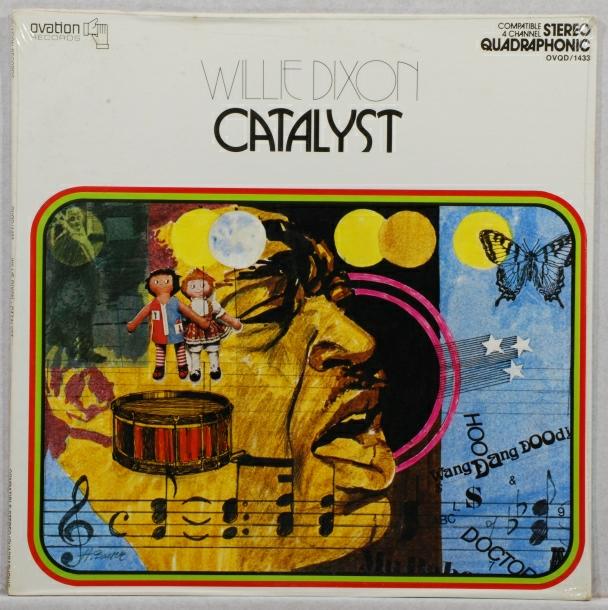
Sealed LP: Willie Dixon: Catalyst (QUAD)
$
41


$ 41
Sold For
May 31, 2010
Sold Date
May 24, 2010
Start Date
$ 40
Start price
2
Number Of Bids
USA
Country Of Seller
eBay
Auctioned at
Favourite Auctions
To save auctions to your favourites, please login
If you don't have an account, please register
Description
Willie Dixon: Catalyst
FACTORY SEALED LP
Format: Sealed LPRecord Company/Release Number: Ovation Records: OVQD/1433
Bar Code: NONE
Original release date: 1973
Country: U.S.A.
Condition of the cover: Mint
Condition of the record: Sealed - Assumed Mint
Shipping Weight: 1 pounds, 2 ounces
Inventory number: 209352
Notes: - - - Please contact me if you have any difficulty viewing the photos.
Songs:
- Bring It On Home
- I Don’t Trust Nobody
- God’s Gift To Man
- Hoo Doo Doctor
- My Babe
- Wang Dang Doodle
- When I Make Love
- I Think I Got The Blues
- But It Sure Is Fun
- I Just Want To Make Love To You
- Lafayette Leake: Piano
- Carrie Bell Harrington: Harmonica
- Buster Benton: Lead Guitar
- “Might” Joe Young: Guitar
- Phil Upchurch: Guitar
- Morris Jenniings: Drums
- Louis Satterfield: Bass
- Dick Schory: Producer
- Ron Steele: Production Assistance
- Scott A. Cameron: Production Coordination
- Steve Skinder: Recording And Mixing Engineer
- Judson B.: Photography
- Herb Bruce: Illustration
- One of his better latter-day efforts.
- Willie Dixon's life and work was virtually an embodiment of the progress of the blues, from an accidental creation of the descendants of freed slaves to a recognized and vital part of America's musical heritage. That Dixon was one of the first professional blues songwriters to benefit in a serious, material way -- and that he had to fight to do it -- from his work also made him an important symbol of the injustice that still informs the music industry, even at the end of the 20th century. A producer, songwriter, bassist, and singer, he helped Muddy Waters, Howlin' Wolf, Little Walter, and others find their most commercially successful voices.
- By the time he was a teenager, Dixon was writing songs and selling copies to the local bands. He also studied music with a local carpenter, Theo Phelps, who taught him about harmony singing. With his bass voice, Dixon later joined a group organized by Phelps, the Union Jubilee Singers, who appeared on local radio. Dixon eventually made his way to Chicago, where he won the Illinois State Golden Gloves Heavyweight Championship. He might have been a successful boxer, but he turned to music instead, thanks to Leonard "Baby Doo" Caston, a guitarist who had seen Dixon at the gym where he worked out and occasionally sang with him. The two formed a duo playing on street corners, and later Dixon took up the bass as an instrument. They later formed a group, the Five Breezes, who recorded for the Bluebird label. The group's success was halted, however, when Dixon refused induction into the armed forces as a conscientious objector. Dixon was eventually freed after a year, and formed another group, the Four Jumps of Jive. In 1945, however, Dixon was back working with Caston in a group called the Big Three Trio, with guitarist Bernardo Dennis (later replaced by Ollie Crawford).
- During this period, Dixon would occasionally appear as a bassist at late-night jam sessions featuring members of the growing blues community, including Muddy Waters. Later on when the Chess brothers -- who owned a club where Dixon occasionally played -- began a new record label, Aristocrat (later Chess), they hired him, initially as a bassist on a 1948 session for Robert Nighthawk. The Chess brothers liked Dixon's playing, and his skills as a songwriter and arranger, and during the next two years he was working regularly for the Chess brothers. He got to record some of his own material, but generally Dixon was seldom featured as an artist at any of these sessions.
- Dixon's real recognition as a songwriter began with Muddy Waters' recording of "Hoochie Coochie Man." The success of that single, "Evil" by Howlin' Wolf, and "My Babe" by Little Walter saw Dixon established as Chess' most reliable tunesmith, and the Chess brothers continually pushed Dixon's songs on their artists. In addition to writing songs, Dixon continued as bassist and recording manager of many of the Chess label's recording sessions, including those by Lowell Fulson, Bo Diddley, and Otis Rush. Dixon's remuneration for all of this work, including the songwriting, was minimal -- he was barely able to support his rapidly growing family on the 100 dollars a week that the Chess brothers were giving him, and a short stint with the rival Cobra label at the end of the '50s didn't help him much.
- During the mid-'60s, Chess gradually phased out Dixon's bass work, in favor of electric bass, thus reducing his presence at many of the sessions. At the same time, a European concert promoter named Horst Lippmann had begun a series of shows called the American Folk-Blues Festival, for which he would bring some of the top blues players in America over to tour the continent. Dixon ended up organizing the musical side of these shows for the first decade or more, recording on his own as well and earning a good deal more money than he was seeing from his work for Chess. At the same time, he began to see a growing interest in his songwriting from the British rock bands that he saw while in London -- his music was getting covered regularly by artists like the Rolling Stones and the Yardbirds, and when he visited England, he even found himself cajoled into presenting his newest songs to their managements. Back at Chess, Howlin' Wolf and Muddy Waters continued to perform Dixon's songs, as did newer artists such as Koko Taylor, who had her own hit with "Wang Dang Doodle." Gradually, however, after the mid-'60s, Dixon saw his relationship with Chess Records come to a halt. Partly this was a result of time — the passing of artists such as Little Walter and Sonny Boy Williamson reduced the label's roster of older performers, with whom he had worked for years, and the company's experiments with more rock-oriented sounds (especially on the "Cadet Concept" imprint) took it's output in a direction to which Dixon couldn't contribute. And the death of Leonard Chess in the fall of 1969 and the subsequent sale of the company brought about the end of Dixon's relationship to the company.
- By the end of the 1960s, Dixon was eager to try his hand as a performer again, a career that had been interrupted when he'd gone to work for Chess as a producer. He recorded an album of his best-known songs, I Am the Blues, for Columbia Records, and organized a touring band, the Chicago Blues All Stars, to play concerts in Europe. Suddenly, in his fifties, he began making a major name for himself on-stage for the first time in his career. Around this time, Dixon began to have grave doubts about the nature of the songwriting contract that he had with Chess' publishing arm, Arc Music. He was seeing precious little money from songwriting, despite the recording of hit versions of such Dixon songs as "Spoonful" by Cream. He had never seen as much money as he was entitled to as a songwriter, but during the 1970s he began to understand just how much money he'd been deprived of, by design or just plain negligence on the part of the publisher doing its job on his behalf.
- Arc Music had sued Led Zeppelin for copyright infringement over "Bring It on Home" on Led Zeppelin II, saying that it was Dixon's song, and won a settlement that Dixon never saw any part of until his manager did an audit of Arc's accounts. Dixon and Muddy Waters would later file suit against Arc Music to recover royalties and the ownership of their copyrights. Additionally, many years later Dixon brought suit against Led Zeppelin for copyright infringement over "Whole Lotta Love" and its resemblance to Dixon's "You Need Love." Both cases resulted in out-of-court settlements that were generous to the songwriter.
- The 1980s saw Dixon as the last survivor of the Chess blues stable and he began working with various organizations to help secure song copyrights on behalf of blues songwriters who, like himself, had been deprived of revenue during previous decades. In 1988, Dixon became the first producer/songwriter to be honored with a boxed set collection, when MCA Records released Willie Dixon: The Chess Box, which included several rare Dixon sides as well as the most famous recordings of his songs by Chess' stars. The following year, Dixon published I Am the Blues (Da Capo Press), his autobiography, written in association with Don Snowden.
- Dixon continued performing, and was also called in as a producer on movie soundtracks such as Gingerale Afternoon and La Bamba, producing the work of his old stablemate Bo Diddley. By that time, Dixon was regarded as something of an elder statesman, composer, and spokesperson of American blues. Dixon eventually began suffering from increasingly poor health, and lost a leg to diabetes. He died peacefully in his sleep early in 1992.
FINE PRINT
- All pictures are of the exact item being sold.
- This record came from a record store called "Phantasmagoria" which was located in Allentown, Pennsylvania. Phantasmagoria went out of business in 1978. I purchased most of their leftover inventory some years later when I owned a new & used record store in Catasauqua called "Music Madness".
- Phantasmagoria used round colored stickers to indicate the price of the albums. They had a sign on the wall with the color sticker combinations for the customers to use so they knew the price of the albums. Most of the albums still have these stickers on them, and in some rare cases, the stickers are written on. Some of the records have prices on them. This is the price you would have paid for the record in 1978 if you would have bought it at Phantasmagoria. Please don't confuse these prices with their current value.
- Your item(s) will be shipped within two business days after I receive your payment.
- I always leave feedback before your item ships. Please consider leaving feedback for me after you have had a chance to inspect and enjoy this record.
- Please avoid questions on the last day of the auction. I might not have enough time to give you an answer before the auction ends.
- Payment by PayPal is preferred. Other payment methods can be discussed. Local pick-ups will require cash at the time of pick-up.
- Almost all album reviews, credits and artist biographies are from All Music Guide. If you haven't been to their web site, you should check it out. It's one of the most comprehensive music references on the internet. In some cases, the above credits may include reissue (CD) information. Obviously any credits referenced to CDs do not apply to these album releases.
- All sealed albums are being sold as collector's items and cannot be returned due to manufacturer's defects. It may be almost impossible to replace many of the sealed albums that I am selling.
I DO NOT END ANY OF MY AUCTIONS EARLY. PLEASE DON'T ASK (unless you are willing to offer enough to pay off my mortgage).
IT IS NOT MY INTENTION TO MAKE A PROFIT ON THE POSTAGE. ANY ACCIDENTAL OVERCHARGE GREATER THAN $1 WILL BE REFUNDED TO YOU. (I've been know to refund less than $1 overcharges too.)
Shipping
Domestic (U.S.A.) buyers:- Priority Mail will be the only option available if you are the winning bidder. If you want your purchase shipped by Media Mail, you will have the option to request a revised invoice.
- Priority Mail: Buyer pays the actual USPS cost.
- Pick-up is fine with me. Just be prepared to pay by cash. No shipping fees apply. E-mail me to setup a time that is convenient for the both of us.
- All uninsured and underinsured shipments are the responsibility of the buyer.
- Foreign buyers must pay with US dollars through PayPal only. Please do not send cash - it's too risky.
- SHIPPING: I will send an invoice with options for the cost of shipping after the auction ends. You will have the choice of the following two options:
- USPS First Class International: Estimated delivery time to most countries is about 10-30 days. (Customs may delay delivery)
- USPS Priority Mail International: Estimated delivery time to most countries is about 6-10 days. (Customs may delay delivery)
- All uninsured and underinsured shipments are the responsibility of the buyer.
- The buyer is responsible for all customs regulations and fees in their own country.
- I will value all records at $5 on the Customs Form. Please let me know if you want the actual winning bid price listed on the Customs Form.
If you also collect Grand Funk, let me know if you have anything that you might want to sell or trade. I am always looking to add something new to my collection.
price rating