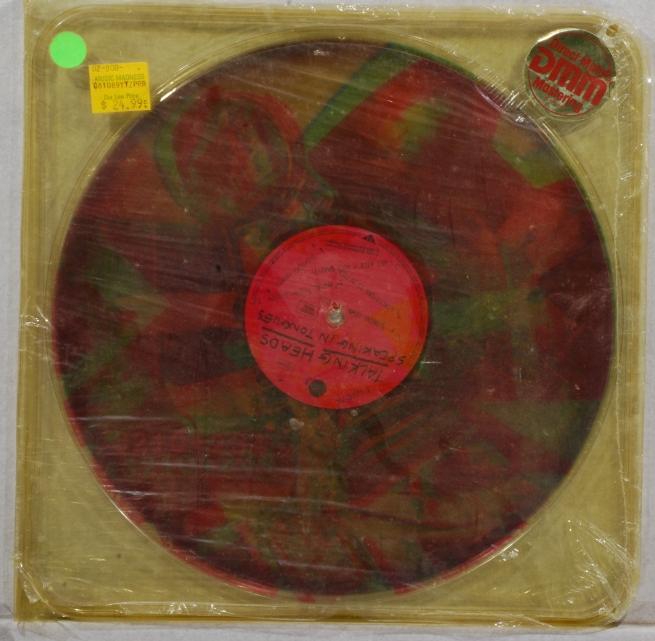
Sealed LP: Talking Heads: Speaking In Tongues (Clear vi
$
35


$ 35
Sold For
Jun 30, 2010
Sold Date
Jun 23, 2010
Start Date
1
Number Of Bids
USA
Country Of Seller
eBay
Sold at
Favourite Auctions
To save auctions to your favourites, please login
If you don't have an account, please register
Description
Talking Heads: Speaking In Tongues (Clear vinyl)
Sealed CD
Format: Sealed LPRecord Company/Release Number: Sire Records: 92-3771-1
Bar Code: NONE
Original release date: 1983
Country: Germany
Condition of the cover: Near Mint (yellowing of the plastic cover). There is a fair amount of shelf wear to the shrink wrap.
Condition of the record: Sealed - Assumed Mint
Shipping Weight: 2 pounds, 0 ounces
Inventory number: 209644
Notes: Clear vinyl with inserts. Please contact me if you have any difficulty viewing the photos.
Songs:
- Burning Down the House
- Making Flippy Floppy
- Girlfriend Is Better
- Slippery People
- I Get Wild/Wild Gravity
- Swamp
- Moon Rocks
- Pull up the Roots
- This Must Be the Place (Naive Melody)
- Wally Badarou: Synthesizer
- David Byrne: Bass, Guitar, Percussion, Keyboards, Vocals
- Raphael Dejesus: Percussion
- Chris Frantz: Synthesizer, Drums, Vocals (bckgr)
- Jerry Harrison: Guitar, Keyboards, Vocals, Vocals (bckgr)
- Nona Hendryx: Vocals, Vocals (bckgr)
- Butch Jones: Engineer
- Richard Landry: Saxophone
- Dolette MacDonald: Vocals (bckgr)
- Dollette McDonald: Percussion, Vocals
- Robert Rauschenberg: Cover Design
- Steve Scales: Percussion
- Lakshminarayana Shankar: Violin
- David Van Tieghem: Percussion
- Alex Weir: Guitar, Vocals
- Tina Weymouth: Synthesizer, Bass, Guitar, Vocals (bckgr)
- Bernie Worrell: Synthesizer
- Talking Heads found a way to open up the dense textures of the music they had developed with Brian Eno on their two previous studio albums for Speaking in Tongues, and were rewarded with their most popular album yet. Ten backup singers and musicians accompanied the original quartet, but somehow the sound was more spacious, and the music admitted aspects of gospel, notably in the call-and-response of "Slippery People," and John Lee Hooker-style blues, on "Swamp." As usual, David Byrne determinedly sang and chanted impressionistic, nonlinear lyrics, sometimes by mix-and-matching clichés ("No visible means of support and you have not seen nothin' yet," he declared on "Burning Down the House," the Heads' first Top Ten hit), and the songs' very lack of clear meaning was itself a lyrical subject. "Still don't make no sense," Byrne admitted in "Making Flippy Floppy," but by the next song, "Girlfriend Is Better," that had become an order -- "Stop making sense," he chanted over and over. Some of his charming goofiness had returned since the overly serious Remain in Light and Fear of Music, however, and the accompanying music, filled with odd percussive and synthesizer sounds, could be unusually light and bouncy. The album closer, "This Must Be the Place (Naive Melody)," even sounded hopeful. Well, sort of. Despite their formal power, Talking Heads' preceding two albums seemed to have painted them into a corner, which may be why it took them three years to craft a follow-up, but on Speaking in Tongues, they found an open window and flew out of it.
- At the start of their career, Talking Heads were all nervous energy, detached emotion, and subdued minimalism. When they released their last album about 12 years later, the band had recorded everything from art-funk to polyrhythmic worldbeat explorations and simple, melodic guitar pop. Between their first album in 1977 and their last in 1988, Talking Heads became one of the most critically acclaimed bands of the '80s, while managing to earn several pop hits. While some of their music can seem too self-consciously experimental, clever, and intellectual for its own good, at their best Talking Heads represent everything good about art-school punks.
- And they were literally art-school punks. Guitarist/vocalist David Byrne, drummer Chris Frantz, and bassist Tina Weymouth met at the Rhode Island School of Design in the early '70s; they decided to move to New York in 1974 to concentrate on making music. The next year, the band won a spot opening for the Ramones at the seminal New York punk club CBGB. In 1976, keyboardist Jerry Harrison, a former member of Jonathan Richman's Modern Lovers, was added to the lineup. By 1977, the band had signed to Sire Records and released its first album, Talking Heads: 77. It received a considerable amount of acclaim for its stripped-down rock & roll, particularly Byrne's geeky, overly intellectual lyrics and uncomfortable, jerky vocals.
- For their next album, 1978's More Songs About Buildings and Food, the band worked with producer Brian Eno, recording a set of carefully constructed, arty pop songs, distinguished by extensive experimenting with combined acoustic and electronic instruments, as well as touches of surprisingly credible funk. On their next album, the Eno-produced Fear of Music, Talking Heads began to rely heavily on their rhythm section, adding flourishes of African-styled polyrhythms. This approach came to a full fruition with 1980's Remain in Light, which was again produced by Eno. Talking Heads added several sidemen, including a horn section, leaving them free to explore their dense amalgam of African percussion, funk bass and keyboards, pop songs, and electronics.
- After a long tour, the band concentrated on solo projects for a couple of years. By the time of 1983's Speaking in Tongues, the band had severed its ties with Eno; the result was an album that still relied on the rhythmic innovations of Remain in Light, except within a more rigid pop-song structure. After its release, Talking Heads embarked on another extensive tour, which was captured on the Jonathan Demme-directed concert film Stop Making Sense. After releasing the straightforward pop album Little Creatures in 1985, Byrne directed his first movie, True Stories, the following year; the band's next album featured songs from the film. Two years later, Talking Heads released Naked, which marked a return to their worldbeat explorations, although it sometimes suffered from Byrne's lyrical pretensions.
- After its release, Talking Heads were put on "hiatus"; Byrne pursued some solo projects, as did Harrison, and Frantz and Weymouth continued with their side project, Tom Tom Club. In 1991, the band issued an announcement that they had broken up. Five years later, the original lineup minus Byrne reunited as the Heads for the album No Talking Just Head. Then in 1999, all four worked together to promote a 15th-anniversary edition of Stop Making Sense.
FINE PRINT
- All pictures are of the exact item being sold.
- Your item(s) will be shipped the next business day after I receive your payment.
- I always leave feedback before your item ships. Please consider leaving feedback for me after you have had a chance to inspect and enjoy this item.
- Please avoid questions on the last day of the auction. I might not have enough time to give you an answer before the auction ends.
- Payment by PayPal only (except for items when local pick-up has been arranged).
- All album reviews, credits and artist biographies are from All Music Guide. If you haven't been to their web site, you have to check it out. It's one of the most comprehensive music references on the internet. In some cases, credits may include reissue (CD) information. Obviously any credits referenced to CDs do not apply to these album releases.
- All sealed albums are being sold as collector's items and cannot be returned due to manufacturer's defects. It may be almost impossible to replace many of the sealed albums that I am selling.
I DO NOT END ANY OF MY AUCTIONS EARLY. PLEASE DON'T ASK (unless you are willing to offer enough to pay off my mortgage).
IT IS NOT MY INTENTION TO MAKE A PROFIT ON THE POSTAGE. ANY ACCIDENTAL OVERCHARGE GREATER THAN $1 WILL BE REFUNDED TO YOU. (I've been know to refund less than $1 overcharges too.)
Shipping
Domestic (U.S.A.) buyers:- Priority Mail will be the only option available if you are the winning bidder. If you want your purchase shipped by Media Mail, you will have the option to request a revised invoice.
- Priority Mail: Buyer pays the actual USPS cost.
- Pick-up is fine with me. Just be prepared to pay by cash. No shipping fees apply. E-mail me to setup a time that is convenient for the both of us.
- All uninsured and underinsured shipments are the responsibility of the buyer.
- Foreign buyers must pay with US dollars through PayPal only. Please do not send cash - it's too risky.
- SHIPPING: I will send an invoice with options for the cost of shipping after the auction ends. You will have the choice of the following two options:
- USPS First Class International: Estimated delivery time to most countries is about 10-30 days. (Customs may delay delivery)
- USPS Priority Mail International: Estimated delivery time to most countries is about 6-10 days. (Customs may delay delivery)
- All uninsured and underinsured shipments are the responsibility of the buyer.
- The buyer is responsible for all customs regulations and fees in their own country.
- I will value all records at $5 on the Customs Form. Please let me know if you want the actual winning bid price listed on the Customs Form.
If you also collect Grand Funk, let me know if you have anything that you might want to sell or trade. I am always looking to add something new to my collection.
price rating


![Mirror Ball [LP] by Neil Young (Vinyl, Jun-1995, Reprise)](https://www.popsike.info/php/thumbnail.php?url=https://www.popsike.pics/pix/20240814/296630117429.jpg)





![Stop Making Sense 2LP Deluxe Edition [VINYL]](https://www.popsike.info/php/thumbnail.php?url=https://www.popsike.pics/pix/20240812/186628056715.jpg)


