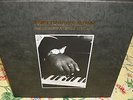
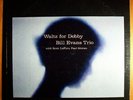
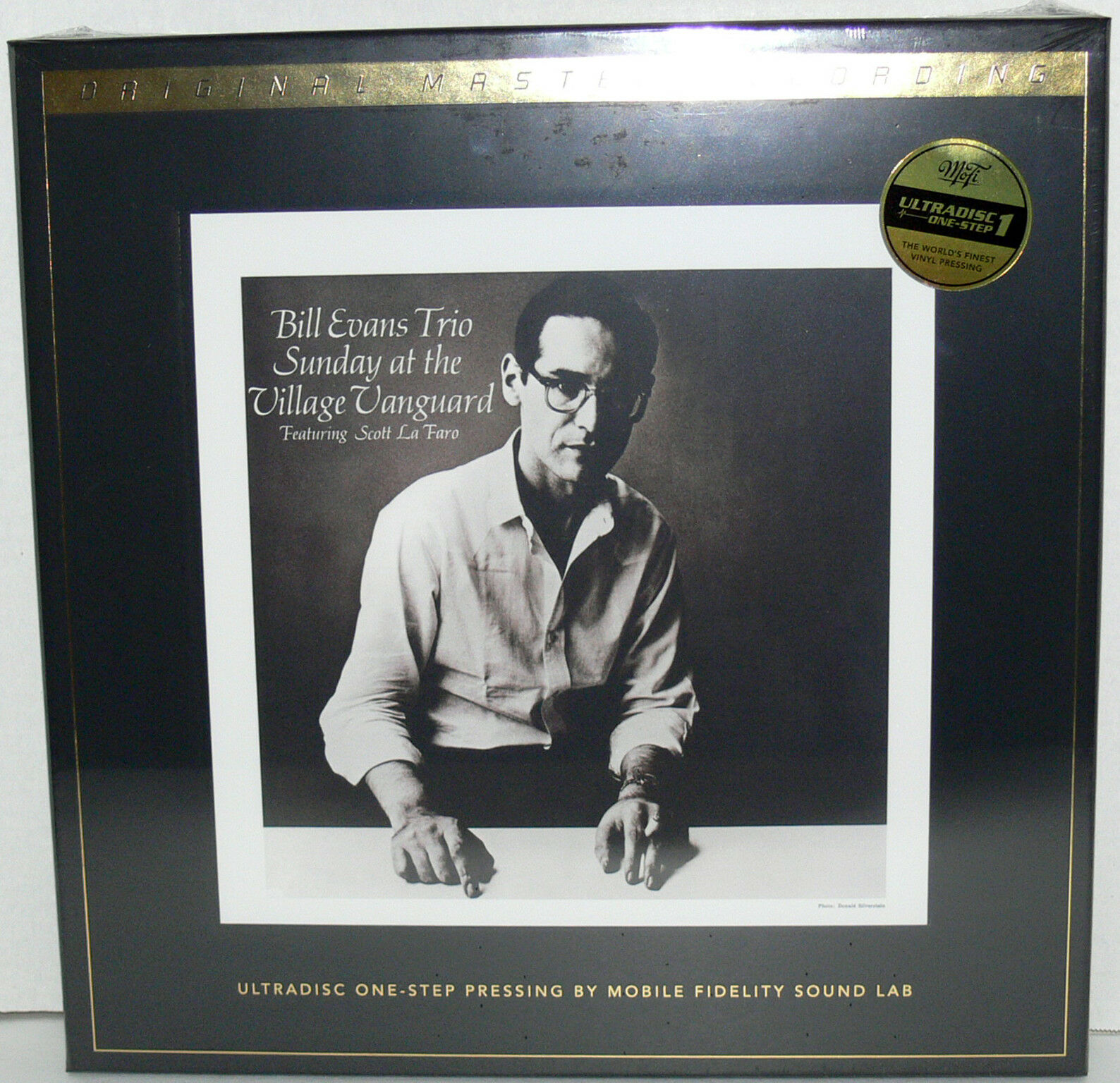
SUNDAY AT THE VILLAGE VANGUARD Bill Evans MFSL UltraDisc One-Step UD1S 2-002 NEW
$
299


Favourite Auctions
To save auctions to your favourites, please login
If you don't have an account, please register
Description
SUNDAY AT THE VILLAGE VANGUARD Bill Evans Trio MFSL UD1S 2-002 UltraDisc One-Step 45RPM (2 record box set)
Tracklist
A1 Gloria's Step Written-By – Scott LaFaro 6:01 A2 My Man's Gone Now Written-By – George & Ira Gershwin6:14 B1 Solar Written-By – Miles Davis
8:39 C1 Alice In Wonderland Written-By – Bob Hilliard, Sammy Fain
8:25 D1 All Of You Written-By – Cole Porter 8:10 D2 Jade Visions Written-By – Scott LaFaro 3:40
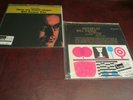
*(all photos are of the actual item)
- Produced At – Bill Grauer Productions
- Recorded At – Village Vanguard
- Pressed By – Record Technology Incorporated
- Bass – Scott LaFaro
- Design [Album] – Ken Deardoff
- Drums – Paul Motian
- Engineer [Recording] – Dave Jones*
- Liner Notes – Ira Gitler
- Liner Notes, Producer – Orrin Keepnews
- Mastered By – Krieg Wunderlich
- Photography By [Back Liner] – Steve Schapiro
- Photography By [Front] – Donald Silverstein
- Piano – Bill Evans
Notes
Recorded (live) at The Village Vanguard, New York City; June 25, 1961Comes with inserts comprising an album sized photo of the front album cover, details of the one step process, photo of the trio backstage and Bill Evans playing piano.
Stamper matrixes run from A1-5 to D1-5. Limited to 3 000 hand numbered copies. Special Limited Edition No. 0254 / 3000 Barcode: 821797200226 AllMusic Review by Thom Jure
Sunday at the Village Vanguard is the initial volume of a mammoth recording session by the Bill Evans Trio, from June 25, 1961 at New York's Village Vanguard documenting Evans' first trio with bassist Scott LaFaro and drummer Paul Motian. Its companion volume is Waltz for Debby. This trio is still widely regarded as his finest, largely because of the symbiotic interplay between its members. Tragically, LaFaro was killed in an automobile accident ten days after this session was recorded, and Evans assembled the two packages a few months afterward. While "Waltz for Debby" -- in retrospect -- is seemingly a showcase for Evans' brilliant, subtle, and wide-ranging pianism, this volume becomes an homage, largely, to the genius and contribution of LaFaro. That said, however, this were never the point. According to Motian, when Evans built this trio based on live gigs at the Basin Street East, the intention was always to develop a complete interactive trio experience. At the time, this was an unheard of notion, since piano trios were largely designed to showcase the prowess of the front line soloist with rhythmic accompaniment. Here, one need listen no further than the elegant and haunting, graceful modal reading of "My Man's Gone Now" from Porgy & Bess to know that there is something completely balanced and indescribably beautiful in their approach. Motian's brushes whisper along the ride cymbals and both Evans and LaFaro enter into a dialogue that emerges from a darkly hued minor mode, into the melody and somehow beyond it, into a form of seamless dialogic improvisation to know that in the act of one musician slipping over and under another -- as happens with all three in an aural basket weave -- is something utterly new and different, often imitated but never replicated. But in a sense it happens before this, on LaFaro's "Gloria's Step," which opens the recording. His thematic statement includes the briefest intro, hesitant and spacious before he and pianist enter into a harmonic and contrapuntal conversation underscored by the hushed dynamics of Motian's snare, and the lightning-fast interlocutions of single string and chorded playing of LaFaro. The shapshifting reading of Miles Davis' "Solar," is a place where angularity, counterpoint, and early modalism all come together in a knotty and insistent, yet utterly seamless blend of post-bop aesthetics and expanded harmonic intercourse with Motian, whose work, while indispensable in the balance of the trio, comes more into play here, and is more assertive with his half-time accents to frame the counterpoint playing of Evans and LaFaro. This is a great place to begin with Evans.
(from Acoustic Sounds)
Mastered from the original master tapes with Mobile Fidelity's one-step lacquer process
Sunday at the Village Vanguard 45 RPM box set: The ultimate analog version of Bill Evans' 1961 jazz staple
180-gram 45 RPM 2LP box set; deluxe packaging includes opulent box, special jackets and unique bonus artwork — strictly limited to 3,000 copies!
The gorgeous romanticism of Bill Evans' Sunday at the Village Vanguard cannot be overstated. Neither can the iconic record's place in history — nor what it signifies to generations upon generations of listeners hypnotized by the consummate playing, resplendent compositions, and seamless chemistry. Originally released in1961, the live set remains the gold standard for symbiotic trio performance, empathy, and communication. Because of Orrin Keepnews' brilliant recording, it also survives as one of the best-sounding jazz albums extant — a fact confirmed by its appearance on multiple reissues over the past few decades. But it's never sounded better than this.
Evans' masterwork reaches three-dimensional sonic and emotional heights never before attained by analog recordings on this opulent Mobile Fidelity UD1S box set complete with special jackets and a unique insert. Strictly numbered to 3000 copies, this ultra-hi-fi audiophile edition literally and figuratively brings you closer to the music of this Riverside staple that, along with the complementary Waltz for Debby, transformed Evans into a legend and became a blueprint for how jazz trios should work together. You'll enjoy deep-black backgrounds, pointillistic details, and staggering dynamics. Experienced via UD1S, Sunday at the Village Vanguard places Evans and his esteemed colleagues in your listening room. Every note, breath, and movement captured by the microphones are reproduced with exquisite accuracy and wowing clarity.
Housed in an opulent box, this UD1S edition contains special jackets and unique bonus artwork that further illuminate the splendor of the recording. Aurally and visually, this Sunday at the Village Vanguard is a curatorial artifact meant to be preserved, poured over, touched, and examined.
Recorded just 10 days before bassist Scott LaFaro perished in a car accident, Sunday at the Village Vanguardchanged the way jazz trios were perceived by audiences and musicians alike. Up until Evans, LaFaro, and drummer Paul Motian proved otherwise, a trio configuration meant two sidemen served as rhythmic support to spotlight the virtuosity of a headline performer or primary soloist. Here, the three instrumentalists operate in complete unison and achieve supreme democratic balance.
More About Mobile Fidelity UltraDisc One-Step and what sets it apart
Instead of utilizing the industry-standard three-step lacquer process, Mobile Fidelity Sound Lab's new UltraDisc One-Step (UD1S) uses only one step, bypassing two processes of generational loss. While three-step processing is designed for optimum yield and efficiency, UD1S is created for the ultimate in sound quality. MFSL engineers begin with the original master tapes and meticulously cut a set of lacquers. These lacquers are used to create a very fragile, pristine UD1S stamper called a "convert." Delicate "converts" are then formed into the actual record stampers, producing a final product that literally and figuratively brings you closer to the music.
price rating