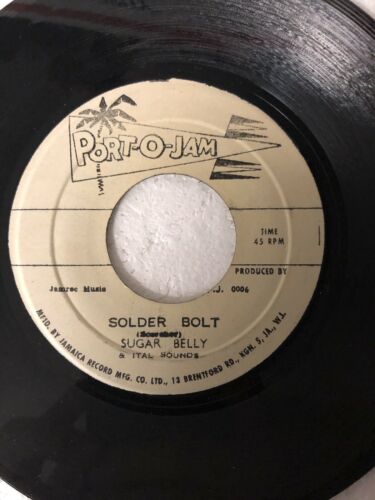
SUGAR BELLY Solder Bolt / Welding JAMAICA Mento 45 on Port-o-Jam #250
$
25


Favourite Auctions
To save auctions to your favourites, please login
If you don't have an account, please register
Description
Vinyl is VISUALLY Graded, but we did check the sound quality:
Side 1: SUGAR BELLY & Ital Sounds: "Solder Bolt" (a well known Mento collector claims the song is actually "SOLDERING") The vinyl looks strong VG++ which is mighty rare for a Jamaica pressing. We do grade conservatively, and we checked the sound and it's great, with deep overpowering bass and crisp highs with slight analog "overload" distortion common to any self-respecting record cutter in JA. The label is slightly off-center on this side, but the lead-out grooves DO NOT go into the paper label, so no worries for your stylus.
B/W ITAL SOUND (aka Sugar Belly): "Welding" (a Melodica version with a completely different bass-line)
On this side, the vinyl is VG to VG+ due to a gouge in the vinyl as well as a piece of embedded schmutz toward the end of the record. Most of the side looks very shiny and clean: perhaps the gouge was caused by the schmutz (most likely a piece of label paper) when the record was pressed. We played most of this side and it sounds GREAT, with MASSIVE bass in your face. The bass drops out right before the finger-felt gouge is heard, but the bass-line kicks back in when the noise starts, and it's only a minor cyclical thump/click sound that cannot really be noticed easily. The embedded schmutz is only audible during the last two revolutions of the tune, which mercifully fades out quickly, right before that last noise gets louder.
Jamaica PORT-O-JAM P.J. 0006
Plain fresh sleeve. Here are excerpts of a 1993 article on Sugar Belly and the instrument he created, from Bart Hopkin of Experimental Musical Instruments. The entire article can no longer be found at its original location: www.windworld.com/emi/articles/sugarbel.htm.
"William Walker, known to all as Sugar Belly, developed on his own the instrument he called the bamboo saxophone, and played it with facility, style, passion and joy. At the height of his popularity in the late 1950s Sugar Belly was one of the important figures in the Jamaican music scene, turning his homemade saxophone into a natural vehicle for a distinctively Caribbean musical style. THE MAN Sugar Belly was raised in Kingston. In music he was entirely self-taught. Just where he got the idea to create a bamboo saxophone is a bit of a mystery, since there is no traditional bamboo reed instrument in Jamaica, and no one that I have spoken to can recall seeing any other locally-made saxophone-like instrument in the island. Sugar Belly's instrument seems to have been entirely his own in conception and design. In its construction the instrument might seem simple and crude, but you know the tree by its fruit: from it Sugar Belly managed to bring the most fluid, warm, agile, and unquestionably sax-like music you could wish for. In the early days Sugar Belly played in talent exhibitions at Victoria Park in downtown Kingston, where years before Marcus Garvey had addressed the crowds. With increasing recognition he moved on to night clubs, such as the popular Glass Bucket located uptown at Halfway Tree. The leading popular music style in Jamaica at that time was mento. Sugar Belly's band originally used a typical mento instrumentation of banjo, guitar and shakers, with the big bass kalimba known in Jamaica as a rumba box providing the bottom. Later he incorporated electric guitar and bass. Through the 1960s mento gradually faded in popularity. Sugar Belly brought popular songs from a broader range of local and international styles into his repertoire; still, as time passed, he and his band were heard from less and less. He later moved to the parish of St. Anne on the island's north coast, and it was there that he died circa 1990 following a long illness. THE INSTRUMENT Sugar Belly did make a fair number of bamboo saxophones over the years, keeping some to play himself and selling others. The main segment of his bamboo saxophone is a straight section of bamboo, an inch or so in diameter and something over a foot long. Into this at one end is inserted a mouthpiece of a few inches long, made from a smaller piece of bamboo sized so as to fit snugly into the main segment. Where a commercial sax has cork to ensure a leakless fit between the mouthpiece and the main tube, Sugar Belly put several rounds of masking tape to provide an adequate gasket. At the other end of the main bamboo tube, Sugar Belly placed a conical commercial thread spool made of heavy cardboard. Once again, masking tape serves as a gasket to ensure a snug fit and a leakless joint. The conical spool in turn leads to a wider-angled funnel of tin. Sugar Belly had this one metal part fabricated for him by a tinsmith."
price rating