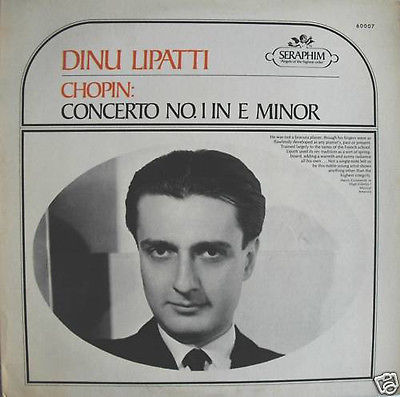
SEALED Dinu Lipatti /Rare Chopin Concerto Scandal Album/MINT Vinyl LP RARE
$
25


Favourite Auctions
To save auctions to your favourites, please login
If you don't have an account, please register
Description
Dinu Lipatti
Rare Chopin Concerto Scandal Album!!!
MINT 1966 Sealed Vinyl Never Opened!!!
No orchestra or conductor was named.The Chopin Concerto Scandal
In 1966, EMI issued a previously unknown recording of Chopin’s Piano Concerto #1 in E Minor featuring the pianist Dinu Lipatti. No orchestra or conductor was named. On the record jacket of the British release of the recording in 1971 was the following statement:
This recording includes a performance by Dinu Lipatti of Chopin’s Piano Concerto No. 1. It comes from a tape, which EMI acquired, made at a concert in Switzerland in May, 1948. Although there is no question that the performance is by Dinu Lipatti, extensive enquiries have failed to establish the name of the conductor and orchestra. However, this particular performance has not been published in the UK before now and is therefore a musical document of rare value.
When EMI reissued the recording in 1981, the BBC broadcast the record, and a listener wrote in noting its similarity with a Supraphon recording dating from the early 1950s featuring the distinguished Chopin pianist Halina Czerny-Stefanska. Tests by BBC and EMI revealed that the two recordings were identical.
When the news broke, Dr. Marc Gertsch of Bern presented a tape to EMI of an authentic live Lipatti performance from a radio broadcast of a Zurich concert given February 7, 1950, featuring the Zurich-Tonhalle Orchestra conducted by Otto Ackermann. The tape formed the basis of a new LP and all previous pressings of the erroneously-attributed recording were withdrawn worldwide.
The behind-the-scenes situations leading up to the release of the Czerny-Stefanska recording are as follows.
In 1960, Walter Legge was approached by one Mr. Kaspar of Zurich, who owned a tape of the Lipatti/Ackermann performance of the Chopin Concerto in excellent sound. EMI expressed an interest in issuing the recording, but according to Legge, Kaspar vanished with the tape when copyright inquiries were made as to who the copyright owner was.
Shortly afterwards, another collector presented another tape of the Chopin Concerto to Madeleine Lipatti. EMI has said that while there were no detailed indications as to the origin of the tape, Madeleine, Legge, and Ansermet agreed that Lipatti was the pianist. EMI made inquiries into the identities of the orchestra (it was thought it might be the Concertgebouw or La Scala), but to no avail. The situation was exasperating to Walter Legge and Madeleine Lipatti. Madeleine wrote to Legge (in French) on October 17, 1963:
“I think that it will be very difficult, if not impossible, to obtain the references to its origin. The person who sold this tape to the man in Basel said that it consisted of a recording made by Dinu Lipatti with the Warsaw Orchestra with a conductor named Mawricki – but Dinu never played with these people! It is obviously a vicious lie… We are certain that Dinu played this Chopin Concerto only in Zurich since magnetos were invented! We can have no doubt.”
Madeleine’s identification of a purported conductor and orchestra runs counter to EMI’s story that the origin of the tape was unclear. In Legge’s reply of October 23, he says:
“If as you say Dinu only played the Chopin Concerto in Zurich after the invention of the magneto, there must have been two performances or a rehearsal and a performance, because in the one tape I have heard there are audience noises and in the other there is absolute silence.”
While Madeleine was clearly expressing doubts as to the authenticity of the recording, it did not seem to cross Legge’s mind that the tape might not be authentic. He did not comment on the significant interpretative differences between the Zurich performance (which he had presumably heard) and the other tape, such as the drastically different tempo of the first movement, or the fact that the orchestral introduction was left intact in the recording that he thought might be a rehearsal, whereas it was cut in the authenticated Zurich performance.
Legge left EMI in 1964 before the situation was resolved, and EMI continued its involvement in the matter in his absence. An internal EMI letter from May 1965 summarizes the situation at that time:“As nothing further could be done, the project lay dormant until a new tape arrived on the scene some months ago, of which the following situation pertains:
- The new performance is not the same as the previous tape, but those who knew Lipatti insist that it is he playing (Legge, Mrs. Lipatti, Ansermet, etc.)
- The orchestra is not the same.
- The conductor is not Ackermann.”
A letter by M.W. Allen of the International Artists Department dated December 7, 1965 reveals some interesting information:
“…we have ascertained that the performance is not that with the Zurich Tonhalle conducted by Otto Ackermann. We have in fact an inferior tape of this performance and it is not the same.”
While EMI’s version of the events stressed that Kaspar had withdrawn his excellent quality tape, it appears that EMI was nevertheless in possession of another authentic copy of this performance. In the 1990s, a Lipatti student presented this writer with a private LP of another tape source of the Zurich concert. This source tape had a one-minute gap in the first movement and radio interference from neighbouring radio stations. It is unclear whether this is the same tape that EMI had in its possession in the 1960s, but it does reveal that there was more than one copy of the Zurich concert in circulation.
Despite the obvious differences in interpretation, EMI and the listed Lipatti experts still felt that the ‘silent audience’ tape was an authentic Lipatti performance – or perhaps they simply wished it to be true. EMI felt, in the words of Peter Andry (May 10, 1965), that “it is thought worth taking a risk in order to issue the tape which is good and contains a fine performance.” EMI’s classification of what is ‘good’ seems to have been recorded sound quality. As they believed that Lipatti was performing on the sonically-superior tape (perhaps they had not been made aware of Mrs. Lipatti’s doubts, which had been expressed to Legge in a private letter; it is nevertheless in EMI archives), this was the performance that was released.
All the while, Dr. Marc Gertsch of Bern had in his possession a complete authentic tape of the Zurich Tonhalle concert. At the age of 15 in 1951, Gertsch had met a collector who had recorded the broadcast in wonderful sound, and having no sophisticated means of transferring the recording, he made a tape by using a handheld microphone. As the recording was progressing, the battery on his player started to wear out, leading to a speed shift as the performance progressed. Regrettably, the collector from whom he had copied the recording later erased his tape with a Wagner opera (leading Gertsch to say, “One more reason to hate Wagner!”).
price rating