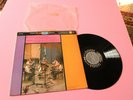
SAVOY BROWN BLUES BAND SHAKE DOWN ORIG 1967 UK PSYCH LP
£
50
$
66


Favourite Auctions
To save auctions to your favourites, please login
If you don't have an account, please register
Description
SAVOY BROWN BLUES BAND
SHAKE DOWN
outer sleeve - excellent condition
inner sleeve like new
vinyl itself near perfect
matrix number side 1 zal 7887-1w
matrix number side 2 zal 7888-1w
Originally called the Savoy Brown Blues Band, this group can rightly take credit for cutting the farewell anthem of the 1960s British blues boom, in the form of a modern blues aptly titled "Train to Nowhere." Historically as well as musically, this song remains a sad reminder that by the time of its 1969 release as a single, most original blues were no longer commercially viable in Britain, as more and more blues clubs closed their doors for good.
Within four years of the bands formation, however, they had become a major league live act in America. At home in Britain, they weren't so lucky, and never really broke out of the club scene despite founder/guitarist Kim Simmonds's (b. December 5, 1947; Newbridge, South Wales) persistence as the band's only continuous member.
Today, critics believe that one reason for Savoy Brown's inability to gain a foothold in Britain was its high personnel turnover, but these frequent lineup changes also led to some noteworthy ensembles. Many consider that the recordings featuring Chris Youlden's rich vocals and songwriting augmented by Kim Simmonds's jazz-tinged, fluent blues guitar, were Savoy Brown's finest work; this being especially so on such late-1960s cuts as "She's Got a Ring in His Nose and a Ring on Her Hand" (a classy swing-blues) and the completely different and desolate groove of "Mr. Downchild." The early-1970s also saw some interesting personnel changes including a collaboration with Chicken Shack's Stan Webb (when the band also was known as the Boogie Brothers).
Early in his life, Savoy Brown guitarist Kim Simmonds was heavily influenced by his older brother Harry (christened Henry). Harry Simmonds had started listening to music when he was about thirteen, especially to Bill Haley. He later became interested in R&B and blues, particularly the music of James Brown, Ike and Tina Turner, Jimmy Reed, Otis Rush and Muddy Waters. He often purchased American imports from The Swing Shop, a small record store located in Streatham, Southwest London, which was also a hangout for Jo Ann Kelly.
Kim became absorbed in the records in his older brother's collection. "My brother, Harry, used to come home with all these records and I used to hear nothing but blues," he told Beat Instrumental. "I was hooked straight away." Among Kim's influences were Howlin' Wolf (and his guitarist Hubert Sumlin), Earl Hooker, Freddy King, Matt Murphy, Otis Rush and Muddy Waters. At age 13, Kim purchased his first guitar and taught himself to play Chuck Berry riffs. By age 15 he was still playing the guitar, though by then he had dropped out of school and taken a clerical job at the Ministry of Defence in Whitehall.
While waiting outside Transat Imports, a record store located in London's Chinatown district, Kim met another blues enthusiast, harmonica player and neighbour John O'Leary. O'Leary was working for an American chemical company and had picked up the harmonica after seeing Cyril Davies perform with Alexis Korner's Blues Incorporated. O'Leary and Kim became friends and O'Leary invited Kim and his brother Harry to a jam session. "I went along not expecting very much, but Kim had got a really good thing going," Harry later observed.
He encouraged his brother to form a band and they all agreed that Harry would manage them. The initial lineup consisted of Kim Simmonds on guitar, O'Leary on harmonica, Leo Manning on drums, vocalist Brice Portius, and bassist Ray Chappell. Both Manning and Portius were black, while the other members were white, thus making Savoy Brown one of the first racially integrated groups to play in British clubs.
Their first pianist, Trevor Jeavons, was soon replaced by Bob Hall (who became one of Savoy Brown's longest-serving, albeit part-time, members). Previously, Hall had been a member of John Lee's Groundhogs (later the Groundhogs), which had backed John Lee Hooker on his 1964 British tour. He had also played backup to Jimmy Reed and Little Walter. By the time of the Groundhogs' first recordings, however, Hall had departed because of time conflicts with his day job.
The new group decided to call themselves the Savoy Brown Blues Band to emphasize their Chicago Blues-style repertoire. They took Savoy from the US blues label, Savoy Records, which they thought sounded elegant and "Brown" because they perceived it as being about as plain as you can get. Strung together, the words created a balance of opposites.
Like many bands, they found it tough to get bookings at first, but unlike other bands, the Simmonds brothers simply decided to open their own blues club, Kilroy's, in May 1966. Kilroy's was located in an upstairs room of Nag's Head Tavern on York Road in Battersea. Kim recalled the club to Relix: "They used to have a folk club one night a week and as folk was dying out by then we approached them about having a blues room on Monday nights. We'd take our gear down in a taxi or something like that. We used to rehearse there anyway. From what I can recall, we distributed flyers around London and the club came into being. At first only a few people came and then we played there every week and it built up, and eventually it became a bona-fide blues club. Fleetwood Mac played there, and Freddie King and all sorts of artists." The Nag's Head eventually became home to the Blue Horizon club-a place where future British blues talents such as Fleetwood Mac's Danny Kirwan (then with his first band, Boilerhouse) were discovered.
As the Savoy Brown Blues Band 's manager, Harry landed a story about the group and their blues club in the pages of the local Wandsworth Borough News. At the time, Harry (who also worked as a London postman) would enterprisingly take the band to gigs in his Post Office van. Kilroy's became a local success and soon attracted the notice of Mike Vernon. Along with childhood friend Neil Slaven, Vernon published the blues and soul music magazine R&B Monthly, and was at the time a producer at Decca. Vernon had also established the Blue Horizon label along with his brother, Richard, which included two subsidiary labels, Purdah and Outa-Site.
As Vernon explained in the liner notes of History of British Blues, "I talked Harry Simmonds, their manager, into letting me record the band for a single to be released on my own Purdah label-that was the precedent to Blue Horizon." They recorded four tracks in August 1966 at London's Wessex Studios, with Vernon producing. Vernon issued two of the tracks, the Willie Dixon-penned "I Can't Quit You Baby" and "I Tried," as a single on Purdah to be distributed by mail order. The other two, "True Blue" (a.k.a. "True Story") and "Cold Blooded Woman" were assigned Purdah catalog numbers but not released. They eventually came out as part of the Immediate label's Blues Anytime series.
The band received a big break when Brian Wilcock, a DJ at Klook's Kleek R&B Club, Railway Hotel located in the West Hampstead area of London and a friend of Harry Simmonds arranged for the band to play the interval for Creams appearance there on August 2, 1966. Since Cream made their official debut at the 6th National Jazz and Blues Festival on July 31, this would be their first club engagement outside of a warmup gig held on July 29 at the Twisted Wheel in Manchester. Expectations were high for the Cream which played two sets but Savoy Brown went down such a storm during their slot that they racked up enough gig offers to enable them to go full time-and Wilcock eventually became their tour manager in September 1967.
The band started to expand their gig list to include engagements at the Tiles Club, Flamingo and the Marquee in central London and the Metro in Birmingham. Kim once said about those early shows, "We started playing places like the Metro in Birmingham, which is like a big soul club, but we managed to please the people because we had Brice Portius, a black singer, and they would relate to him in the sense that they might relate to Geno Washington, even though we were playing blues. I mean we would play up-tempo stuff and bounce around a little." Several shows even found them backing Champion Jack Dupree. Altogether, their lineup remained stable except for pianist Hall, who once again had conflicts with his daytime job that caused him to drop out for awhile but return on a part-time basis when his replacement didn't work out. Demos and acetates were recorded with this lineup prior to the sessions for their first album. Ex-Stone's Masonry guitarist Martin Stone was added while O'Leary departed to become a member of John Dummer's Blues Band [see John Dummer's Blues Band]. Both Graham "Shakey Vick" Vickery and Steve Hackett auditioned to play harp during this period, but O'Leary was not replaced.
Decca signed the band on the recommendation of Slaven and Vernon, and by mid-1967 the group was at West Hampstead Studios, London, recording their first album with Mike Vernon again producing. In the excellent Blue Horizon CD set, Vernon discussed his rationale for signing the band to Decca rather than to one of his own labels: "Firstly, Blue Horizon was still, at the time, little more than a fanzine label and secondly, I must herein admit that I didn't care too much for Brice as a vocalist."
The Savoy Brown Blues Band's first Decca long player was recorded in just thirty hours spanning three consecutive days. Shake Down was a gritty collection of blues standards with just one original, Stone's "Doormouse Rides the Rails." Among the tracks were B.B. King's "Rock Me Baby," John Lee Hooker's "It's All My Fault," three Willie Dixon songs and "Black Night" by Fenton Robinson. The standout track was the group-arranged "Shake 'Em on Down," a raucous workout extending to just over six minutes. Shake Down was released in the U.K. in September 1967, but for reasons unknown, the LP didn't appear at all in the U.S.
The Savoy Brown Blues Band continued to gig extensively while Shake Down was in production, doing a punishing 24 gigs in just 21 days as backing band for John Lee Hooker. They also got a summer-long residency in Charlottenlund, north of Copenhagen, Denmark. At around the time of Shake Down's release, in an odd coincidence the band experienced a true drug-related "shake down" in Barnstaple, a town in Devon, England, during a short tour of the West Country. This incident led Harry to actually fire his brother Kim from the band after the dates in Denmark. Other changes ensued as Chappell and Portius left and were replaced by Bob Brunning on bass and Chris Youlden on vocals. Brunning had previously been Fleetwood Mac's bassist for a few weeks in August 1967.
Youlden had been in various outfits, including a band that had alternately called itself the Down Home Blues Band and Shakey Vick's Big City Blues Band, and another called the Cross Ties Blues Band.
Next, Manning quit and was replaced on drums by Hughie Flint, formerly of John Mayall's Bluesbreakers and Alexis Korner's band, Free at Last band. Finally, Stone departed and Kim asked O'Leary to rejoin the band. O'Leary agreed at first, then changed his mind due to "unreasonable conditions." Stone was instead replaced by "Lonesome" Dave Peverett.
Dave Peverett (b. April 16, 1943; d. February 7, 2000) was born in Dulwich but grew up in Brixton, southwest London. He first got into music after hearing "Rock Around the Clock" by Bill Haley and the Comets. He then listened to Jerry Lee Lewis, Little Richard, Fats Domino, Chuck Berry and Elvis Presley before turning on to blues musicians like Bo Diddley, Muddy Waters, Lightnin' Hopkins and John Lee Hooker. At age 16, he bought his first guitar and, with his brother on drums, gathered other musicians and formed a band that played its first party in 1963. After undergoing a series of name changes, the group (whose membership included Chris Youlden) eventually settled on the name the Cross Ties Blues Band. By 1966, they had become the Lonesome Jax Blues Band, named after Dave Peverett's first stage name. The band played the London club circuit and colleges.
Later, Peverett joined the Swiss blues group Les Questions, with which he played until October 1967, at which point he returned to the U.K. brimming with plans to start a band along with Youlden. Instead, he joined Savoy Brown.
With only Kim (who had since made amends with Harry) and Hall from the prior lineup, the group entered the studio to record their next single. Youlden emerged as a major creative force within the band, contributing the frantic "Taste and Try Before You Buy," which became the A-side of their next release. Kim had written the flipside, "Someday People."
Record Mirror praised the band as playing "a style of Chicago blues which is both commercial and authentic" and observed that Youlden was "often rated in the same breath as Long John Baldry and Rod Stewart."
Shortly after the single was cut the band underwent more member changes. Both Brunning and Flint left; Brunning has since cited the "creative accountancy" of the band's management as the main reason for walking. (Manager Harry used to pay band members a fixed weekly wage regardless of how many gigs they played and the money made from each gig. From a musician's point of view, this was a good incentive for not getting too successful). By 1968, Brunning formed the Brunning Sunflower Band with Bob Hall, and Flint went on to early-1970s pop-chart success in McGuinness-Flint, later settling with the Blues Band.
After the Savoy Brown Blues Band had tried out several replacements for drums (including drummer Bill Bruford) and bass, the band decided on Rivers Jobe and Roger Earle, respectively. Jobe had previously been a member of the Anon (from May 1965 to July 1966) with Anthony Phillips and future Genesis founding member Mike Rutherford.
price rating