Russian early electronic Artemiev+Denisov+Schnittke+ LP
$
63


Favourite Auctions
To save auctions to your favourites, please login
If you don't have an account, please register
Description
VERY RARE!!!
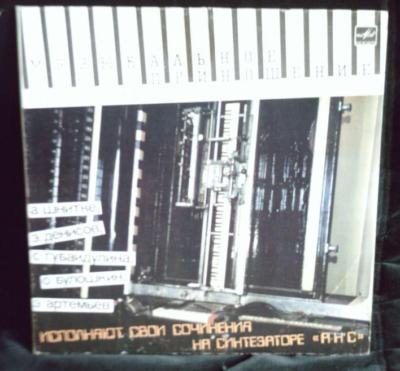
Musical Offering: Soviet Composers Perform Their Works On Synthesizer ANS-- Edward Artemiev: Mosaic (1968); Twelve Looks at the World of Sound (1970) / Alfred Schnittke: Stream (1969) / Edison Denisov: Birds' Singing / Sofiya Gubaidulina: Vivente-non Vivente / Oleg Buloshkin: Sacrament
label & cat. no.:
Melodiya C60 30721 000
pressed in:
USSRdate:
1990format:
LPcondition:
Vinyl: ex+
Cover: vg+
Fantastic ultra-rare gatefold lp (pressed in small numbers just as Melodiya was phasing out vinyl) containing stunning early electronic works composed entirely on the innovative ANS Synthesizer photoelectronic instrument during the 60s and early 70s; this is the only ever release of these recordings on vinyl. Inventor Eugeny Murzin designed the ANS in 1938 (naming it after composer Alexander N. Scriabin), but he was not able to fully realize its construction until 1958, when he established a studio and began commissioning composers. The ANS generates sound via an additive synthesis method adapted from the photo-optic sound recording technology used in film. It is capable of producing 720 pure tones (allowing for microtonal scales of 72 notes per octave) and requires the composer to literally draw sound waves onto a graphical score, a "coding field" in the form of a glass disc that is fed into the machine after it has been physically scraped and smeared by the composer to create the desired sounds. The ANS also features a keyboard for controlling its 20 bandpass amplifiers and a joystick for controlling tempo. The actual music on this lp is superb and truly lives up to the hype of the elusive Russian early electronic music you may have heard of but never had a chance to listen to; it compares to the greatest electronic music and musique concrete from this period, abounding in alien, reverb-soaked microtonal soundscapes showing the influence of Russian-American Vladimir Ussachevsky or Oskar Sala's trautonium work. Apparently these compositions were originally met with repression by the Soviet government and labeled as too elitist/avant garde, which is why they only began to be heard internationally after the collapse of the USSR (aside from on a few 60s and 70s Russian film soundtracks); over the years they have acquired a well-deserved legendary status. Only one ANS was ever constructed (it is still used today by a small group of composers at Moscow State University, and was recently used by industrial group Coil in the COILANS project). Includes extensive notes in Russian and a few short paragraphs in English. Some filler from the English: "Please, try to imagine a score sounding by itself without a conductor, orchestra even without musical instruments. This magic is possible by using musical synthesizer 'ANS'... a composer can not only create but even draw his music... You can see twinkling of different lamps, rotating of figured discs made of glass. Notes are cut on a glass disc covered with a special layer. The drawings on the glass are 'sounding notes.' To listen to the drawn picture you should press the button and a wonderful transformation will begin. The engraving will transfer into music..."
artist info from album notes:
Artemiev is an electronic composer known for his film scores (the ANS Synthesizer is featured prominently in his soundtracks to the great Andrei Tarkovsky films Solaris and The Mirror) as well as his later prog-rock experiments; he studied under Yuri Shaporin and worked at the Moscow Experimental Studio of Electronic Music where, thanks to the Studio's library of bootleg recordings smuggled past Soviet censors, he became influenced by Tangerine Dream, Herbert Eimert, Luciano Berio, Yes, King Crimson, Genesis, Klaus Schulze, Isao Tomita, Karlheinz Stockhausen, Luigi Nono, Pierre Schaeffer, Gyorgi Ligety, Edgard Varese, Milton Babbitt, Pierre Boulez, John Cage, Pierre Henry, Earle Brown, York Holler, Takehisa Kosugi, Steve Reich, and Henri Pousseur. Gubaydulina studied under Nikolay Peyko and Vissarion Shebalin, associated with Shostakovich, and founded the folk-improv group Astreja. Denisov studied engineering before music and was influenced by Shostakovich, Prokofiev, Stravinsky, Arnold Schoenberg, Luigi Nono, and Pierre Boulez. Schnittke worked as a film composer, studied with Yevgeny Golubev and Nikolai Rakov, and associated with Webern disciple Phillip Herschkowitz. This record needs to be heard by anyone interested in early electronic instruments and composers like Oskar Sala and his trautonium, Robert Moog, Donald Buchla/Morton Subotnick, Clara Rockmore and the Theremin, John Eaton and the Syn-Ket, Olivier Messiaen and the ondes Martenot, the Ondioline, Raymond Scott, Bruce Haack, Henry Cowell, Hugh Le Caine, Percy Grainger, Gottfried Michael Koenig, Bulent Arel, Otto Luening, Tom Dissevelt, Dick Raaijmakers, Luc Ferrari, Francois Bayle, Jean-Jacques Perrey, Gershon Kingsley, Tod Dockstader, etc., as well as the tradition of microtonal composers like Harry Partch, Ivan Wyschnegradsky, Lou Harrison, La Monte Young, Ben Johnston, Easley Blackwood, Glenn Branca, Alvin Lucier, Pauline Oliveros, Terry Riley, Charles Ives, Alois Haba, Julian Carrillo, James Tenney, Rhys Chatham, etc
Payment: Paypal, Cash (on your risk) or Bank Transfer
Shipping: Worldwide FREE shipping. REGRISTED, of course!
price rating