Rare (Sir Thomas Beecham,Bart) RCA RED SEAL RECORD SET
$
113


Favourite Auctions
To save auctions to your favourites, please login
If you don't have an account, please register
Description
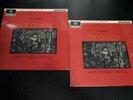
You are bidding on a "Very Rare" 3 Record set of (Sir Thomas Beecham, Bart. Conduting the Royal Philharmonie Orchestra These Records are RED see through Vinyl From RCA Victor RED SEAL COLLECTION" Have seen some Sets by this Condutor, Go at Auction in the $100,000 Range, This set will only go up as each year go's bye, I am selling off many rear collections of records right now,,,,, With a 100% Feedback Rateing on Ebay Since 2001 HAPPY BIDDING....
Record 1 insert # Cert-Side A is 49-0460-A Side B 49-0460-B Record 2 # Side A 49-0468-A Side B 49-0468-B Record 3 #Side A 49-0469-A Side B 49-0469-B ALL RECORDS in this set Numberded WDM 1311 on left side
The Red Seal label was begun in 1902 by the Gramophone Company in the United Kingdom and was quickly picked up by its United States affiliate, the Victor Talking Machine Company, and its president, Eldridge R. Johnson. Distinctive, red paper information labels affixed to the centre of the two affiliated companies' black shellac discs inspired the name. Led by the work of the great tenor Enrico Caruso, Victor's Red Seal Records changed the perception of recorded music. The first Caruso 10-inch, 78-rpm records were issued in the United States in 1903 and became wildly successful. Other legendary opera stars were soon attracted to the studios of the Gramophone Company and its affiliates in Europe, as well as to the studios of the Victor Talking Machine Company in the United States, thus consolidating Victor's place as the American market leader in recordings.
Early acoustic recordings could be a surprisingly good medium for capturing the sound of singing voices, male voices especially, but not for musical instruments. The introduction of "Orthophonic" electrical recording in 1925 allowed for the reproduction of music with better fidelity. In 1929, Victor was purchased by the Radio Corporation of America (RCA) and the company eventually became RCA Victor Records.
RCA Victor's Red Seal series continued its pre-eminence from the 1930s through the 1950s due partly to the recorded output of three of the leading conductors of the time, Serge Koussevitzky, Leopold Stokowski, and Arturo Toscanini. Nearly all of Toscanini's recordings were issued on Red Seal, most of them with the NBC Symphony Orchestra (NBC was a subsidiary of RCA at the time). Conductor Eugene Ormandy made his first recordings with the Philadelphia Orchestra for Red Seal, and returned to the label in 1968, after spending many years with Columbia Masterworks Records. Leonard Bernstein also made his first recordings for RCA. Another best-selling RCA Red Seal conductor was Arthur Fiedler, who made many recordings with the Boston Pops orchestra for the label.
In 1950 RCA finally began releasing long-playing vinyl gramophone records, or LPs (originally introduced by Columbia Records in 1948), because they were losing artists and sales due to the company's resistance to adopting the new format. Then, in 1954, RCA began experiments with stereophonic recording. Their first "Stereo Orthophonic" reel to reel tapes were issued in 1955. When stereo long-playing records first appeared in 1958, RCA introduced their highly regarded "Living Stereo" albums, many of which are available on CDs. During this period RCA was consistently seen as producing some of the finest-sounding recordings then available.