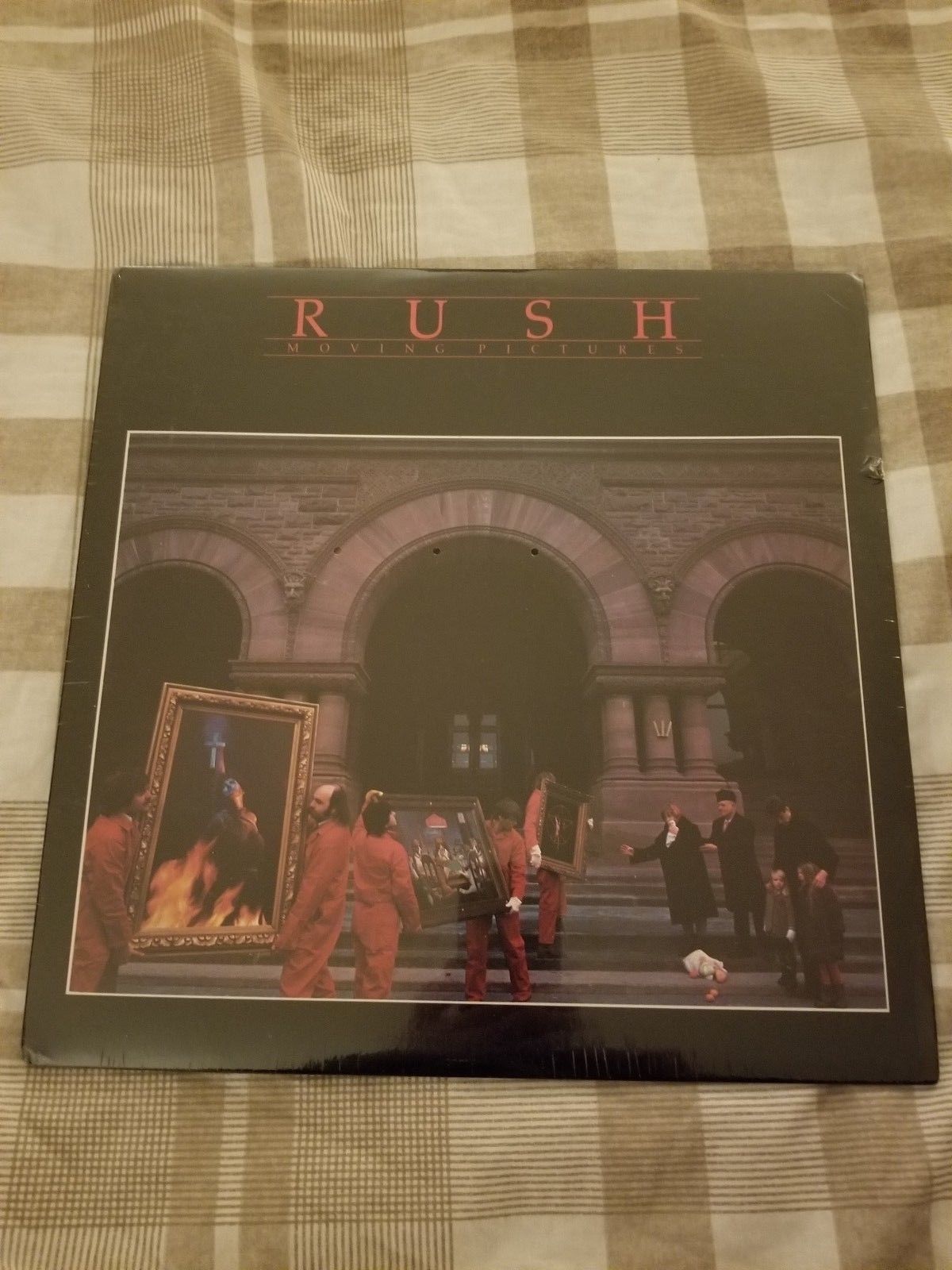
RUSH Moving Pictures Factory Sealed Never Opened Vinyl LP Record Album
$
43


Favourite Auctions
To save auctions to your favourites, please login
If you don't have an account, please register
Description
RUSH Moving Pictures Factory Sealed Never Opened Vinyl LP Record Album Unplayed Note there is a small half inch 'dent' in the album cover - located on the front right side, 3 inches from the top.
Moving Pictures (Rush album)
From Wikipedia, the free encyclopedia Moving Pictures Studio album by Rush Released February 12, 1981 Recorded October–November 1980 Studio Le Studio, Morin-Heights, Quebec, Canada Genre- Progressive rock
- hard rock
- Rush
- Terry Brown
(1980) Moving Pictures
(1981) Exit...Stage Left
(1981) Singles from Moving Pictures
- "Tom Sawyer"
Released: February 28, 1981 - "Limelight"
Released: February 28, 1981 - "Vital Signs"
Released: 1981
Moving Pictures is the eighth studio album by the Canadian rock band Rush, released on February 12, 1981 on Anthem Records. After touring to support their previous album, Permanent Waves (1980), the band started to write and record new material in August 1980 with co-producer Terry Brown. They continued to write songs with a more radio friendly format, featuring tighter song structures and songs of shorter length compared to their early albums.
Moving Pictures received a positive reception from current and retrospective music critics and became an instant commercial success, reaching number one in Canada and number 3 in the United States and the United Kingdom. It remains Rush's highest selling album in the United States after it was certified quadruple-platinum by the Recording Industry Association of America (RIAA) for over 4 million copies sold. "Limelight", "Tom Sawyer" and "Vital Signs" were released as singles across 1981, and the instrumental "YYZ" was nominated for a Grammy Award for Best Rock Instrumental Performance. Rush supported the album with a concert tour from September 1980 to July 1981.
Contents
[hide]- 1Production
- 1.1Recording
- 1.2Songs
- 1.3Artwork
- 2Release
- 2.1Commercial performance
- 2.2Reception
- 2.3Reissues
- 3Track listing
- 4Personnel
- 5Charts
- 5.1Weekly charts
- 5.2Singles
- 6Certifications
- 7References
- 8External links
Production[edit]
Recording[edit]
In June 1980, the band ended their ten-month tour of North America and the United Kingdom in support of their seventh studio album, Permanent Waves (1980). During the tour's stop in New York City, the band agreed to start work on a new studio album, rather than prepare a second live album from several recordings they set up during the tour, partly due to the ideas they were developing at sound checks interested them enough to put them onto tape.[1] Peart was instrumental in doing a new album, and Lee and Lifeson found themselves catching onto his enthusiasm. The trio pitched the idea to their manager and producer who had mapped out a two-year plan for them, but agreed to the sudden change and cancelled the schedule.[2] After a short break, they regrouped at Phase One Studios in Toronto, Canada in July 1980 with members of rock band Max Webster to record "Battlescar" for their album. During the sessions, their lyricist Pye Dubois suggested a song that he thought was suitable for Rush to record which was developed into "Tom Sawyer".[1] Rush then moved to Stony Lake, Ontario to write and prepare material for their new album. The sessions were productive, with "The Camera Eye" the first song to be worked on, followed by "Tom Sawyer", "Red Barchetta", "YYZ" and "Limelight".[1] Following the initial writing sessions, Rush returned to Phase One Studios with their co-producer Terry Brown and prepared demos of the songs. The band worked on them further during rehearsals of their 1980–1981 tour which began in September, and included "Tom Sawyer" and "Limelight" in their live set prior to recording.[1]
With the material fully prepared, Rush recorded Moving Pictures in October and November 1980 at Le Studio in Morin-Heights, Quebec.[1] By the time they started the studio was fitted out with a digital 48-track machine, both of which were unfamiliar to the band at first and spent some time familiarising themselves with using the equipment.[3] Moving Picturesis Brown's first digitally-produced album.[3] The band made a conscious effort to preserve the quality of their recordings as much as possible by transferring finished sections onto a fresh piece of tape and placing the original copy in storage, thereby reducing the damage to it from frequent playback.[3] During the sessions they experimented with a pressure zone microphone, a type of boundary microphone that picks up direct sound and no reverberated signals, that was taped onto Peart's chest as he played. The audio captured from it was used to pick up the ambience in the studio room in the final mix.[4] Peart wore the microphone for the filming of the music video to "Vital Signs".[4] "Red Barchetta" was recorded in one take. There were problems with equipment failures and they finished the album three days behind schedule.[1]
Songs[edit]
"Tom Sawyer" features a backbeat in a 4/4 time signature with its instrumental and closing sections in seventh notes. Peart described the track as "an enjoyable work" which took around a day and a half to record, "collapsing afterwards with raw, red, aching hands and feet".[4] Its instrumental section grew from what Lee would play on his synthesiser during sound checks on tour, which initially was forgotten about until the band traded ideas on what the section should be.[1] It became one of the best known songs by Rush and a mainstay of subsequent live shows.
Peart's lyrics to "Red Barchetta" were inspired by the short story "A Nice Morning Drive" by Richard S. Foster, originally written in the November 1973 edition of the American car magazine Road & Track.[5] Lee described the tale as "Orwellian in nature" which deals with an individual taking their Barchetta on a fast ride despite the banning of high speeds, and is chased after by hovering patrol cars for breaking the rule.[3] Instead of an MGB roadster as featured in the original story, Peart reported the Ferrari 166 MM Barchetta was the car that inspired the song's title. In 2007, Foster and Peart met for the first time and shared their mutual interest of BMW motorcycles, which was documented in an article titled "The Drummer, The Private Eye, and Me".
"YYZ" is an instrumental titled after the IATA Airport Code for Toronto Pearson International Airport, with its rhythm a mirror of the letters "YYZ" in Morse code (-.--/-.--/--..).[4] It stemmed from the band's enjoyment of recording "La Villa Strangiato", a nine-minute instrumental on Hemispheres (1978), which they wanted to do again for Moving Pictures only shorter.[3] The code was adapted into the song's rhythm of a 5/4 time signature, where the dashes (-) are played using eighth notes and the dots (.) use sixteenth notes.
The lyrics to "Limelight" are autobiographical and based on Peart's own dissatisfaction with fame and its intrusion into one's personal life. The song contains two self-references: the first, the line "living in a fish-eye lens, caught in the camera eye" references the album's following track, "The Camera Eye", while the line "all the world's indeed a stage, and we are merely players", references the title of the band's first live album All the World's a Stage (1976), itself taken from William Shakespeare's comedy play As You Like It.
"The Camera Eye" is a two-part track with sections titled "New York" and "London". Peart wrote the lyrics after taking walks in both cities, recalling observations and the rhythms he felt during them.[3] It remains the band's last song with a duration over 10 minutes, a frequent occurrence in their earlier albums. Its title refers to short pieces of the same name in the U.S.A. trilogy of novels written by American writer John Dos Passos, one Passos's works that Peart admired.
"Witch Hunt" opens with faint voices, which Lifeson explained were recorded outside Le Studio in sub-zero temperatures with the band and others shouting in a humorous way, and sound effects produced by a synthesizer, before transitioning into the song proper. It features cover designer Hugh Syme on synthesizer[6] and double-tracked drums in one verse. "Witch Hunt" would become a part of the Fear series of songs, which includes "The Weapon" from Signals (1982), "The Enemy Within" from Grace Under Pressure, and "Freeze" from Vapor Trails.
"Vital Signs" features a sequencer part produced by an Oberheim OB-X synthesizer, and shows distinct reggae flavour. Reggae influences in Rush's music were first heard on Permanent Waves, and would later be heard more extensively on their next two albums.
Artwork[edit]
The Ontario Legislature in Queen's Park, Toronto, pictured on the album's front coverThe album cover is a monument to triple entendre. On the front cover there are movers who are moving pictures. On the side, people are shown crying because the pictures passing by are emotionally "moving". Finally, the back cover has a film crew making a "moving picture" of the whole scene.[7] The album cover was taken in front of the Ontario Legislative Building at Queen's Park, Toronto. The pictures that are being moved are the starman logo featured on the reverse cover of 2112 (1976), one of the famous Dogs Playing Poker paintings entitled A Friend in Need, and a painting that presumably shows Joan of Arc being burned at the stake on May 30, 1431.
Mike Dixon, one of the movers on the cover of Moving Pictures and the band's next album, Exit...Stage Left (1981), discussed the various people on the Moving Pictures cover. The first, Bobby King, seen furthest to the left on the album cover, was a member of Hugh Syme's design team, and is credited for assisting Syme on A Farewell to Kings, Hemispheres and Archives. Dixon explained that King is not only one of the movers, but also the original Starman on 2112 and Dionysus (the nude man) on the Hemispheres cover. The mover holding the Starman painting is Kelly Jay, singer of the Toronto band Crowbar who performed a show with Rush in 1973, an advertisement for which is printed in the liner notes to Different Stages (1976). Dixon confirmed photographer Deborah Sammuels is the Joan of Arc character, and her relatives are the family on the right. However, this conflicts with information provided in the Rush biography Chemistry which states: "Hugh borrowed friends, neighbours and even his hairdresser's parents".[8] The film crew on the back cover actually shot the scene with film stock, from which the album's front cover is a single frame taken from it. This was revealed to Rush concertgoers several years later when the still image was projected on a large screen behind the band, and then suddenly came to life as a motion picture sequence.
Release[edit]
Commercial performance[edit]
Moving Pictures was played in its entirety during Lee's visit to Rick Ringer's radio show on CHUM-FM in Toronto, on February 11, 1981.[3] The album was released on the following day.
Reception[edit]
Professional ratings Review scores Source Rating AllMusic [9] The Rolling Stone Album Guide [10]Kerrang! magazine listed the album at #43 among the "100 Greatest Heavy Metal Albums of All Time".[11] In 2012, Moving Pictures was listed as #10 on 'Your Favorite Prog Rock Albums of All Time' by Rolling Stone.[12] In 2014, readers of Rhythm voted Moving Picturesthe greatest drumming album in the history of progressive rock.[13] Moving Pictures and 2112 (1976) are two Rush albums listed in 1001 Albums You Must Hear Before You Die.[14]
Moving Pictures was played live in its entirety for the first time to open the second set during each show of Rush's 2010–11 Time Machine Tour.[15]
Reissues[edit]
The album was released on compact disc in 1984 by Mercury Records. Initial pressings were missing the first beat of "Tom Sawyer" by mistake, but were corrected in subsequent releases.[16] In 1997, Mercury Records released a digital remastered version. The disc tray has a logo of three fingerprints with "The Rush Remasters" printed, a feature of all remastered albums from Moving Pictures through A Show of Hands, originally found on the cover of Retrospective II. The remaster restores all of the original artwork and lyrics found on the vinyl release, and includes the moving picture of Peart which was missing on the original CD issue.
Moving Pictures was remastered twice in 2011. The first, by Andy VanDette, was for the "Sector" box sets which re-released all of Rush's Mercury-era albums. It is included in the Sector 2 box set.[16] The second reissue was in April 2011 as 2-disc 30th anniversary set. The first disc contains the standard stereo mix and the second, available as a DVD-Audioor Blu-ray disc, contains the album in a stereo and 5.1 surround sound mix with music videos as the three singles as bonus features.[17]
In 2015, Moving Pictures was remastered for vinyl as part of the "12 Months of Rush" promotion.[18] The mastering was also made available in a 24-bit/48kHz digital format on various high-resolution online music stores. These remasters have less dynamic range compression than the 1997 and 2011 versions. Sean Magee remastered the album from an analogue copy of the original digital master tape using a 192kHz sample rate. However, as Moving Pictures was originally mixed on digital equipment at 16-bit/44.1kHz, no audio above 22kHz exists in the original master or any of the remasters, which explains why many digital music stores only sell the album with 48kHz as the maximum available rate.[19]
Track listing[edit]
All lyrics written by Neil Peart except where noted; all music composed by Alex Lifeson and Geddy Lee except where noted.
Side one No. Title Length 1. "Tom Sawyer" (Peart and Pye Dubois) 4:34 2. "Red Barchetta" 6:10 3. "YYZ" (Lee, Peart; instrumental) 4:26 4. "Limelight" 4:20 Side two No. Title Length 5. "The Camera Eye"- I: "New York"
- II: "London"
Personnel[edit]
Credits are adapted from the album's 1981 liner notes.[6]
Rush
- Geddy Lee – bass guitars, synthesizers (Oberheim polyphonic, Oberheim OB-X, Minimoog, and Moog Taurus pedals), bass pedals, lead vocals
- Alex Lifeson – 6- and 12-string electric and acoustic guitars, Moog Taurus pedals
- Neil Peart – drums, timbales, gong, orchestra bells, glockenspiel, wind chimes, bell tree, crotales, cowbell, plywood
Additional musician
- Hugh Syme – synthesizer on "Witch Hunt"
Production
- Rush – production, arrangements
- Terry Brown – production, arrangements
- Paul Northfield – engineering
- Robbie Whelan – assistant engineering
- Albert, Huey, Dewey, Huey – computerized companions
- Peter Jensen – digital mastering, editing
- Bob Ludwig – mastering and remastering
- Hugh Syme – art direction, graphics, cover concept
- Deborah Samuel – photography
Charts[edit]
Weekly charts[edit]
Year Chart Position 1981 Canadian Albums Chart 1[20] Billboard 200 3[21] UK Albums Chart 3[22]Singles[edit]
Information[23] "Limelight"- Released: February 1981
- Written by: Geddy Lee, Alex Lifeson and Neil Peart
- Produced by: Rush and Terry Brown
- Chart positions: #55 US Hot 100; #4 US Mainstream Rock
- Released: October 1981
- Written by: Geddy Lee, Alex Lifeson, Neil Peart and Pye Dubois
- Produced by: Rush and Terry Brown
- Chart positions: #44 US Hot 100; #8 US Mainstream Rock; #25 UK
- Released: March 1982
- Written by: Geddy Lee, Alex Lifeson and Neil Peart
- Produced by: Rush and Terry Brown
- Chart positions: #41 UK
Certifications[edit]
Country Organization Sales U.S. RIAA 4x Platinum (4,000,000) Canada RIAA 4x Platinum (400,000) UK BPI Silver (60,000)price rating


![The Beatles in Mono [Vinyl Box Set] by The Beatles (Vinyl)](https://www.popsike.info/php/thumbnail.php?url=https://www.popsike.pics/pix/20240111/176171734965.jpg)




![Various Artists - Supafunkanova Vol.3 Compiled By Woody Bianchi [2LP]](https://www.popsike.info/php/thumbnail.php?url=https://www.popsike.pics/pix/20250301/167347972141.jpg)