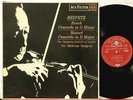
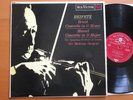
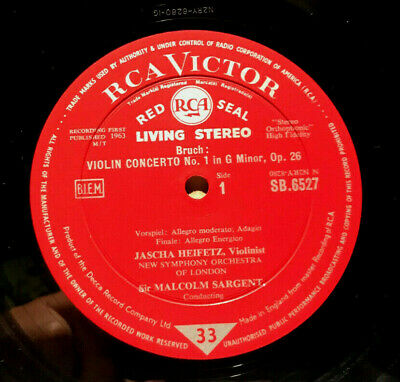
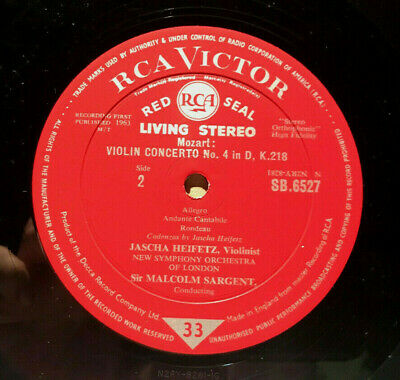
RCA LP SB-6527: Jascha HEIFETZ - Bruch / Mozart Violin Concertos, 1963 UK 1st Ed
$
700
Favourite Auctions
To save auctions to your favourites, please login
If you don't have an account, please register
Description
****Welcome to our listing, thanks very much for looking!
****See our own website! We have lots of out of print LPs and CDs! Find us on the web at -
hearthedifference.net
****Please see our other listings - new items added daily!
****Shipping cost is only an estimate - it depends on the actual weight and size of the package as well as the service required. We do not profit from shipping costs, so if we overcharge, we will refund the difference back to you. It's always best to wait for our invoice before paying for your item. We will combine shipping for multiple items purchased.
Background -
Jascha Heifetz (2 February [O.S. 20 January] 1901 – 10 December 1987) was a Russian born violinist. Many consider him to be the greatest violinist of all time. Born in Wilno, Russian Empire (present-day Vilnius, Lithuania), he moved as a teenager to the United States, where his Carnegie Hall debut was rapturously received. He was a virtuoso since childhood—Fritz Kreisler, another leading violinist of the twentieth century, said on hearing Heifetz's debut, "We might as well take our fiddles and break them across our knees."He had a long and successful performing and recording career; after an injury to his right (bowing) arm, he focused on teaching.
Heifetz and his family left Russia in 1917, traveling by rail to the Russian far east and then by ship to the United States, arriving in San Francisco. On 27 October 1917, Heifetz played for the first time in the United States, at Carnegie Hall in New York, and became an immediate sensation. Fellow violinist Mischa Elman in the audience asked "Do you think it's hot in here?", whereupon the pianist Leopold Godowsky, in the next seat, imperturbably replied, "Not for pianists."
In 1917, Heifetz was elected as an honorary member of Phi Mu Alpha Sinfonia, the national fraternity for men in music, by the fraternity's Alpha chapter at the New England Conservatory of Music in Boston. As he was aged 16 at the time, he was perhaps the youngest person ever elected to membership in the organization. Heifetz remained in the country and became an American citizen in 1925. An apocryphal story circulates that tells of an interaction with one of the Marx brothers: when he told the brother (usually Groucho or Harpo) that he had been earning his living as a musician since the age of seven, he received the reply, "Before that, I suppose, you were just a bum."
In 1954, Heifetz began working with pianist Brooks Smith, who would serve as Heifetz's accompanist for many years until he chose Dr. Ayke Agus as his accompanist. He was also accompanied in concert for more than 20 years by Emmanuel Bay, another immigrant from Russia and a personal friend. Heifetz's musicianship was such that he would demonstrate to his accompanist how he wanted passages to sound on the piano, and would even suggest which fingerings to use.
After the seasons of 1955–56, Heifetz announced that he would sharply curtail his concert activity, saying "I have been playing for a very long time". In 1958, he tripped in his kitchen and fractured his right hip, resulting in hospitalisation at Cedars of Lebanon Hospital, and a near fatal staphylococcus infection. He was invited to play Beethoven at the United Nations General Assembly, and entered leaning on a cane. By 1967, Heifetz had considerably curtailed his concert performances.
Heifetz was "regarded as the greatest violin virtuoso since Paganini," wrote Lois Timnick of the Los Angeles Times. "He set all standards for 20th-century violin playing...everything about him conspired to create a sense of awe," wrote music critic Harold Schonberg of the New York Times. "The goals he set still remain, and for violinists today it's rather depressing that they may never really be attained again," wrote violinist Itzhak Perlman.
-
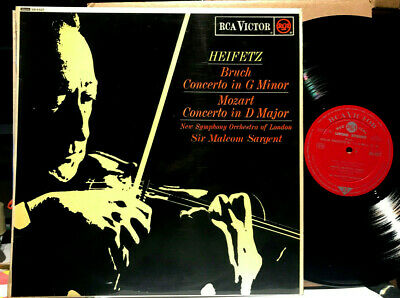
LP issued by RCA Victor Records, in the UK / England / Great Britain, actually made by DECCA Records
-
LP released in 1963
-
LP is recorded in STEREO
-
Record Catalog Number: SB 6527
-
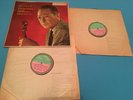
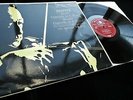
Record Labels are primarily RED with SILVER lettering.
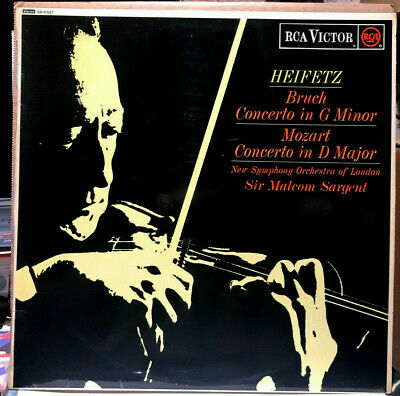
Bruch / Mozart // Jascha Heifetz / Sir Malcolm Sargent
Bruch: Violin Concerto No. 1 in G minor, Op. 26
Mozart: Violin Concerto No. 4 in D Major, K.218
Track Listing -Bruch: Concerto No. 1 In G Minor, Op. 26
A1. Vorspiel. Allegro Moderato; Adagio
A2. Adagio
A3. Finale. Allegro Energico
Mozart: Violin Concerto No. 4 In D Major K 218
B1. Allegro
B2. Andante Cantabile
B3. Rondeau
Performers / Credits / Other Information -
• Record Company – The Decca Record Company Limited
• Printed By – Robert Stace
• Copyright (c) – Radio Corporation Of America
• Mastered At – Decca Studios
• Made By – British Celanese Limited
• Composed By – Bruch (tracks: A1 to A3), Mozart (tracks: B1 to B3)
• Conductor – Sir Malcolm Sargent
• Engineer – K. E. Wilkinson
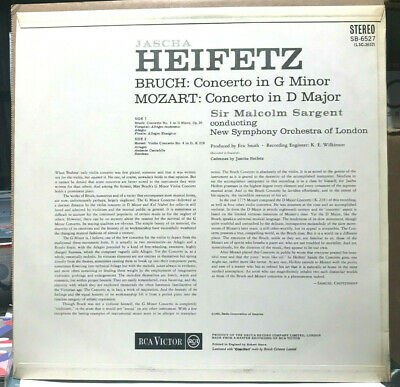
• Liner Notes – Samuel Chotzinoff
• Mastered By – Ted Burkett
• Orchestra – New Symphony Orchestra Of London
• Producer – Erik Smith
• Violin – Heifetz
Recorded in England
• Matrix / Runout (Label side A): N N2RY-8280
• Matrix / Runout (Label side B): N N2RY-8281
• Matrix / Runout (Runout side A): N2RY-8280-1G 1 U
• Matrix / Runout (Runout side B): N2RY-8281-1G 1 B
• Rights Society: B.I.E.M.
CONDITION Details:
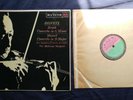
The LP jacket is in near mint minus condition. The jacket is tight and clean, with NO seam splits, NO discoloration or hand writing and NO cut out marks. The corners are solid. The colors on the jacket are sharp and clean. The jacket has the flipped over straight edge seams at the top and bottom. The front is covered in clear plastic or "clairifoil", the back does not have any clear plastic. The corners and seams show slight shelf wear due to aging - see pictures with this listing for more detail as they are of the actual item.
The LP is in near mint minus overall condition! This is the earliest or first edition of this item. There are no serious marks on the vinyl. This is the nicest copy we have ever had. There are no serious marks on the LP. The LP may have just some slight spider marks, which are caused by sliding the LP in and out of the original inner sleeve. Most of the time, these types of marks are not audible, but it really depends on the sensitivity of your audio gear. Considering the vintage of this LP, the vinyl looks superb! However, this is not a new audiophile LP....some extraneous sound is inevitable and should be expected for a vintage LP. A record from the 1960s is rarely perfect. However this LP retains much of the original gloss and sheen! There are NO serious spindle marks on the record labels either - a true archival copy. For best results, always CLEAN your LPs before auditioning them.A Short Note About LP GRADING -
- Mint = Only used for sealed items.
- Near Mint = Virtually flawless in every way.
- Near Mint Minus = Item has some minor imperfections, some audible.
- Excellent = Item obviously played and enjoyed with some noise.
- Very Good Plus = Many more imperfections which are noticeable and obtrusive.
For best results, always thoroughly clean your LPs before playing them.
LPs can be audiophile quality pressings (any collector of fine MFSL, half speeds, direct to discs, Japanese/UK pressings etc., can attest to the difference a quality pressing can make to an audio system).
Do not let this rarity slip by!price rating
![Kind of Blue [180-Gram Vinyl with Bonus CD] by Davis, Miles (Record, 2020)](https://www.popsike.info/php/thumbnail.php?url=https://www.popsike.pics/pix/20240716/235655393125.jpg)