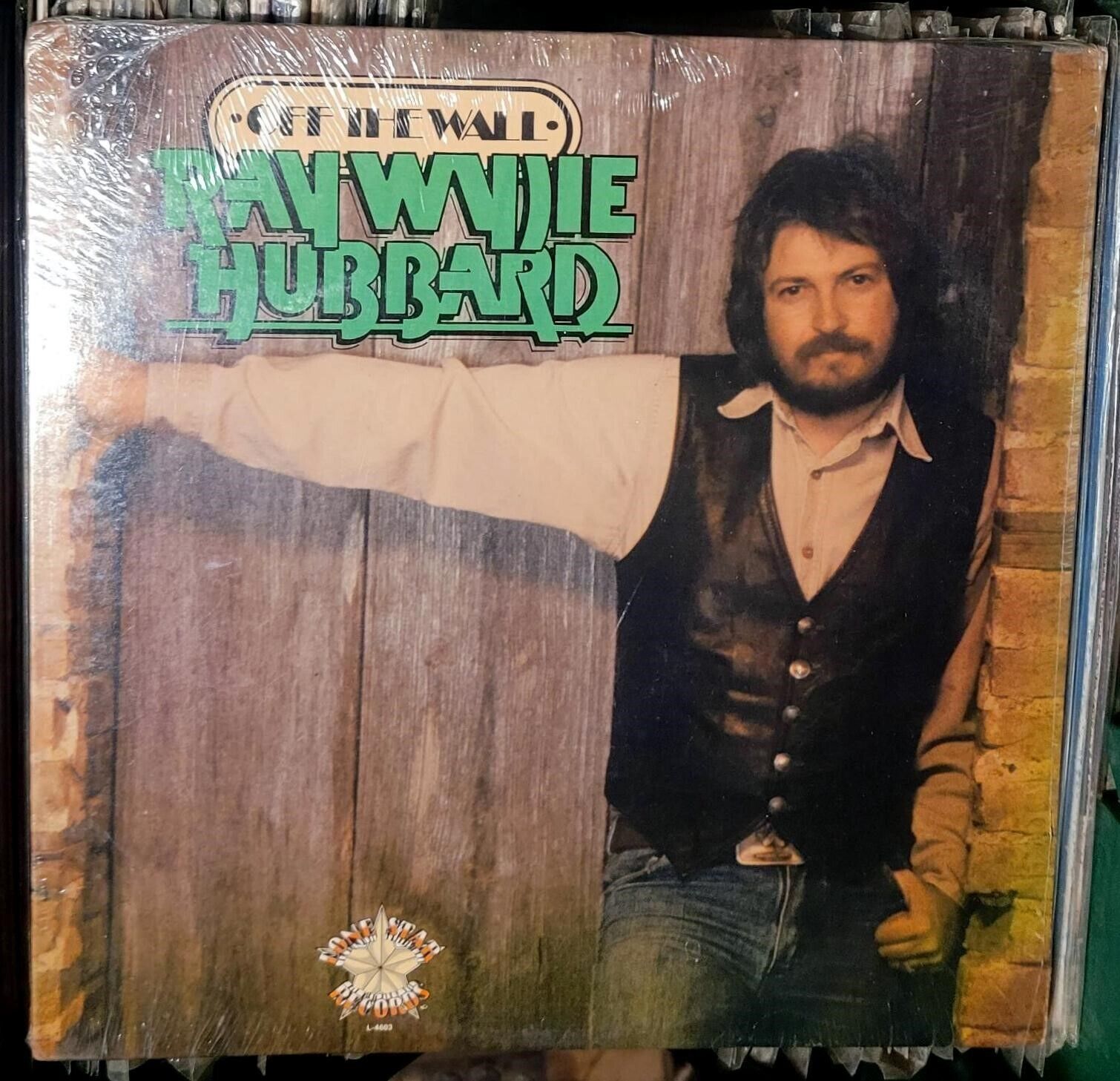
RAY WYLIE HUBBARD Off the Wall STILL SEALED 1978 LP Texas Outlaw Americana
$
78


Favourite Auctions
To save auctions to your favourites, please login
If you don't have an account, please register
Description
Record: Mint (M) Still Sealed! Cover: Very Good Plus (VG+) Labels: Clean! Ray Wylie Hubbard Off the Wall 1978 United States Lone Star L-4603 12" Stereo 33 RPM Vinyl LP SB-60686
Ray Wylie Hubbard
Off the Wall
1978 United States Lone Star 12" LP Vinyl Record
Gift Quality Still Sealed As New Classic Texas Americana
Condition
Vinyl: Mint (M) Still Sealed!
Sleeve: Very Good Plus (VG+) some light bends at lower left, shrink torn at lower opening with slight wear, otherwise no cuts or marks
Please see item specifics section above for more details
Tracks:
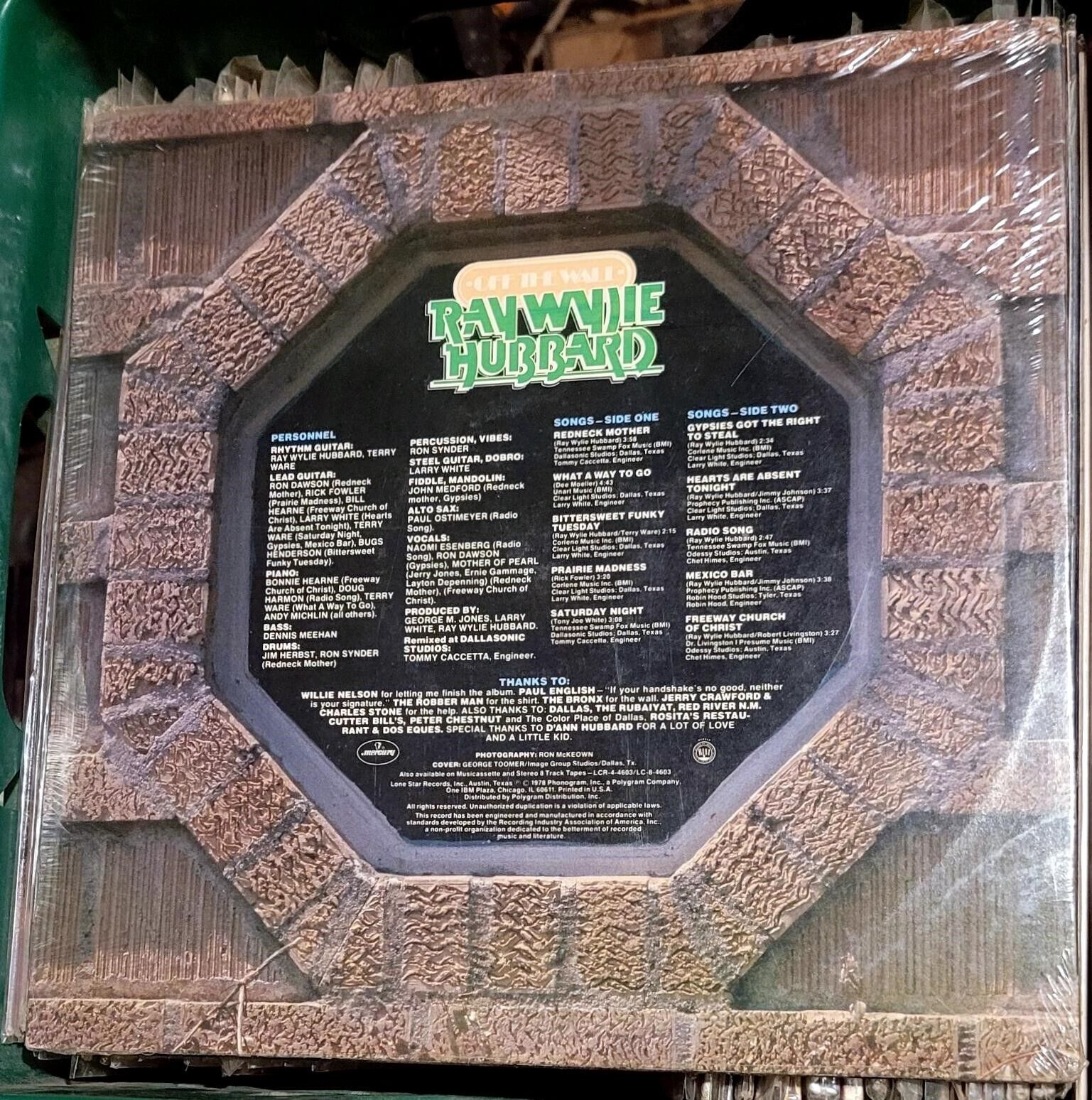
Ray Wylie Hubbard – Off The Wall Label: Lone Star – L-4603 Format: Vinyl, LP, Album Country: US Released: 1978 Genre: Rock, Funk / Soul, Blues, Folk, World, & Country Style: Blues Rock, Country, Texas Blues, Country Rock, Swamp Pop, Gospel A1 Redneck Mother Songwriter – Ray Wylie Hubbard 3:58 A2 What A Way To Go Songwriter – Dee Moeller 4:43 A3 Bittersweet Funky Tuesday Songwriter – Ray Wylie Hubbard, Terry "Buffalo" Ware 2:15 A4 Prairie Madness Songwriter – Rick Fowler (6) 3:20 A5 Saturday Night Songwriter – Tony Joe White 3:08 B1 Gypsies Got The Right To Steal Songwriter – Ray Wylie Hubbard 2:34 B2 Hearts Are Absent Tonight Songwriter – Jimmy Johnson (30), Ray Wylie Hubbard 3:37 B3 Radio Song Songwriter – Ray Wylie Hubbard 2:47 B4 Mexico Bar Songwriter – Jimmy Johnson (30), Ray Wylie Hubbard 3:38 B5 Freeway Church Of Christ Songwriter – Ray Wylie Hubbard, Robert Livingston 3:27 Record Company – Lone Star Records, Inc. Phonographic Copyright ℗ – Phonogram, Inc. Copyright © – Phonogram, Inc. Manufactured By – Phonogram, Inc. Marketed By – Phonogram, Inc. Distributed By – PolyGram Distribution, Inc. Remixed At – Dallasonic Studios Lacquer Cut At – Masterdisk Bass – Dennis Meehan Cover – George Toomer Drums – Jim Herbst Drums, Percussion – Ron Synder Fiddle, Mandolin – John Medford Lacquer Cut By – G.K.* Lead Guitar – Bill Hearne, Bugs Henderson, Rick Fowler (6), Ronnie Dawson Lead Guitar, Steel Guitar, Dobro – Larry White (4) Photography By – Ron McKeown Piano – Andy Michlin, Bonnie Hearne, Doug Harmon* Producer – George M. Jones, Larry White (4), Ray Wylie Hubbard Rhythm Guitar, Lead Guitar, Piano – Terry Ware* Rhythm Guitar, Vocals – Ray Wylie Hubbard
RAY WYLIE HUBBARD Off the Wall STILL SEALED 1978 LP Texas Outlaw Americana Ray Wylie Hubbard (born November 13, 1946) is an American singer and songwriter. Early life Hubbard was born on November 13, 1946, in Soper, Oklahoma.[2] His family moved to Oak Cliff in southwest Dallas, Texas, in 1954. He attended W. H. Adamson High School with Michael Martin Murphey.[3] Hubbard graduated in 1965 and enrolled in North Texas State University (now the University of North Texas) as an English major. He spent the summers in Red River, New Mexico, playing folk music in hootenannies with a trio known as Three Faces West.[4] Career 1970s During his time in New Mexico, Hubbard wrote "Up Against the Wall, Redneck Mother"[4] first made famous by Jerry Jeff Walker's 1973 recording, and covered by a wide variety of other artists since.[5] Bolstered by the success of the song, he was signed by Warner Bros. Records. Hubbard then assembled a band of friends and locals and, in 1976, released Ray Wylie Hubbard and the Cowboy Twinkies.[6] Unbeknownst to Hubbard, producer Michael Brovsky had decided to "Nashville-ize" the sound by adding overdub mixes and female backup singers to the recordings. The result was "a botched sound" that Hubbard disapproved of vehemently, but the album was released despite his attempts to block it.[4] 1980s Hubbard then recorded albums for various other labels for the next decade, but struggled with the sales of his mix of country, folk and blues.[7] The last album he recorded in the 1980s was Caught in the Act (1984) on his newly formed Misery Loves Company record label. 1990s and beyond Hubbard performing in 2009 He returned to recording in the early 1990s, and released his album Lost Train of Thought in 1992,[4] followed by Loco Gringo's Lament in 1994. Eventually a steady following began to re-discover Hubbard's music and he has been recording steadily since. He describes his 2017 album Tell the Devil I'm Getting There as Fast as I Can as rock & roll, though his style has become associated with outlaw country.[8] Discography 1975 Ray Wylie Hubbard and the Cowboy Twinkies – Warner Bros. Records[6] 1978 Off the Wall – Lone Star Records/Mercury/Polygram[9] 1979 Something About the Night – Renegade Records 1984 Caught in the Act – Misery Loves Company Records 1992 Lost Train of Thought – Misery Loves Company/DejaDisc Records 1994 Loco Gringo's Lament – Misery Loves Company/DejaDisc Records 1997 Dangerous Spirits – Rounder/Philo Records[10] 1998 Live at Cibolo Creek – Misery Loves Company Records 1999 Crusades of the Restless Knights – Rounder/Philo Records 2001 Eternal and Lowdown – Rounder/Philo Records[11] 2003 Growl – Rounder/Philo Records[11] 2005 Delirium Tremolos – Rounder/Philo Records 2006 Snake Farm – Sustain Records[12] 2010 A. Enlightenment B. Endarkenment (Hint: There is No C) – Bordello Records (Thirty Tigers/RED) 2012 The Grifter's Hymnal – Bordello Records (Thirty Tigers/RED)[13] 2015 The Ruffian's Misfortune – Bordello Records (Thirty Tigers/RED) 2017 Tell the Devil That I'm Getting There As Fast As I Can – Bordello Records (Thirty Tigers/RED)[8][14] 2020 Co-Starring – Big Machine Records 2022 Co-Starring Too – Big Machine Records – Released March 18, 2022 Texas country singer and songwriter, born November 13, 1946 in Soper, Oklahoma, USA. Hubbard grew up in town of Hugo, Oklahoma. His family moved to Oak Cliff in south Dallas, Texas in 1954. Ray Wylie Hubbard is an American singer, songwriter, and musician known for his significant contributions to the genres of country, folk, and blues music. Here's an overview of his career and notable aspects: Early Life and Career: Born on November 13, 1946, in Soper, Oklahoma, Hubbard moved to Oak Cliff, Dallas, Texas, as a child. He attended W. H. Adamson High School with Michael Martin Murphey and later enrolled at North Texas State University (now the University of North Texas) as an English major. His musical journey began in New Mexico during the summers, where he played folk music in hootenannies with a group named Three Faces West. Breakthrough Song: Hubbard is most famously known for writing "Up Against the Wall, Redneck Mother," which became iconic after Jerry Jeff Walker recorded it in 1973. This song brought him initial recognition and led to a record deal with Warner Bros. Records. However, his debut album with the Cowboy Twinkies was not well received due to unwanted production changes. Music Style and Influence: Hubbard's music style blends elements of folk, country, blues, and rock, often characterized by his unique, gravelly voice and poetic, sometimes humorous lyrics. His work has been described as outlaw country, though he himself has referred to some of his music, like his 2017 release "Tell the Devil I'm Getting There as Fast as I Can," as rock & roll. Career Revival: After struggles with alcohol and a less successful initial phase in his career, Hubbard made a comeback in the 1990s, particularly with albums like "Lost Train of Thought" (1992) and "Loco Gringo's Lament" (1994). His later work in the 2000s and beyond has been critically acclaimed, with albums like "The Grifter's Hymnal" (2012) and "The Ruffian's Misfortune" (2015). Awards and Recognition: Over the years, Hubbard has received various accolades for his songwriting and music. His contributions have been acknowledged by the Texas music scene and broader music community, with performances on platforms like NPR's "Mountain Stage" and appearances on Austin City Limits. Literature and Other Works: In addition to his musical career, Hubbard has ventured into writing. His autobiography, "A Life... Well, Lived," published in 2015, provides insights into his life and career. He's also featured in books and documentaries related to the Texas music scene. Current Activities: Ray Wylie Hubbard continues to perform, write new music, and engage with fans. He has moved between Texas and New Mexico, maintaining a strong connection with both places. His live performances are known for their storytelling and engaging nature. Cultural Impact: Hubbard is often cited as a "songwriter's songwriter," respected for his craftsmanship and influence on younger musicians. His songs have been covered by numerous artists, reflecting his broad impact on American music. Hubbard's career illustrates the journey of an artist who has evolved and adapted, maintaining relevance through decades with his authentic, often self-deprecating, and always engaging musical narrative. Country Americana Music is a genre that blends elements of traditional country music with the broader, more eclectic sounds of Americana, creating a rich tapestry of musical expression. Here's an overview of this genre: Origins and Definition: Country Music: Originating from folk and blues, country music has its roots in the Southern United States, characterized by simple melodies, often with themes of love, heartbreak, rural life, and storytelling. Americana Music: A term coined in the 1990s, Americana is an umbrella genre encompassing various styles rooted in American traditional music but with a modern twist. It includes elements of folk, bluegrass, country, blues, rockabilly, and roots rock. Fusion: Country Americana is where these two overlap, often featuring acoustic instruments, storytelling through lyrics, and a focus on authenticity and musicianship. It's less commercial than mainstream country, offering a more roots-oriented sound. Key Characteristics: Instrumentation: Acoustic guitars, banjos, mandolins, fiddles, pedal steel guitars, and harmonica are common. The music often values live performance and organic sound over studio polish. Lyrics and Themes: Songs frequently explore personal narratives, historical events, social commentary, or the American experience, with a poetic or narrative quality. Musical Style: Embraces a wide range of influences but typically maintains a connection to traditional sounds while allowing for experimentation. The music can be introspective, gritty, or nostalgic. Notable Artists: Early Influencers: Artists like Gram Parsons, Emmylou Harris, and Johnny Cash have been pivotal in blending country with other American music forms, laying groundwork for Americana. Contemporary Figures: Jason Isbell - Known for his introspective songwriting and storytelling. Sturgill Simpson - Combines traditional country with rock, soul, and outlaw country elements. Lucinda Williams - Her music blends folk, rock, blues, and country with strong lyrical content. Chris Stapleton - Although mainstream successful, his roots are deeply embedded in Americana with his soulful voice and songwriting. Brandi Carlile - Her music touches on Americana with its emotional depth and folk roots. Bands: The Avett Brothers, Old Crow Medicine Show, and The Band have also contributed significantly to this genre. Cultural Impact: Festivals: Events like the Americana Music Festival & Conference in Nashville highlight the genre's growth and community. Other festivals like Telluride Bluegrass Festival or MerleFest also feature a lot of Country Americana acts. Radio and Media: Stations like SiriusXM's The Spectrum or Outlaw Country, and shows like "eTown" or "AmericanaFest" help spread the music. Awards: The Americana Music Honors & Awards recognize achievements in this genre, showcasing its increasing recognition. Current Trends: Diversity in Sound: There's a broad spectrum within Country Americana, with artists increasingly mixing in indie rock, folk, and even hip-hop elements. Revival of Roots: There's a noted revival in interest in traditional sounds, with modern artists reinterpreting old country songs or writing in a style reminiscent of the '60s and '70s country. Digital Age: Streaming platforms have allowed for greater exposure, with curated playlists often featuring Country Americana under various sub-genres like 'Alt-Country' or 'Roots Music.' Country Americana music continues to evolve, offering listeners a connection to America's musical past while pushing the boundaries of what country music can be in the contemporary era. Americana (also known as American roots music)[1] is an amalgam of American music formed by the confluence of the shared and varied traditions that make up the musical ethos of the United States of America, with particular emphasis on music historically developed in the American South. Definition The term "Americana music" was defined by the Americana Music Association (AMA) in 2020 as "…the rich threads of country, folk, blues, soul, bluegrass, gospel, and rock in our tapestry."[2] A previous 2016 AMA definition of the genre included rhythm and blues, with additional comments that Americana music results "in a distinctive roots-oriented sound that lives in a world apart from the pure forms of the genres upon which it may draw. While acoustic instruments are often present and vital, Americana also often uses a full electric band."[3] History Prehistory: Roots music The origins of Americana music can be traced back to the early 20th century, when rural American musicians began incorporating elements of folk, blues, and country music into their songs.[4] Americana musicians often played acoustic instruments such as the guitar, banjo, fiddle, and upright bass, and their songs typically told stories about the struggles and hardships of everyday life.[5] Folk music revival Pete Seeger in 1955 The American folk music revival began during the 1940s and peaked in popularity in the mid-1960s. The folk revival in New York City was rooted in the resurgent interest in square dancing and folk dancing there in the 1940s as espoused by instructors such as Margot Mayo, which gave musicians such as Pete Seeger popular exposure.[6][7][8] The folk revival more generally as a popular and commercial phenomenon begins with the career of The Weavers, formed in November 1948 by Pete Seeger, Lee Hays, Fred Hellerman, and Ronnie Gilbert of People's Songs, of which Seeger had been president and Hays executive secretary. The Kingston Trio, a group originating on the West Coast, were directly inspired by the Weavers in their style and presentation and covered some of the Weavers' material, which was predominantly traditional. The Kingston Trio's popularity would be followed by that of Joan Baez, whose debut album Joan Baez reached the top ten in late 1960 and remained on the Billboard charts for over two years. It was not long before the folk-music category came to include less traditional material and more personal and poetic creations by individual performers, who called themselves "singer-songwriters". As a result of the financial success of high-profile commercial folk artists, record companies began to produce and distribute records by a new generation of folk revival and singer-songwriters Phil Ochs, Tom Paxton, Eric von Schmidt, Buffy Sainte-Marie, Dave Van Ronk, Judy Collins, Tom Rush, Fred Neil, Gordon Lightfoot, Billy Ed Wheeler, John Denver, John Stewart, Arlo Guthrie, Harry Chapin, and John Hartford, among others. Some of this wave had emerged from family singing and playing traditions, and some had not. These singers frequently prided themselves on performing traditional material in imitations of the style of the source singers whom they had discovered, frequently by listening to Harry Smith's celebrated LP compilation of forgotten or obscure commercial 78rpm "race" and "hillbilly" recordings of the 1920s and 30s, the Folkways Anthology of American Folk Music (1951). A number of the artists who had made these old recordings were still very much alive and had been "rediscovered" and brought to the 1963 and 64 Newport Folk Festivals. For example, traditionalist Clarence Ashley introduced folk revivalists to the music of friends of his who still actively played the older music, such as Doc Watson and The Stanley Brothers. Emergence of folk rock In the 1950s and 1960s, folk revival music began to evolve and incorporate elements of rock and roll and other popular music styles. Artists such as Bob Dylan and the Byrds began blending traditional folk and country music with electric guitars and drums, creating a new sound that came to be known as folk rock.[4] Joan Baez and Bob Dylan in 1963 On January 20, 1965, the Byrds entered Columbia Studios in Hollywood to record Bob Dylan's acoustic tune "Mr. Tambourine Man" for release as their debut single on Columbia. The full, electric rock band treatment that the Byrds and producer Terry Melcher had given the song effectively created the template for the musical subgenre of folk rock.[9][10] McGuinn's melodic, jangling 12-string Rickenbacker guitar playing—which was heavily compressed to produce an extremely bright and sustained tone—was immediately influential and has remained so to the present day. The single also featured another major characteristic of the band's sound: their clear harmony singing, which usually featured McGuinn and Clark in unison, with Crosby providing the high harmony.[11] Additionally, Richie Unterberger has stated that the song's abstract lyrics took rock and pop songwriting to new heights; never before had such intellectual and literary wordplay been combined with rock instrumentation by a popular music group.[12] Within three months "Mr. Tambourine Man" had become the first folk rock smash hit,[13] reaching number one on both the U.S. Billboard Hot 100 chart and the UK Singles Chart.[14][15] The single's success initiated the folk rock boom of 1965 and 1966, during which a number of Byrds-influenced acts had hits on the American and British charts.[12] The term "folk rock" was itself coined by the American music press to describe the band's sound in June 1965, at roughly the same time as "Mr. Tambourine Man" peaked at number 1 in the U.S.[16][17] The commercial success of the Byrds' cover version of Dylan's "Mr. Tambourine Man" and their debut album of the same name, along with Dylan's own recordings with rock instrumentation—on the albums Bringing It All Back Home (1965), Highway 61 Revisited (1965), and Blonde on Blonde (1966)—encouraged other folk acts, such as Simon & Garfunkel, to use electric backing on their records and new groups, such as Buffalo Springfield, to form. Dylan's controversial appearance at the Newport Folk Festival on July 25, 1965, where he was backed by an electric band, was also a pivotal moment in the development of the genre. Emergence of alternative country Exene Cervenka and John Doe during an X concert in 1983 In the 1990s the term alternative country, paralleling alternative rock, began to be used to describe a diverse group of musicians and singers operating outside the traditions and industry of mainstream country music. Many eschewed the increasingly polished production values and pop sensibilities of the Nashville-dominated industry for a more lo-fi sound, frequently infused with a strong punk and rock and roll aesthetic. Alternative country drew on traditional American country music, the music of working people, preserved and celebrated by practitioners such as Woody Guthrie, Hank Williams, and The Carter Family, often cited as major influences.[18] Another major influence was country rock, the result of fusing country music with a rock & roll sound. The artist most commonly thought to have originated country rock is Gram Parsons (who referred to his sound as "Cosmic American Music"), although Michael Nesmith, Steve Earle[19] and Gene Clark are frequently identified as important innovators.[20] The third factor was punk rock, which supplied an energy and DIY attitude.[19] Attempts to combine punk and country had been pioneered by Nashville's Jason and the Scorchers, and in the 1980s Southern Californian cowpunk scene with bands like the Long Ryders[21] and X,[22] and the Minneapolis-based band the Jayhawks. X signed with major label Elektra in 1982 and released Under the Big Black Sun, which marked a departure from their trademark sound. While still fast and loud, with raw punk guitars, the album displayed evolving country leanings. The Scorchers released their debut, D.I.Y. EP, Reckless Country Soul, in 1982 on the independent Praxis label. But these styles merged fully in Uncle Tupelo's 1990 LP No Depression, which is widely credited as being the first "alt-country" album, and gave its name to the online notice board and eventually magazine that underpinned the movement. Formation of Americana Music Association In the 1990s and 2000s, Americana music underwent a resurgence in popularity, as a new generation of artists began incorporating elements of traditional American music into their songs. Artists such as Wilco, Lucinda Williams, and Gillian Welch helped to popularise a new style of Americana music that blended elements of rock, folk, country, and blues.[23][24] Rolling Stone notes that "Americana" first came to fashion as a descriptive musical phrase in the mid-Nineties, when a group of radio promoters and industry outsiders dispersed throughout Nashville, California and Texas sought to carve out a distinct marketplace for a wave of traditionally minded songwriters like Guy Clark, Darrell Scott and Jim Lauderdale, artists whose work was no longer being served by a country music industry riding high on Garth Brooks and Shania Twain.[25] This new style of music reflected a renewed interest in traditional American music forms, and it helped to establish Americana music as a distinct and important genre in its own right. The Americana Music Association, a not-for-profit trade organization advocating for American Roots Music around the world, was formed in 1999.[26] It is a network for Americana artists, radio stations, record labels, publishers, and others with the goal of developing an infrastructure that will boost visibility and economic viability. The Lumineers performing in 2023 The 2010s saw several musical groups connected with Americana music finding their way on to the Billboard charts. Bands like Mumford and Sons, The Lumineers and The Avett Brothers helped bring contemporary Americana to more people than ever before. Their popularity as artists took the genre (which was somewhat of a niche, in the shadow of country and rock) and made it mainstream.[27] In 2011, the genre was officially inducted into the Merriam-Webster dictionary.[28] Expansion of definition In modern times, Americana music continues to evolve and expand, as new generations of artists continue to draw inspiration from the rich history and cultural traditions of the United States. The instrumentation of Americana music continues to be characterized by acoustic guitars, fiddles, banjos, mandolins, and harmonicas, as well as electric guitars and drums. The genre remains deeply rooted in the cultural and social landscape of the United States, and it continues to reflect the diverse experiences and perspectives of the American people. In recent years, the genre has incorporated more influences from blues, R&B, and soul, in addition to the country and folk elements that have always been prominent. In 2017 Rolling Stone published an article claiming that Americana was having an "identity crisis," which focused on changing definitions and efforts to promote ethnic diversity in the genre. In 2014, traditional country musician Dale Watson formed the Ameripolitan Music Awards, focused on the genres of honky tonk, outlaw, Western swing, and rockabilly, on the premise that these genres can no longer be properly categorized as country or Americana, thus necessitating the creation of a new term, "Ameripolitan". Radio format The radio station laying the best claim to the Americana radio format origins is KFAT in Gilroy, California, active from mid-1975 to January 1983, as described in the book Fat Chance,[29] authored by Gilbert Klein in 2016 and published by MainFramePress.com. KFAT was succeeded by KHIP in Hollister CA, KPIG in Freedom CA, and Fat 99 KPHT-LP in Laytonville CA. Though some[who?] say Americana as a radio format had its origins in 1984 on KCSN ("college radio") in Northridge, California, but that did not happen until after KFAT, Gilroy went off the air when it was sold and the format changed. Mark Humphrey, a contributor to country/folk Frets magazine, hosted a weekly radio show called "Honky Tonk Amnesia" which played "country, folk, honky tonk, cajun, dawg, blues, and old-time music", a combination that the country music station KCSN advertised as "Americana".[30] The format came into its own in the mid-1990s as a descriptive phrase used by radio promoters and music industry figures for traditionally-oriented songwriters and performers. Americana type radio shows can be heard on a variety of non commercial radio stations. Instrumentation Acoustic guitar The acoustic guitar is perhaps the most essential instrument in Americana music. It is often used to provide the rhythmic foundation of a song, as well as to accompany vocals and other instruments.[31] In Americana music, the acoustic guitar is often played fingerstyle, which produces a warm and organic sound that is perfect for the genre's earthy, rootsy feel.[32] Banjo The banjo is a distinctive and essential instrument in Americana music.[33] Its bright, twangy sound is instantly recognizable and often associated with Appalachian and bluegrass music also. Banjos are often played using a technique called clawhammer, which involves striking the strings with the back of the fingernail.[34] The banjo adds a unique texture to Americana music, and its intricate, fast-paced playing can create a driving rhythm that propels a song forward. Mandolin The mandolin is a small, stringed instrument that is commonly used in folk and bluegrass music. Its bright, high-pitched sound adds a distinctive flavor to Americana music, and its fast, intricate playing can create a lively and upbeat feel. Mandolins are often played using a technique called tremolo, which involves rapidly picking the strings to create a sustained, shimmering sound.[35] Fiddle The fiddle is a traditional stringed instrument that is often used in Americana music.[36] Its versatile sound can create both slow, mournful melodies and fast, lively rhythms. Fiddles are often played using a technique called "sawing," which involves rapidly moving the bow back and forth across the strings to create a driving rhythm.[37] Fiddles can add a haunting quality to Americana music and can create a sense of nostalgia and longing. Use in Canada Despite the genre's most common name, it is not practiced solely by artists from the United States, as numerous artists from Canada are also prominent in the genre.[38] Canadian bands in the genre will sometimes be referred to as Canadiana rather than Americana in Canadian media,[39] although this is not a widely recognized synonym elsewhere. A Norwegian scene is often referred to as Nordicana.[40] See also Grammy Award for Best Americana Album Alternative country Country rock Roots rock Heartland rock Southern rock Americana Music Festival & Conference Sisters Folk Festival Mile of Music Outlaw country[2] is a subgenre of American country music created by a small group of iconoclastic artists active in the 1970s and early 1980s, known collectively as the outlaw movement, who fought for and won their creative freedom outside of the Nashville establishment that dictated the sound of most country music of the era. Willie Nelson, Waylon Jennings, Merle Haggard, Johnny Cash, Kris Kristofferson, Johnny Paycheck and David Allan Coe were among the movement's most commercially successful members. The music has its roots in earlier subgenres like Western, honky tonk, rockabilly and progressive country, and is characterized by a blend of rock and folk rhythms, country instrumentation and introspective lyrics.[3][4] The movement began as a reaction to the slick production and limiting structures of the Nashville sound developed by Chet Atkins and other record producers.[3][5] History Some country fans consider outlaw country a slightly harder-edged variant of progressive country.[6] The outlaw sound has its roots in blues music,[7] honky tonk music of the 1940s and 1950s, rockabilly of the 1950s, and the evolving genre of rock and roll.[4][8] Early outlaws were particularly influenced by predecessors like Bob Wills, Hank Williams, Elvis Presley, and Buddy Holly. A greater transition occurred after Waylon Jennings and Willie Nelson were able to secure their own recording rights, and began the trend of bucking the "Nashville sound". According to Michael Streissguth, author of Outlaw: Waylon, Willie, Kris, and the Renegades of Nashville, Jennings and Nelson became outlaws when they "won the right" to record with the producers and studio musicians they preferred.[4] The 1960s was a decade of enormous change, a change reflected in the music of the time. The Beatles, Brian Wilson, Bob Dylan, The Rolling Stones, and many who followed in their wake cast off the traditional role of the recording artist. They wrote their own material, had creative input in their albums, and refused to conform to what society required of its youth. One author states that the Beatnik movement, from the late 1940s to the mid-1960s, was a precursor to outlaw country, as participants in both movements emphasized that they felt "out of place" in mainstream society.[9] At the same time, country music was declining into a formulaic genre that appeared to offer the establishment what it wanted with artists such as Porter Wagoner and Dolly Parton making the kind of music that was anathema to the growing counterculture. While Nashville continued to be the focus of mainstream country music, cities like Lubbock and Austin became the creative centers of outlaw country. Southern rock also had a strong influence on the outlaw country movement, and that sound and style of recording was centered in Muscle Shoals, Alabama. In the Western United States, the Bakersfield sound was providing a counterpoint to the traditional Nashville sound, and the counterculture was also giving rise to the fusion genre of country rock, with groups such as the Flying Burrito Brothers and The First National Band (whose lead singer Michael Nesmith had similar creative rebellion against the West Coast music establishment dating to his time with The Monkees). Origin of term The movement was named, at various points, "redneck rock", progressive country, or "armadillo country", after the animal which would become the movement's unofficial mascot, before it was termed "outlaw country".[1] The origin of the outlaw label is debated. According to Jason Mellard, author of Progressive Country: How the 1970s Transformed the Texan in Popular Culture, the term "seems to have sedimented over time rather than exploding in the national consciousness all at once".[10] The term is often attributed to "Ladies Love Outlaws", a song by Lee Clayton and sung by Waylon Jennings on the 1972 album of the same name.[11] Another plausible explanation is the use of the term a year later by publicist Hazel Smith of Glaser Sound Studios to describe the music of Jennings and Tompall Glaser. Art critic Dave Hickey, who wrote a 1974 profile in Country Music magazine, also used the term to describe artists who opposed the commercial control of the Nashville recording industry.[10] In 1976, the outlaw movement solidified the term with the release of Wanted! The Outlaws, a compilation album featuring songs sung by Waylon Jennings, Willie Nelson, Jessi Colter, and Tompall Glaser. Wanted! The Outlaws became the first country album to be platinum-certified, reaching sales of one million.[12] L-R Kris Kristofferson, Willie Nelson, Waylon Jennings at the Dripping Springs Reunion in 1972 Development As Southern rock flourished, veteran country artists incorporated rock into their music in this genre. Songwriters/guitarists such as Willie Nelson, Waylon Jennings, and Hank Williams, Jr. shed the formulaic Nashville sound, grew long hair, and replaced rhinestone-studded suits with leather jackets. Outlaw country artists spoke openly about smoking marijuana.[13] Fiercely independent, the "outlaws" abandoned lush orchestrations, stripped the music to its country core, and added a rock sensibility to the sound.[2] At the same time, outlaw country performers brought back older styles that had fallen into disuse, such as honky tonk songs and "cowboy ballads".[14] As well, Nelson and Jennings incorporated more R&B and soul music into their country music by working with Memphis and Muscle Shoals Rhythm Section musicians.[13] The outlaw country artists aimed to resist the big "machine" of the Nashville establishment, which "codified" norms of sounds, styles, and even appearance and behavior through influential "tastemaker" shows such as Grand Ole Opry.[15] The Grand Ole Opry, which was "staunchly conservative", used its influence over Nashville's Music Row to control who could play and what types of songs they could perform. Jennings described his experience in that city's recording industry as like working on an assembly line, in which records were produced like "clockwork".[15] In 1973 Jennings produced Lonesome, On'ry and Mean. The theme song was written by Steve Young, a songwriter and performer who never made it in the mainstream, but whose songs helped to create the outlaw style.[citation needed] The follow-up album for Jennings was Honky Tonk Heroes and the songwriter hero was Texan Billy Joe Shaver. Like Steve Young, Shaver never made it big, but his 1973 album Old Five and Dimers Like Me is considered a country classic in the outlaw genre.[citation needed] Willie Nelson's career as a songwriter in Nashville peaked in the late 1960s. As a songwriter, he had written a number of major pop-crossover hits, including "Crazy" for Patsy Cline and "Hello Walls" for Faron Young, but as a singer, he was getting nowhere. He left Nashville in 1971 to return to Texas. The musicians he met in Austin had been developing the folk and rock influenced country music that grew into the outlaw genre. Performing and associating with the likes of Jerry Jeff Walker, Michael Martin Murphey and Billy Joe Shaver helped shape his future career. Williams Jr. had long spent much of his early career in the shadow of his father Hank Williams Sr., who died when Williams Jr. was three years old. In 1975, Williams was severely injured in an avalanche while mountain climbing, disfiguring him to the point where he no longer resembled his father; he grew a beard to hide the scars, which he has maintained ever since. He also began collaborating with the other outlaws, beginning with his album Hank Williams Jr. and Friends released shortly before he was injured. At the same time as Nelson was reinventing himself, other influential musicians were writing songs and playing in Austin and Lubbock. Butch Hancock, Joe Ely and Jimmie Dale Gilmore formed the Flatlanders, a group that never sold huge numbers of albums, but continues to perform. The three founders have each made a significant contribution to the development of the outlaw genre. The Lost Gonzo Band and their work in conjunction with Jerry Jeff Walker and Michael Murphey were integral in the birth of Outlaw Country.[16] Other Texans, like Townes Van Zandt, Steve Earle and Guy Clark, developed the outlaw ethos through their songwriting and ways of living. Although Johnny Cash spent most of his time in Arkansas and Tennessee, he experienced a revival of his career with the outlaw movement, especially after his live albums At Folsom Prison and At San Quentin, both of which were recorded in prisons. Cash had working relationships with Nelson, Jennings and Kris Kristofferson in his later career, culminating in the formation of The Highwaymen; the four would record and perform as a supergroup in addition to their solo careers through the late 1990s. Cash had also been on good terms with several folk counterculture figures, a fact that irked Nashville and television executives (Cash hosted a variety show from 1969 to 1971). Like the other outlaw singers, he eschewed the polished Nashville look with a somewhat ragged (especially in later years), all-black outfit that inspired Cash's nickname, the "Man in Black". Outlaw Country is a subgenre of country music that emerged in the 1970s as a reaction against the polished, pop-oriented Nashville sound that dominated country radio at the time. Here's an in-depth look at Outlaw Country: Origins and Development: Early Roots: The term "outlaw" was initially used more for marketing than as a strict musical definition, but it captured the essence of musicians who were outside the mainstream Nashville recording scene. Willie Nelson, Waylon Jennings, and Kris Kristofferson were central figures in this movement. Key Albums: The pivotal release often credited with kickstarting Outlaw Country is the 1976 compilation album "Wanted! The Outlaws", which included songs by Jennings, Nelson, Jessi Colter, and Tompall Glaser. It was the first country album to be certified platinum. Philosophy: Outlaw Country was as much about lifestyle and attitude as it was about music. It stood for independence from Nashville's control over music production, songwriting, and artist image. It emphasized authenticity, raw talent, and a rebellious spirit. Musical Characteristics: Sound: Outlaw Country typically features a more rugged, less produced sound compared to the slick Nashville sound. Electric guitars are prominent, and there's a blend of traditional country elements with rock and blues influences. Themes: Lyrics often dealt with themes of individualism, freedom, drinking, drug use, love, and life on the road. The songs were often more personal and less formulaic than what was popular on country radio. Performance: There's an emphasis on live performance and the musicians' ability to convey emotion through their music, often with an improvisational flair. Notable Artists and Contributions: Willie Nelson: Known for his distinctive voice and songwriting, Nelson's albums like "Red Headed Stranger" are seminal works in the genre. Waylon Jennings: With hits like "Are You Sure Hank Done It This Way" and "Luckenbach, Texas (Back to the Basics of Love)", Jennings epitomized the outlaw spirit. Kris Kristofferson: More known for his songwriting ("Me and Bobby McGee"), but his lifestyle and music fit the outlaw ethos. Johnny Cash: Though not always labeled strictly as Outlaw, his association with the movement through the "Highwaymen" supergroup with Nelson, Jennings, and Kristofferson, and his own rebellious image, made him a key figure. David Allan Coe, Billy Joe Shaver, and Hank Williams Jr. also contributed significantly to the genre's sound and ethos. Cultural Impact: Influence: Outlaw Country opened the door for future country artists to explore more personal and diverse musical expressions, influencing the development of alternative country, Americana, and even modern country music's shift back to storytelling and authenticity. Legacy: The outlaw image became iconic, influencing not just music but also fashion and lifestyle, symbolizing an anti-establishment stance in country music. Revival: There have been periods of revival, particularly in the 2000s with artists like Hank Williams III, Shooter Jennings (Waylon's son), and Sturgill Simpson embracing or harking back to the outlaw ethos and sounds. Modern Outlaw Country: Current Artists: While the term "outlaw" might be more of a marketing label now, artists like Chris Stapleton, Tyler Childers, and Margo Price keep the spirit alive with their raw, honest music. Festivals: Events like the Outlaw Music Festival, organized by Willie Nelson, continue to celebrate this genre, bringing together both veterans and new acts. Outlaw Country remains an enduring part of country music, symbolizing freedom in art and often standing as a reminder of the genre's roots in the American experience. Ray Wylie Hubbard Off the Wall 1978 United States Lone Star L-4603 12" Cover: Very Good Plus (VG+) some light bends at lower left, shrink torn at lower opening with slight wear, otherwise no cuts or marks Record: Mint (M) Still Sealed! Labels: Clean! SB-60686
This exquisite slice of retro music history is a vinyl sound recording (not a CD). Please reference Item Specifics above for additional detail. Strict Goldmine grading -- Over 26 years on Ebay! Combine Items to Save $$$!
©A Sound Deal
price rating