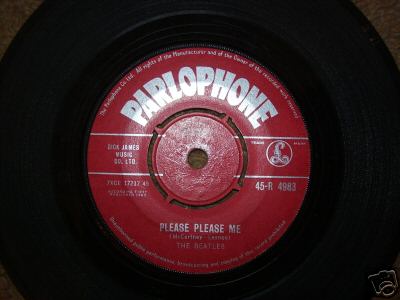
RARE X RARE - BEATLES - ORIGINAL RED PARLOPHONE 1963 45
£
38
$
50


Favourite Auctions
To save auctions to your favourites, please login
If you don't have an account, please register
Description
Keeping Vinyl alive..
********
________________
RARE X RARE - BEATLES - ORIGINAL RED PARLOPHONE 1963 45
@@@@@@@@@@@@@@@@@@
++++++
BEATLES
PLEASE PLEASE ME
ASK ME WHY
Rare Red label PARLOPHONE 45-R 4983
LABELS PRETTY CLEAN - ONLY BP WRITTEN ON LABEL
Obviously with such a rare and old record like this it is far from Mint but it is in VG condition and plays well with only a bit of background noise - Sounds Great
POSTAGE = £1.50 TO THE UK
£2.50 TO EUROPE
£3.50 TO USA
GREAT SOUNDS FOR LAMBRETTA LOVERS
"I wouldn't have believed at the time that 40 years later I'd still be talking about the phenomenon of The Beatles," said producer George Martin recently. Measured on purely commercial success and popularity then The Beatles are the greatest pop stars of the 20th century. The changes in the music industry wrought by their success - from recording techniques to marketing and songwriting- means their impact will probably remain unsurpassed. From 1962 until 1970 when they split, The Beatles changed the face of popular music. With 17 No.1 hits, their musical development was as rapid as it was innovative - from the pure Merseybeat pop of I Wanna Hold Your Hand to psychedelic mantras of Strawberry Fields Forever and Lucy In The Sky With Diamonds. The Beatles evolved from the Quarrymen, the band John Lennon (born 9 October, 1940) formed at Quarry Bank school in 1956. Lennon was obsessed with the rock and roll bands of the era - Buddy Holly, Gene Vincent and Elvis Presley. Paul McCartney, (born 18 June, 1942) who had impressed Lennon with his musical knowledge and already burgeoning songwriting skills joined the band in 1957 and the pair immediately started writing together. Within a year, two more musicians had been brought in, the 15-year-old guitarist George Harrison (b. 25 February 1943, Liverpool, England, d. 29 November 2001, Los Angeles, California, USA) and an art school friend of Lennon's, Stuart Sutcliffe (b. 23 June 1940, Edinburgh, Scotland, d. 10 April 1962, Hamburg, Germany). The band underwent several names -Jonny and the Moondogs and the Silver Beetles - before becoming The Beatles. Without a Pop Idol style reality TV show to enter, the band cut their teeth with a six month stint in Hamburg, playing lengthy sets each day. Together with Pete Best who had joined as a drummer, the band turned themselves into a tightly knit, professional group.Back in Liverpool in 1961 the band soon secured a regular spot at The Cavern club. Brian Epstein soon became the group's manager and set about finding them a record contract. The group was eventually signed to EMI. By this time Stucliffe had left the band, deciding to stay in Hamburg to pursue his art studies (he died there of a brain haemorrhage in 1962). In 1962 drummer Pete Best was replaced by Ringo Starr. (b. Richard Starkey, 7 July 1940). The first Beatles single, Love Me Do, was released in 1962 and reached No.17 in the UK charts. With the next single, Please Please Me, the characteristic Beatles style was forged, soaring harmonies, Harrison's precise guitar patterns combined with simple, almost mundane but oddly compelling lyrics. The record reached No.2 in the charts but the band would make up for it by reaching No.1 three times in 1963 with From Me To You, She Loves You and I Wanna Hold Your Hand. Two albums, Please Please Me and With The Beatles, also topped the chart that year. By the end of 1963 The Beatles were the most popular group across Europe and anyone without a moptop and a collarless Beatles jacket was probably a square, or Des O' Connor. They made little dent in the US market until Brian Epstein persuaded US TV chat show host/institution Ed Sullivan to feature the band on his show. Within a month of appearing on the show in 1963 I Wanna Hold Your Hand was No.1 in America. The next two years were the high point of Beatlemania. The group undertook world tours and topped the charts across the world. By the time they played what was to be their last public performance in San Francisco on 28 August, 1966 the band had scored eight further No.1 singles in the US and had made two critically acclaimed, sharp, witty films, A Hard Day's Night (1964) and Help (1965) as well as five further albums including Beatles For Sale, (1964) Rubber Soul, (1965) and the influential Revolver, (1966). It was during these two years that the band underwent their most important changes. The band had transformed their personas from innocent moptops to acid tounged urban sophisticates and long haired, chemically induced experimentalists. The Rubber Soul album of 1965, a year which also saw the band receive MBE's, was the sound of a band in flux. They were shedding their pop image and experimenting with Bob Dylan's pioneering folk rock experiments. The songwriting, which also aped the more personal nature of Dylan's songs, was more mature. In My Life was beautifully bittersweet while the lilting Norwegian Wood saw Harrison's first foray with the sitar. The recording of Revolver in 1966, often cited as The Beatles' crowning achievement, came at the end of a heavy period of drug experimentation for John Lennon, whose drug of choice was LSD while McCartney's was cocaine. "We're bigger than Jesus," said Lennon in March 1966 and it was hard to argue with him. Success had opened up cultural vistas for the Fab Four. Harrison would become fascinated with Indian mysticism while Lennon embraced the 'acid experience' as touted by drug gurus such as Timothy Leary. "Turn off your mind, relax and float downstream. Lay down all thoughts, surrender to the void," said Leary and Lennon took him at his word, holing up in his Weybridge mansion most nights lulling himself into an acid-fried state. I'm Only Sleeping from Revolver probably best sums up Lennon's state of mind at the time. Harrison's embittered Taxman kicks off the album in strident style while She Said She Said was a swirling piece of trippy pop. The Beatles massive leap in musical development also alienated several of their fans who weren't ready for the mind-trip. But the experimentation would continue for 1967's concept album, Sgt Pepper's Lonely Hearts Club Band. Producer George Martin played a vital role in translating the band's musical 'trips' with studio invention and unusual instrumentation. Sgt Pepper was conceived as the idea of a North Country brass band - the nostalgic, quintessential Englishness of the project contrasting with the trippiness and LSD haze of the music. Sgt Pepper's release coincided perfectly with the fabled '67 Summer Of Love and the album set new standards in pop and sonic trickery and singlehandedly invented the concept album that so many laughable prog rock bands would follow in the '70s. Tracks such as Lucy In The Sky With Diamonds (wrongly thought by many to be about LSD), She's Leaving Home and A Day In The Life caused many fans and critics to call it the greatest album of all time although there was a feeling that the album was too overblown for its own good. The album went straight to No.1 and a month later the anthemic single, All You Need Is Love also topped the charts, helped by the simultaneous worldwide TV broadcast. The death of Brian Epstein cast a shadow over the celebrations but the band moved on, filming and recording The Magical Mystery Tour later that year. The film was a trippy larkabout, inspired by American counter-culturalist and author Ken Kesey and his wandering lysergic minstrels and contained Lennon's surrealistic I Am The Walrus. The film was screened on British TV on Boxing Day in 1967 and the film was almost universally panned. (Never mind. The Only Fools & Horses Christmas special would be along soon.) The band decamped to India for spitirual healing with the Maharishi Mahesh Yogi during which time they accumulated the material that would form the White Album. But from 1968 onwards the Beatles began to disintegrate in a slow, painful manner. They declared their economic dependence by forming Apple Corps, a hippie- capitalist enterprise, designed to encourage creative projects of all kinds but centred on a record label. Financial mismanagement eventually killed the enterprise. Despite the strained relationships within the band, the songs on 1968's the White Album were among The Beatles' finest. The sprawling double album featured the cryptic genius of Lennon's Happiness Is A Warm Gun while Revolution No.9 was defiantly experimental. But the recording of the album had strained relationships to breaking point. Already distanced by Lennon's relationship with Yoko Ono, McCartney and Lennon were in dispute as to who should be brought in to save the Beatles' fortunes, in disarray after the Apple venture. McCartney favoured Lee Eastman, the father of his future wife, Linda while the other three Beatles favoured Allen Klein, a tough lawyer who had recently become the Rolling Stones' manager. A back to basics recording session in 1969 was designed to ease tensions in the band but only served to exacerbate them. The recordings would eventually emerge as the patchy Let It Be album, an unfitting epitaph to The Beatles legend. Phil Spector's syrupy production came in for some flak, not least from McCartney himself who in 2003 released a stripped-down, original version of the recorded album entitled Let It Be Naked. Incredibly, in 1969 the band got it together one last time for the Abbey Road album. As well as immortalising the Abbey Road studio and the zebra crossing outside the studio on the LP's cover, the album was a breathtaking sweep through the diverse styles of each of the songwriters. George Harrison contributed two of his best tracks, Something and the pastoral Here Comes The Sun. The Beatles officially split in February 1970, a few months before the release of Let It Be. In his solo career Lennon continued to be a figurehead for the peace movement, speaking out against America's involvement in the Vietnam war and with his solo hits Give Peace A Chance (1969) and Imagine (1971). When his son Sean was born in 1975 (Lennon already had a son, Julian, by first wife Cynthia) John became a reclusive house husband until the release of his 'comeback' album, Double Fantasy in 1980. He was returning from a radio interview when he was shot on the doorstep of his apartment in New York's Dakota Building in 1980 by Mark Chapman. Harrison continued to explore Indian mysticism and spirituality in his music. The triple album All Things Must Pass was released to critical acclaim in 1970 while the album's single, My Sweet Lord, was a UK No.1. In 1972 he organised the Concert For Bangladesh in New York to aid famine relief. In 1999 Harrison faced tragedy when he was attacked by a crazed fan in his mansion home in Henley On Thames. He survived serious stab wounds only to be diagnosed with throat cancer the following year. By 29 November 2001, George finally lost his battle for life. Post-Fab Four, Macca managed to carve out a highly successful second career with Wings. Latterly, as a solo artist, his material has received mixed reviews. And it's sometimes hard to reconcile this modern day pop genius with tunes such as The Frog Chorus and Pipes Of Peace. He recently married second wife, Heather Mills (following the death of his first wife, Linda from breast cancer in 1998). Macca's last album, 2001's Driving Rain received favourable reviews from critics suggesting the pioneering spirit of The Beatles hadn't completely left him. Solo, the individual Beatles were never as strong as the whole. The band remain one of the greatest cultural icons of the 20th century. And let's face it, however hard they try, Oasis will never match their back catalogue. Sign up for PayPal; the fast, easy, and secure way to pay online.PAYMENTS
UK OR USA Cash / Paypal / UK Cheques / Postal Orders.
Sorry No non - UK cheques / p.o.s Thanks For Looking - Good Luck.
I am a collector - not a dealer and I can normally only get to the post office once a week - so please be patient
Be sure to add me to your favourites list!
THANKS FOR LOOKING :)
price rating