RARE Henry Fillmore's Jazz Trombone book 1919 1st ever?
$
28


Favourite Auctions
To save auctions to your favourites, please login
If you don't have an account, please register
Description
Click to Enlarge
Click to Enlarge
Click to Enlarge
Click to Enlarge
Click to Enlarge
This auction is for one copy of the following book.
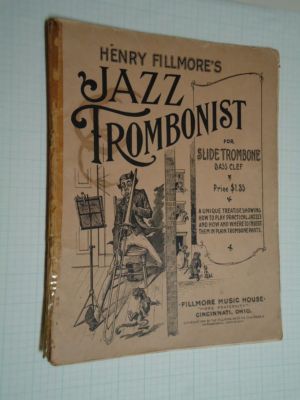
Henry Fillmore's Jazz Trombonist for Slide Trombone Bass Clef. Price $1.35 A unique treatise showing how to play practical jazzes and how and where to insert them in plain trombone parts. Published by Fillmore Music House - More Fraternity - Cincinnati, Ohio copyright 1919 by The Fillmore Bros. Co. Cincinnati O. Front cover and title page image looks very Robert Crumb. Book measures 9 1/2 X 12 inches. Tape repair to spine from what looks like years ago. Book is overall quite clean. Great preface about Jazz mentions Lafcadio Hearn and jazz origins - preface by Henry Fillmore. Book is 50 pages long with many pieces- jazz shorts, jazz inserts, Medium and Long jazzes, many actual works by henry Fillmore. I could find very little on this book but one book says that Fillmore used to play for one circus or another and developed his work there. It also says that this book may be the very first method book for jazz trombone!!! Very early jazz music method book. I am listing a few other rare trombone and jazz books, including an amazing glenn Miller book, so check them out and ask questions. I will combine for shipping.
The following is a biography of Henry Fillmore from Virginia Tech -
Born: December 3, 1881 - Cincinnati, Ohio, America Died: December 7, 1956 - Miami, Florida, America Nationality: American Era: Romantic/Twentieth Century Main genre: March Music Main works: Marches American We Men Of Ohio His Honor The Footlifter Military Escort Klaxon Mt. Healthy Noble Men Rolling Thunder The Circus Bee King Karl King Trombone Rags Miss Trombone (1908) Teddy Trombone (1911) Lassus Trombone (1915) Pahson Trombone (1916) Sally Trombone (1917) Slim Trombone (1918) Mose Trombone (1919) Shoutin' Liza Trombone (1920) Hot Trombone (1921) Bones Trombone (1922) Dusty Trombone (1923) Bull Trombone (1924) Lucky Trombone (1926) Boss Trombone (1929) Ham Trombone (1929) Brief biography:
James Henry Fillmore Jr. was eldest of 5 children and his father was a partner in the Fillmore Religious music publishing house. Fillmore was said to have had an outstanding singing voice and was often rewarded by his father with fifty-cents to sing in the church choir. He played a little piano and was a natural with the flute, violin, and guitar. It was the slide trombone that most fascinated Fillmore. His father considered the trombone too evil for any righteous person to play, in fact, the instrument was often associated with street corner musicians whom were known to drink alcohol. But Fillmore’s mother believed that practicing trombone might help keep Henry out of mischief, and she secretly saved enough money to buy a second-hand instrument for her son. He was educated in Cincinnati public schools and graduated from a junior college in 1901 with a "Bachelor of Arts" degree. His b composing began when he was 18. His first known publication is the march Higham, named after a line of brass instruments. He also attended the Cincinnati Conservatory of Music for a short time studying trombone with Charles Kohlman and composition with John Broekhoven.
He worked in his father's publishing business for a while, but left in 1905. They had an argument concerning the "evils'' of band music and his displeasure with Henry's personal life. The disagreement centered on Fillmore's lovev for Mabel May Jones, an exotic show dancer. He proposed to her by mail and they were subsequently married in St. Louis. They both were hired by the Lemon Brothers Circus, starting his career as musician and bandmaster.
Fillmore settled his differences with his father and returned to music publishing in 1910. He needed to supplement his income and began to teach trombone and perform in private groups. From 1921 to 1926 he led the Syrian Temple Shrine Band and in 1927 Fillmore organized his own professional band. His band was the last in a long line of great professional bands in America. Sousa's band and Gilmore's band had already stopped performing when Fillmore started his band in Cincinnati.
Fillmore's band became very popular with his flamboyant style and entertaining manner. Often being refered to as the "Showman Supreme," he often turned directly around to the audience and conducted the band while interacting with the audience. He also became famous as the ``Father of the Trombone Smear,'' writing fifteen songs over a period of 21 years featuring the trombone smear (glissando). The trombone "smears" were ragtime pieces reflecting the minstrel show idiom of vaudeville. John Phillip Sousa and his band performed Lassus Trombone on many occasions, being his favorite smear.
During those years, he wrote, arranged, and edited more band music than any other composer/ bandmaster in history with over 250 compositions (including 113 marches) and over 750 arrangements. He also spent free time publishing band instruction books that became standard learning material in the homes of thousands of young musicians. He published under eight names to prevent saturating the market with his own name. Aside from Henry Fillmore, he also used the names Harold Bennett, Al Hayes, Will Huff, Gus Beans, Ray Hall, Harry Hartley, and even feminine name of Henrietta Moore.
Fillmore developed heart problems and, in 1938, moved to Miami, Florida for his health. He went to work for the University of Miami band, even after he decided to retire. He stayed active adjudicating musical competitions and guest conducting. His last composition was dedicated to the President of Miami University at the time, Jay F.W. Pearson. It was titled the Presidents March.
If you have any questions about this item please e-mail me.
- Payment Terms
- Please use Paypal. If you would like to use a payment method other than paypal you have to e-mail me first.
- Shipping Terms
- Standard shipping using USPS.
inkfrog terapeak
i000000
price rating