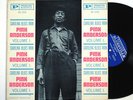
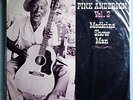
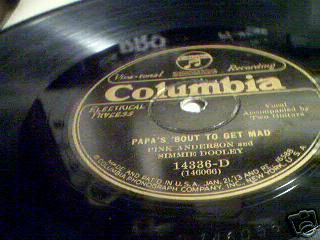
RARE BLUES " PINK ANDERSON & SIMMIE DOOLEY" CL-14336
$
260


Favourite Auctions
To save auctions to your favourites, please login
If you don't have an account, please register
Description
THEY ONLY CUT TWO 78's THIS ONE "PAPA'S BOUT TO GET MAD" GONNA TIP OUT TONIGHT" COLUMBIA -14326
THE OTHER ONE IS EVERY DAY IN THE WEEK BLUES CL-14400
DONT READ THIS WRONG I ONLY HAVE 14326 FOR SALE AND IT HAS SOME NEEDLE WEAR IS ALL PLAYS GREAT HERE FOR ME
THEY CUT SOME LPS FROM 1961 TO 1963
Pink Anderson was born in Lawrence, South Carolina, on the 12th of February 1900, and was raised in Spartanburg in the northwestern part of South Carolina. He first went on the road at age fourteen, employed by a Dr. Kerr of the Indian Remedy Company. In the early 1900’s, pitchmen such as this would travel from town to town with a ‘Medicine show’. Musicians attracted attention to the cart, from which the ‘doctor’ would sell a most miraculous elixir, available today only for the paltry sum of one dollar-step-right-up. Pink travelled with Kerr until 1945, when the good doctor retired. In the early days Pink sang a little, danced and told a few jokes: ‘I couldn’t play nothing but ‘bastopol’ tuning when I started on guitar. You know, “John Henry” and songs like that.’ In 1916 Pink met Simmie Dooley, a blind singer much older than himself, living in Spartanburg. With Simmie he became a blues singer. When Pink wasn’t out with the Indian Remedy Company, he and Simmie played at picnics and parties in small towns around Spartanburg, like Woodruff and Roebuck. Pink’s musical life with Simmie was very different from his stage life. They’d go into the woods to practise, usually with a bottle of corn Whiskey to help their throats, and Simmie would sing the songs over and over until Pink got the chords. Sometimes Simmie would cut a switch and hit at Pink’s hands if he kept missing a change. Pink recalled playing at a country club party, after he’d spent the entire day sitting on a log in the woods behind the golf course trying to learn the chords for ‘The stars and stripes forever’. His hands were so swollen from Simmie’s switch that he could hardly play. With Simmie, Pink made his first recordings: two sides for the old Columbia 1400 series, made in Atlanta in the late ‘20s. Columbia tried to get him into the studio again without Simmie, but Pink refuse, and it was not until the early ‘50s that Paul Clayton heard him playing at a fair and recorded him again, doing a group of his favourite medicine show tunes. After Dr. Kerr’s retirement in 1945, Pink worked less and less, preferring to stay near his home in Spartanburg. He kept a small guitar, washboard and harmonica trio working until 1957, when heart troubled forced him into retirement. After Simmie’s death in December 1960, Pink made a few recordings, including his appearance in a film called The Bluesmen (1963). Otherwise, he mainly played for friends, and taught songs to his son. Pink Anderson died in 1974.