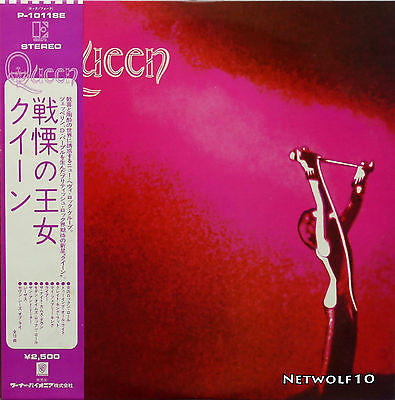
Queen - Queen - LP - Japan press with OBI - P-10118E
€
70
$
81


Favourite Auctions
To save auctions to your favourites, please login
If you don't have an account, please register
Description
QUEEN
QUEEN
LP
JAPAN PRESS WITH OBI
Descrizione Dettagliata – Detailed Description
Artista - Artist
Queen
Titolo - Title
Queen
Stampa - Issue
Japan Press
Stampa - Pressed
Warner Pioneer Corporation Japan
Etichetta - Label
Elektra (Butterfly)
Anno - Year
1981
N° Catalogo - N° Catalog
P-10118E
N° Dischi - N° LP
1
Commento - Comment
LP a copertina non apribile. Rara seconda stampa a 10 tracce, stampata su etichetta Elektra butterfly, con inserto aggiuntivo lucido di 2 pagine, con testi in inglese, giapponese e note biografiche. Obi a colori a sfondo bianco e porpora riportante il prezzo di yen 2.500.
I Queen sono un gruppo rock britannico originario di Londra, molto popolare soprattutto negli anni settanta ed ottanta. Nonostante la morte del frontman Freddie Mercury il 24 novembre 1991, ancora oggi mantengono un grande seguito sia fra le vecchie che fra le nuove generazioni. Il loro nome equivale all'appellativo inglese per Regina. Si stima che il gruppo abbia venduto oltre 300 milioni di dischi, di cui oltre 32.5 milioni nei soli Stati Uniti, risultando perciò tra gli artisti di maggior successo nella storia della musica. Con le loro 1422 settimane nelle classifiche sono i musicisti di più lungo successo commerciale nel Regno Unito, superando leggende della musica, come i Beatles o Elvis Presley. Nel 2001 la band è stata inclusa nella Rock and Roll Hall of Fame di Cleveland, nell'Ohio, nel 2004 nella UK Music Hall of Fame e, nello stesso anno, il brano Bohemian Rhapsody è entrato nella Grammy Hall Of Fame, seguito nel 2009 dai brani We Will Rock You e We Are The Champions. Inoltre il complesso è l'unico nella storia ad essere stato ammesso per intero nella Songwriters Hall Of Fame. Il gruppo ha riscosso nel corso degli anni un grandissimo successo di pubblico ed ha avuto una forte influenza sulle generazioni che l'hanno seguito e sui musicisti che ad esso si sono ispirati. Ognuno dei componenti era in grado di occuparsi della parte compositiva dei brani (numerosi furono infatti i pezzi scritti a più mani, come quelli composti dai soli membri in autonomia), ma era Freddie Mercury il personaggio più noto del gruppo, sia per via del ruolo di leader sia per le proprie straordinarie capacità vocali, con un'estensione pari a tre ottave, senza l'uso del falsetto, ed a 3 e mezzo con l'uso dello stesso. Tra i brani scritti da Mercury si ricordano We Are the Champions, Bohemian Rhapsody (proclamata più volte da critici e da sondaggi popolari la migliore canzone di sempre), Somebody to Love. Degli altri membri della band sono molto citati anche Radio Ga Ga di Roger Taylor, We Will Rock You e Who Wants to Live Forever di Brian May, e Another One Bites the Dust e I Want to Break Free di John Deacon. In quasi tutti gli album pubblicati, tranne nei primissimi, era presente almeno un brano scritto da ogni componente del gruppo. Altra caratteristica che li ha resi celebri erano le loro esibizioni dal vivo; dal 1970 al 1986 hanno sostenuto 707 concerti in 26 nazioni toccando tutti e 5 i continenti. Alla band è stato spesso attribuito, nel corso degli anni, il titolo di miglior live-band della storia e la loro esibizione al Live Aid è stata votata da un vasto numero di critici non solo come la migliore dell'evento, ma una delle migliori in assoluto della storia della musica moderna.
Queen è il loro primo album in studio pubblicato 1973. L'album venne registrato presso i Trident e i De Lane Lea Studios, in Inghilterra, e prodotto da Roy Thomas Baker, John Anthony, Louie Austin e i Queen. Gli assistenti di registrazione furono Roy Thomas Baker, Mike Stone, Ted Sharpe e Dave Hentschel. La registrazione proseguì per un lungo periodo di tempo, poiché la band usava le off-hours (i "tempi morti" tra le registrazioni di altri gruppi) per risparmiare. Lo stile di Queen venne influenzato dal rock progressivo e dall'heavy metal dell'epoca, rifacendosi a gruppi come Led Zeppelin e Yes.I testi spaziano attraverso vari argomenti, tra cui la religione (nella nona traccia Jesus) e il mito (in My Fairy King). Cinque dei brani di questo album sono stati scritti da Freddie Mercury, quattro da Brian May (compresa Doing All Right, scritta in collaborazione con Tim Staffell, bassista e cantante degli Smile), mentre uno (Modern Times Rock 'n' Roll) è stato composto e interpretato dal batterista Roger Taylor. I Queen erano già inseriti nel circuito universitario e dei club nei dintorni di Londra, quando venne concessa loro l'opportunità di testare i nuovi accessori di registrazione dei De Lane Lea Studios, che usarono per elaborare delle versioni pulite di cinque canzoni: Keep Yourself Alive, The Night Comes Down, Great King Rat, Jesus e Liar. Nonostante la qualità di tali registrazioni, nessuna casa discografica volle assumerli, eccetto la Chrysalis Records, che usarono per cercare di convincere altre case. Nel 1972 vennero finalmente notati da Norman e Barry Sheffield, che stavano allestendo i Trident Studios. Il patto con la band principiante era che loro potessero registrare solo durante i tempi morti degli Studios, quando l'artista pagante fosse andato via (di solito tra le ore 3.00 e le 7.00). Un giorno, durante una di queste attese, il produttore Robin Cable chiese a Freddie Mercury di registrare delle parti vocali per delle versioni di I Can Hear Music e Goin' Back su cui stava lavorando. Mercury portò con sé anche Brian May e Roger Taylor (ma non John Deacon, che all'epoca faceva già parte del gruppo), e i pezzi vennero registrati e pubblicati in vinile nel 1973 con lo pseudonimo di Larry Lurex.Questa situazione disagiata durò da giugno a novembre del 1972. A causa delle limitazioni, in questo periodo la band si concentrò sul terminare un brano alla volta, prima di passare al successivo, ma i problemi sorsero immediati. La band infatti aveva una grande considerazione dei demo registrati ai De Lane Lea Studios, ma il produttore Roy Thomas Baker chiese loro di registrare nuovamente le canzoni, stavolta con un equipaggiamento migliore. Keep Yourself Alive fu la prima a venire re-registrata, ma ai Queen il risultato non piacque. La traccia venne registrata ancora una volta, ma nelle sessioni di mixaggio nessun mix andava incontro alle loro pretese, finché dopo altri sette o otto tentativi falliti Mike Stone - che sarebbe poi rimasto come addetto al mixaggio e a volte anche come co-produttore per i loro cinque successivi album - con la sua prima prova incontrò l'approvazione dei Queen. La prima re-registrazione di Keep Yourself Alive venne più tardi pubblicata dalla Hollywood Records negli USA con il titolo di Keep Yourself Alive (Long Lost Retake), con l'autorizzazione di Brian May. Anche il brano Mad the Swine andò incontro a dei problemi. Questa traccia infatti era stata registrata per l'album di debutto, ma Baker e i Queen erano ancora in disaccordo a causa della qualità del suono delle percussioni. Non avendo risolto la disputa, il brano venne lasciato fuori dall'album. Mad the Swine apparve successivamente come B-side del singolo Headlong pubblicato nel Regno Unito. La versione di The Night Comes Down che appare nell'album è, al contrario di Keep Yourself Alive, il demo registrato ai De Lane Lea, poiché la sua qualità risultò migliore rispetto allo standard del resto delle canzoni dell'album. Altre registrazioni di questo periodo, come due tracce degli Smile (Silver Salmon e Polar Bear), Rock And Roll Medley (allora eseguito molto spesso nei bis) e Hangman (un brano dalla pessima reputazione, la cui esistenza venne a lungo negata nonostante la registrazione di esecuzioni live), vennero incise su vinile e fanno ora parte di collezioni private. Nonostante l'album fosse già completo e mixato dal novembre 1972, i Trident impiegarono dei mesi per cercare un'etichetta discografica disposta a pubblicarlo. Infine lo pubblicarono essi stessi, ma solo nel 1973, dopo otto mesi. Durante questo lasso di tempo i Queen avevano iniziato a scrivere materiale per l'album successivo, ma erano demoralizzati dai ritardi nella pubblicazione del lavoro corrente, ritenendo di aver superato quella fase, anche se il pubblico, acquistandolo a tempo di record, li stava spaventando. Nello stesso periodo registrarono due sessioni per la BBC Radio 1.
LP not gatefold. Rare second print 10 tracks, in exceptional conditions of preservation, a printed label Elektra butterfly, with extra glossy insert of 2 pages, with texts in English, Japanese and biographical notes. Obi color purple and white background showing the price of 2.500 yen.
The Queen is a British rock group originally from London, especially popular in the seventies and eighties. Despite the death of frontman Freddie Mercury November 24, 1991, still maintain a large following both among the old than among the younger generation. Their name is equivalent with the little English for the Queen. It is estimated that the group has sold over 300 million albums worldwide, including over 32.5 million in the United States, thus making it among the most successful artists in music history. With their 1422 weeks in the charts are the musicians of the longest commercial success in the United Kingdom, surpassing legends of music, like the Beatles or Elvis Presley. In 2001 the band was included in the Rock and Roll Hall of Fame in Cleveland, Ohio, in 2004 in the UK Music Hall of Fame and that same year, the song Bohemian Rhapsody has entered the Grammy Hall of Fame, followed in 2009 songs from We Will Rock You and We Are The Champions. Furthermore, the complex is the only one in history to be admitted in full into the Songwriters Hall Of Fame. The group has collected over the years a great public success and had a strong influence on the generations that have followed, and the musicians who were inspired by it. Each component was unable to pursue the composition of the songs (many were in fact the stories written in many hands, such as those made independently by members only), but Freddie Mercury was the person most known of the group, both because of the role leaders for both their unique vocal abilities, with an extension of three octaves, without the use of falsetto, and 3 and a half with the use of the same. Among the songs written by Mercury remember We Are the Champions, Bohemian Rhapsody (proclaimed repeatedly by critics and popular polls, the best song ever), Somebody to Love. The other band members are very well quoted by Roger Taylor Radio Ga Ga, We Will Rock You and Who Wants to Live Forever by Brian May, and "Another One Bites the Dust" and "I Want to Break Free by John Deacon. In almost all the albums published, except in the very first, was present at least one song written by each member. Another feature that made them famous was their live performances, from 1970 to 1986 claimed 707 concerts in 26 countries touching all 5 continents. The band has often been attributed over the years, the title of best live band in history and their performance at Live Aid was voted by a large number of critics not only as the best event, but one of the best ever in the history of modern music.
Queen is their first studio album released 1973. The album was recorded at Trident and De Lane Lea Studios in England, and produced by Roy Thomas Baker, John Anthony, Louie Austin and Queen. Assistants were recording Roy Thomas Baker, Mike Stone, Ted Sharpe and Dave Hentschel. The recording went on for a long period of time, as the band was using the off-hours (the "dead time" between the records of other groups) to save. Queen's style was influenced by progressive rock and from heavy metal era, referring to bands such as Led Zeppelin and Yes texts ranging through various topics, including religion (in the ninth track Jesus) and myth (in my Fairy King). Five of the tracks on this album were written by Freddie Mercury, Brian May from four (including "Doing All Right, written in collaboration with Staffell, bass player and singer of Smile), while one (Modern Times Rock 'n' Roll) was composed and played by drummer Roger Taylor. The Queen had already entered the academic world and clubs around London, when he granted them the opportunity to test new equipment for registration of the De Lane Lea Studios, who used to process the clean versions of five songs: "Keep Yourself Alive , The Night Comes Down Great King Rat, Jesus and Liar. Despite the quality of these recordings, no record company wanted to hire them, except for Chrysalis Records, who used to try to entice other companies. In 1972 they were finally noticed by Norman and Barry Sheffield, who were setting up Trident Studios. The pact with the beginner band was that they could record only during the dead time of the studios, when the artist was left paying (usually between the hours of 3.00 and 7.00). One day, during one of these expectations, the producer Robin Cable asked Freddie Mercury to record vocals for the versions of I Can Hear Music "and" Goin 'Back where they left off. Mercury enlisted Brian May and Roger Taylor (but not John Deacon, who at the time was part of the group), and the pieces were recorded and released on vinyl in 1973 under the pseudonym Larry Lurex.Questa uncomfortable situation lasted from June in November 1972. Because of limitations in this period the band to focus on completing one track at a time, before moving to the next, but problems arose almost immediately. The band had a great view of demos recorded at De Lane Lea Studios, but producer Roy Thomas Baker asked them to re-record the songs with better equipment. Keep Yourself Alive was the first to be re-recorded, but the Queen did not like the result. The track was recorded again, but in no mix mixing sessions met their demands, until, after seven or eight failed attempts Mike Stone - which later remained as employed to mix and eventually co-produce their next five albums - with his first try met the approval of the Queen. The first re-recording of "Keep Yourself Alive" was later released by Hollywood Records in the U.S. under the title of "Keep Yourself Alive (Long Lost Retake), by permission of Brian May. Also the full Mad the Swine went to meet the problems. This track had in fact been recorded for the debut album, but Baker and Queen were still in disagreement because of the quality of the sound of drums. Not having resolved the dispute, the song was left off the album. Mad the Swine appeared later as B-side on the Headlong published in the United Kingdom. The version of "The Night Comes Down" which appears on it, as opposed to Keep Yourself Alive, the demo recorded at De Lane Lea, as its quality was better compared to the standards of the rest of the songs of the album. Other recordings from this period, as two Smile tracks (Silver Salmon and Polar Bear), Rock And Roll Medley (then run very often in a) and Hangman (a song from the bad reputation, whose existence was long denied notwithstanding the registration for live performances), were recorded on vinyl and are now part of private collections. Though the album was already complete and mixed by November 1972, Trident spent months trying to get a record label to release it. Finally they released him themselves, but only in 1973, after eight months. During this time the Queen had begun writing material for their next album, but they were demoralized by the delays in publication of the current work, feeling they had passed that stage, even if the buying public in record time, they were scaring . They recorded two sessions for BBC Radio 1.
Condizioni - Conditions
Copertina
Cover
NM
Vinile
Vinyl
NM
Testi
Lyric Sheet
NM
Obi
NM
Foto Dettagliate
Modalità di pagamento e condizioni generali – Shipping and Payment
Accetto pagamenti solo con Paypal e bonifico bancario.
Per i pagamenti effettuati tramite Paypal, si accettano solo spedizioni tracciabili.
Il pagamento dovrà avvenire entro 7 giorni dalla chiusura dell’ acquisto ( a meno che il compratore non comunichi le sue motivazioni). Trascorso tale termine l’ oggetto sarà rimesso in vendita con conseguente rilascio di feedback negativo.
Tutte le foto utilizzate nelle mie aste sono sempre riferite ai reali oggetti in vendita.
Tutti gli imballi, sia per i dvd che per i vinili, saranno effettuati nel miglior modo possibile, per evitare danneggiamenti del prodotto durante il trasporto.
I accept payments only through Paypal and bank transfer.
For payments made via Paypal, we only accept shipments traceable.
Payment must be within 7 days from the closure of purchase (unless the buyer does not give reasons). After that time, the object will be relisted for sale, with consequent release of negative feedback.
All photos used in my auctions are always referring to real objects in the sale.
All packaging, both for the dvd for the vinyl, will be made in the best possible way, to avoid damage of the product during transport. Any duty or customs for incoming items are the responsibility of buyer.
Tipologie di Spedizione e costi per l’ Italia
Posta Raccomandata
Per Acquisti fino a 350 grammi
6,50 euro
Per Acquisti da 350 grammi a 1 Kg
8,50 euro
Pacco celere 3
Per Acquisti oltre 1 Kg
11 euro
Tipologie di Spedizione e costi per l’ Estero – Shipping’s metod and cost
Posta Raccomandata
ZONA 1
ZONA 2
ZONA 3
Europa,
Bacino del Mediterraneo
Africa,
Asia,
Americhe
Oceania
For Purchases of up to 350 grams
Per Acquisti fino a 350 grammi
11 euro
14 euro
18 euro
For Purchases from 350 grams to 1 kg
Per Acquisti da 350 grammi a 1 Kg
15 euro
19 euro
26 euro
For Purchases of 1 Kg to 2 Kg
Per Acquisti da 1 Kg a 2 Kg
21 euro
31 euro
36 euro
price rating