Picture Sleeve 1935 MILIZA KORJUS rarest REC' Goethe WARUM? MOVIE STUDENT v PRAG
$
40


Favourite Auctions
To save auctions to your favourites, please login
If you don't have an account, please register
Description
I am currently selling a series of great Richard Wagner and classic European 78 rpm orchestral recordings on all the great European labels:
Click here for more great Dealer and Picture RECORD SLEEVES and STORAGE ALBUMS!
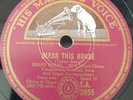
Superb soprano MILIZA KORJUS her rarest record recorded in Berlin 1935 in her role of Julia in the 1935 horror movie THE STUDENT OF PRAGUE, itself a remake from the classic 1913 Paul Wegner movie
Theo Mackleben conducting
Es zogen zwei Spielleut' im Land herum / Warum ?
Warum is the haunting song of the realization of impossible love of Goethe's famous poem to Charlotte von Stein
Warum gabst du uns die tiefen Blicke
Why give us insight?
by Johann Wolfgang von Goethe
Why give us the ability
to see consciously our destiny:
our love, our earthly happiness,
and to blissfully fancy
that we can ignore our foreboding?
Why give us, O Fate, the vision
to look each other in the heart,
to seek out, in the crush of crowds,
our true connection?
Oh, so many thousands of people
in their bland oblivion
barely even know their own hearts.
They wander aimlessly, run
hopelessly in sourceless hurt,
cheering again when quick joy
comes with the unexpected blush of dawn.
Only to us, both unfortunate, full of love,
is that fickle happiness denied:
to love each other without understanding,
each seeing in the other what never really was,
going about in an illusion of happiness
and shrinking only from imaginary dangers.
10" 78 rpm record
Condition: EXCELLENT faint rubs, plays E very quiet lightest crackle
A CHOICE COPY
The Student of Prague (German: Der Student von Prag) is a 1935 German horror film directed by Arthur Robison and starring Anton Walbrook, Theodor Loos and Dorothea Wieck. It is based on the eponymous novel by Hanns Heinz Ewers which had previously been adapted into celebrated silent films on two occasions.[1][2]
The film's sets were designed by the art director Karl Haacker.
Miliza Elizabeth Korjus (18 August 1909 - 26 August 1980) was a coloratura soprano and Oscar-nominated film actress.Early life
Miliza Korjus' father was Arthur Korjus, an Estonian lieutenant colonel in the Imperial Russian Army and later Chief of Staff to the War Minister of Estonia. Her mother was Anna Gintowt, who was descended from Lithuanian-Polish nobility. Miliza was born in Warsaw, Poland (then part of the Russian Empire) during her father's military posting there in 1909; later the family moved to Moscow. She was the fifth of six children (she had one brother, and four sisters). Her mother and father separated during the Russian Revolution of 1917 and in 1918 she moved from Moscow to Kiev with her mother and sisters where she began her musical training.
[edit] Career
While a teenager, Korjus toured the Soviet Union with the Dumka Choir. In 1927, while performing in Leningrad, she managed to cross the border into Estonia, where she was reunited with her father. She then began touring the Baltic countries and Germany, and, in 1929, married Kuno Foelsch, a physicist. Korjus continued her concert career as a soprano in Germany and was eventually engaged by the Berlin State Opera in 1933. Her operatic appearances and recordings quickly propelled her to the forefront of European singers and earned her the nickname "The Berlin Nightingale". Film producer Irving Thalberg heard her recordings and signed her to a ten year film contract, sight unseen.
Korjus' first Hollywood film was The Great Waltz (1938). She was nominated for the Academy Award for Best Supporting Actress for the role.
Korjus was scheduled to star in a film version of the novel Sandor Rozsa in 1940, but an automobile accident caused her leg to be crushed, and, although she avoided amputation, she required extensive recuperation, causing the film to be cancelled. By 1941 she had healed well enough to begin a tour of South America. During her tour, the United States became involved in World War II, and she decided to stay in Mexico for the duration. While living there, she made a Spanish language film, Caballería del Imperio.
In 1944, Korjus returned to the United States, where she performed at Carnegie Hall. She toured the country for several more years, eventually settling in Los Angeles, California.
price rating