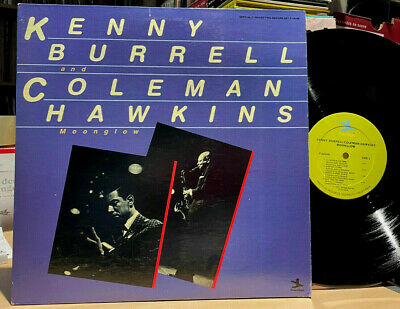
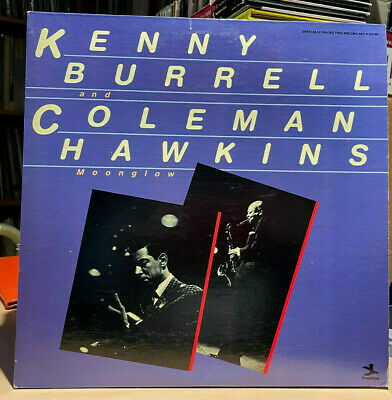
PRESTIGE 2-LPs P-24106: Kenny Burrell And Coleman Hawkins ?– Moonglow - 1981 USA
$
70
Favourite Auctions
To save auctions to your favourites, please login
If you don't have an account, please register
Description
****Welcome to our listing, thanks very much for looking!
****See our own website! We have lots of out of print LPs and CDs! Find us on the web at -
hearthedifference.net
****Please see our other listings - new items added daily!
****Shipping cost is only an estimate - it depends on the actual weight and size of the package as well as the service required. We do not profit from shipping costs, so if we overcharge, we will refund the difference back to you. It's always best to wait for our invoice before paying for your item. We will combine shipping for multiple items purchased.
Background -
It is said that one grows wiser and mellower with age, as proven by this recording from Coleman Hawkins that is a successful follow-up to his previous Moodsville album At Ease. There is a difference, as Kenny Burrell joins the legendary tenor saxophonist in this quintet setting, with no threat of upstaging or even a hint of any real showcasing of the guitarist's then developing laid-back side. Underrated Ronnell Bright is on the piano, and also proves a veritable equal to Hawkins even more than Burrell. But it is the burgeoning talent of bassist Ron Carter and drummer Andrew Cyrille who mark their territory, not as the maverick individualists they would become, but as supple performers who understand the strength of Hawkins from a modest standpoint. Not all ballads, the fare is standard American popular song played for people sitting by the fire, the calm ocean, or late at night with a sweetheart over candles and wine. Any version of a well-known tune can be made classic by Hawkins, as heard during the somber "I'll Never Be The Same," the straight ballad "Under a Blanket of Blue" with the tenor's slight fluttery trills, or "Just a Gigolo" where the spotlight is firmly focused on the leader's droll tones. Burrell's strumming on "When Day Is Done" signifies a downplayed, wound down feeling, and where he generally chooses a sublimated role in these recordings, he does come out with a strong lead melody for the soulful ballad "More Than You Know." The modified tunes on the session are the midtempo take of "Moonglow" as Hawkins adopts some of Lester Young's swagger as Cyrille's nimble brushwork keeps the song moving forward. "Speak Low" is interpreted in a sleek and seductive calypso beat ably conjured by the drummer, a nice touch to end the album. This quintet -- as unique as any Hawkins ever fronted -- speaks to his open mindedness, but more so to his innate ability in adapting musicians to his situational hitting. The Hawk Relaxes is one of his best latter period efforts. - Michael G. NastosThis session is valuable for the majestic playing of tenor great Coleman Hawkins, who performs on half of the eight tracks. Released on the Prestige subsidiary Moodsville -- a label that specialized in recordings with an intimate, reflective atmosphere -- the Moodsville sound doesn't sit comfortably on Hawkins. His playing is brilliantly relaxed, but it's not mood music. Leader Kenny Burrell's playing is much more in line with the Moodsville groove. The guitarist is not amplified as much as he is on his Prestige dates from this time. In fact, he performs on a nylon-string instrument almost as much as he does on his hollow-body electric. Unlike Hawkins, Burrell's subdued contribution is made to measure for this date. Listeners expecting to hear Burrell the hard bopper won't. The key moments come during the interaction between the guitarist and tenor player, especially during their exchanges on Burrell's "Montono Blues." The rhythm section, Hawkins' working band from this period (pianist Tommy Flanagan, bassist Major Holley, and drummer Eddie Locke) provides impeccable, sublime support. - Jim Todd
This is a decent but not very exciting outing. Then 52, Hawkins uses a typically young rhythm section (including guitarist Kenny Burrell and pianist Ray Bryant) and plays melodically on a variety of originals and standards. This insipid version of "Greensleeves" is difficult to sit through but the rest of this title is enjoyable if not overly inspiring. - Scott Yanow
One of the leading exponents of straight-ahead jazz guitar, Kenny Burrell is a highly influential artist whose understated and melodic style, grounded in bebop and blues, made him in an in-demand sideman from the mid-'50s onward and a standard by which many jazz guitarists gauge themselves to this day. Born in Detroit in 1931, Burrell grew up in a musical family in which his mother played piano and sang in the Second Baptist Church choir, while his father favored the banjo and ukulele. Burrell began playing guitar at age 12 and quickly fell under the influence of such artists as Charlie Christian, Django Reinhardt, Oscar Moore, T-Bone Walker, and Muddy Waters. Surrounded by the vibrant jazz and blues scene of Detroit, Burrell began to play gigs around town and counted among his friends and bandmates pianist Tommy Flanagan, saxophonists Pepper Adams and Yusef Lateef, drummer Elvin Jones, and others.
In 1951, Burrell made his recording debut on a combo session that featured trumpeter Dizzy Gillespie as well as saxophonist John Coltrane, vibraphonist Milt Jackson, and bassist Percy Heath. Although his talent ranked among the best of the professional jazz players at the time, Burrell continued to study privately with renowned classical guitarist Joe Fava, and enrolled in the music program at Wayne State University. Upon graduating in 1955 with a B.A. in music composition and theory, Burrell was hired for a six-month stint touring with pianist Oscar Peterson's trio. Then, in 1956, Burrell and Flanagan moved to New York City and immediately became two of the most sought-after sidemen in town, performing in gigs with such luminaries as singers Tony Bennett and Lena Horne, playing in Broadway pit orchestras, and recording with an array of legendary musicians including Coltrane, trumpeter Kenny Dorham, organist Jimmy Smith, vocalist Billie Holiday, and many others. Burrell made his recorded debut as a leader on the 1956 Blue Note session Introducing Kenny Burrell -- technically his second session for the label, but the first to see release. From the late '50s onward, Burrell continued to record by himself and with others, and has appeared on countless albums over the years including such notable albums as 1957's The Cats featuring Coltrane, 1963's Midnight Blue featuring saxophonist Stanley Turrentine, 1965's Guitar Forms with arrangements by Gil Evans, and 1968's Blues -- The Common Ground.
Beginning in 1971, Burrell started leading various college seminars including the first regular course to be held in the United States on the music of composer, pianist, and bandleader Duke Ellington. He continued performing, recording, and teaching throughout the '80s and '90s, releasing several albums including 1989's Guiding Spirit, 1991's Sunup to Sundown, 1994's Collaboration with pianist LaMont Johnson, 1995's Primal Blue, and 1998's church music-inspired Love Is the Answer.
In 2001, Burrell released the relaxed quartet date A Lucky So and So on Concord and followed it up in 2003 with Blue Muse. He celebrated turning 75 years old in 2006 by recording a live date, released a year later as 75th Birthday Bash Live! In 2010, Burrell released the live album Be Yourself: Live at Dizzy's Club Coca-Cola, recorded at Lincoln Center's smaller club-like venue, followed two years later by Special Requests (And Other Favorites): Live at Catalina's. In 2015, Burrell released The Road to Love, recorded live at Catalina's Jazz Club in Hollywood. Another Catalina's live date, Unlimited 1, appeared in 2016 and featured Burrell backed by the Los Angeles Jazz Orchestra. Besides continuing to perform, Burrell is the founder and director of the Jazz Studies Program at UCLA, as well as president emeritus of the Jazz Heritage Foundation. - Matt Collar
Coleman Hawkins was the first important tenor saxophonist and he remains one of the greatest of all time. A consistently modern improviser whose knowledge of chords and harmonies was encyclopedic, Hawkins had a 40-year prime (1925-1965) during which he could hold his own with any competitor.
Coleman Hawkins started piano lessons when he was five, switched to cello at age seven, and two years later began on tenor. At a time when the saxophone was considered a novelty instrument, used in vaudeville and as a poor substitute for the trombone in marching bands, Hawkins sought to develop his own sound. A professional when he was 12, Hawkins was playing in a Kansas City theater pit band in 1921, when Mamie Smith hired him to play with her Jazz Hounds. Hawkins was with the blues singer until June 1923, making many records in a background role and he was occasionally heard on instrumentals. After leaving Smith, he freelanced around New York, played briefly with Wilbur Sweatman, and in August 1923 made his first recordings with Fletcher Henderson. When Henderson formed a permanent orchestra in January 1924, Hawkins was his star tenor.
Although (due largely to lack of competition) Coleman Hawkins was the top tenor in jazz in 1924, his staccato runs and use of slap-tonguing sound quite dated today. However, after Louis Armstrong joined Henderson later in the year, Hawkins learned from the cornetist's relaxed legato style and advanced quickly. By 1925, Hawkins was truly a major soloist, and the following year his solo on "Stampede" became influential. Hawk (who doubled in early years on clarinet and bass sax) would be with Fletcher Henderson's Orchestra up to 1934, and during this time he was the obvious pacesetter among tenors; Bud Freeman was about the only tenor who did not sound like a close relative of the hard-toned Hawkins. In addition to his solos with Henderson, Hawkins backed some blues singers, recorded with McKinney's Cotton Pickers, and, with Red McKenzie in 1929, he cut his first classic ballad statement on "One Hour."
By 1934, Coleman Hawkins had tired of the struggling Fletcher Henderson Orchestra and he moved to Europe, spending five years (1934-1939) overseas. He played at first with Jack Hylton's Orchestra in England, and then freelanced throughout the continent. His most famous recording from this period was a 1937 date with Benny Carter, Alix Combille, Andre Ekyan, Django Reinhardt, and Stephane Grappelli that resulted in classic renditions of "Crazy Rhythm" and "Honeysuckle Rose." With World War II coming close, Hawkins returned to the U.S. in 1939. Although Lester Young had emerged with a totally new style on tenor, Hawkins showed that he was still a dominant force by winning a few heated jam sessions. His recording of "Body and Soul" that year became his most famous record. In 1940, he led a big band that failed to catch on, so Hawkins broke it up and became a fixture on 52nd Street. Some of his finest recordings were cut during the first half of the 1940s, including a stunning quartet version of "The Man I Love." Although he was already a 20-year veteran, Hawkins encouraged the younger bop-oriented musicians and did not need to adjust his harmonically advanced style in order to play with them. He used Thelonious Monk in his 1944 quartet; led the first official bop record session (which included Dizzy Gillespie and Don Byas); had Oscar Pettiford, Miles Davis, and Max Roach as sidemen early in their careers; toured in California with a sextet featuring Howard McGhee; and in 1946, utilized J.J. Johnson and Fats Navarro on record dates. Hawkins toured with Jazz at the Philharmonic several times during 1946-1950, visited Europe on a few occasions, and in 1948 recorded the first unaccompanied saxophone solo, "Picasso."
By the early '50s, the Lester Young-influenced Four Brothers sound had become a much greater influence on young tenors than Hawkins' style, and he was considered by some to be out of fashion. However, Hawkins kept on working and occasionally recording, and by the mid-'50s was experiencing a renaissance. The up-and-coming Sonny Rollins considered Hawkins his main influence, Hawk started teaming up regularly with Roy Eldridge in an exciting quintet (their appearance at the 1957 Newport Jazz Festival was notable), and he proved to still be in his prime. Coleman Hawkins appeared in a wide variety of settings, from Red Allen's heated Dixieland band at the Metropole and leading a bop date featuring Idrees Sulieman and J.J. Johnson, to guest appearances on records that included Thelonious Monk, John Coltrane, and (in the early '60s) Max Roach and Eric Dolphy. During the first half of the 1960s, Coleman Hawkins had an opportunity to record with Duke Ellington, collaborated on one somewhat eccentric session with Sonny Rollins, and even did a bossa nova album. By 1965, Hawkins was even showing the influence of John Coltrane in his explorative flights and seemed ageless.
Unfortunately, 1965 was Coleman Hawkins' last good year. Whether it was senility or frustration, Hawkins began to lose interest in life. He practically quit eating, increased his drinking, and quickly wasted away. Other than a surprisingly effective appearance with Jazz at the Philharmonic in early 1969, very little of Hawkins' work during his final three and a half years (a period during which he largely stopped recording) is up to the level one would expect from the great master. However, there are dozens of superb Coleman Hawkins recordings currently available and, as Eddie Jefferson said in his vocalese version of "Body and Soul," "he was the king of the saxophone.” - Scott Yanow
-
2xLPs made by PRESTIGE Records, in the USA
-
2xLPs released in 1974
-
Record Catalog Number: P-24106
-
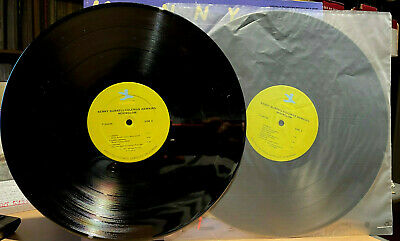
Record Labels are primarily GREEN with BLACK lettering
Kenny Burrell // Coleman Hawkins
2 x LP Title -
Moonglow (this set has tracks from "The Hawk Relaxes", "Bluesy Burrell" and "Soul" LP titles)
Track Listing -
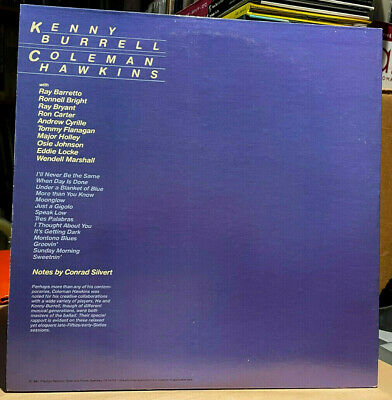
A1. I'll Never Be The Same - 6:07
A2. When Day Is Done - 4:35
A3. Under A Blanket Of Blue - 4:35
A4. More Than You Know - 4:10
B1. Moonglow - 5:58
B2. Just A Gigolo - 5:04
B3. Speak Low - 6:39
C1. Tres Palabras - 6:45
C2. I Thought About You - 4:39
C3. It's Getting Dark - 6:50
C4. Montono Blues - 4:40
D1. Groovin’ - 5:44
D2. Sunday Morning - 6:29
D3. Sweetnin’ - 6:50
Performers / Other Information -
• Phonographic Copyright (p) – Prestige Records
Specially Priced Two-Record Set
Side 1 & 2 originally realeased as Coleman Hawkins "The Hawk Relaxes" (Prestige/Moodsville 15 - 1962), Side 3 as Kenny Burrell "Bluesy Burrell" (Prestige/Moodsville 29 - 1962), Side 4 as Coleman Hawkins with Kenny Burrell & Ray Bryant "Soul" (Prestige 7149 - 1958)
CONDITION Details:
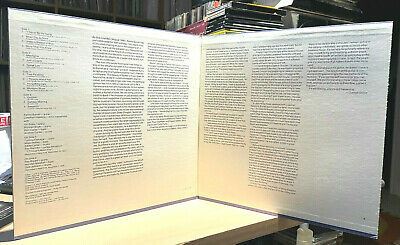
The GATE-FOLD LP JACKET is in near mint minus overall condition! The jacket has NO seam splits, NO cutout marks and NO writing on it. The corners and seams are solid with just some light shelf wear. The jacket does have a little bit of color foxing on the front and back, nothing serious. The colors on the jacket are sharp and clean - see our pictures with this listing as they are of the actual item offered.
The LPs are in near mint minus overall condition. We found that the vinyl looked superb - there are no serious marks evident. The vinyl may have a light spider mark or two, which does not affect play. Spider marks may sound on some audio systems, depending on the sensitivity of your audio gear. When play tested, the LPs performed very well for a vintage set of records, with no skips, with some light noise periodically, mostly during quieter passages of the music. The LPs retain much of the original gloss and sheen. They may have a bit of dust, dirt, and perhaps a finger print or two on the vinyl so they should be cleaned before playing for best results. There are NO serious spindle marks on the record labels - this is a fine collector's grade copy of this LP.A Short Note About LP GRADING -
- Mint = Only used for sealed items.
- Near Mint = Virtually flawless in every way.
- Near Mint Minus = Item has some minor imperfections, some audible.
- Excellent = Item obviously played and enjoyed with some noise.
- Very Good Plus = Many more imperfections which are noticeable and obtrusive.
For best results, always properly clean your LPs before playing them.
The LP is an audiophile quality pressing (any collector of fine MFSL, half speeds, direct to discs, Japanese/UK pressings etc., can attest to the difference a quality pressing can make to an audio system).
Do not let this rarity slip by!
price rating