POLYDOR LP 2391 043: STONE THE CROWS - Continuous Performance - 1972 FRANCE OOP
$
50


$ 50
Sold For
Jan 6, 2016
Sold Date
Sep 24, 2015
Start Date
1
Number Of Bids
USA
Country Of Seller
eBay
Sold at
Favourite Auctions
To save auctions to your favourites, please login
If you don't have an account, please register
Description
****Welcome to our listing, thanks very much for looking!
****Check out our website! We have lots of out of print LPs and CDs! You can find us on the world wide web at -
hearthedifference.net
****Please check out our other listings for more great LPs and CDs - new items added daily!
****To access our eBay store either click on the little red door at the top right section of any of our eBay listings or, click on -
http://stores.ebay.com/Hear-The-Difference
Background -
Stone the Crows were a blues-rock band formed in Glasgow in late 1969. The band were formed after Maggie Bell was introduced to Les Harvey by his elder brother, Alex Harvey. After playing together in the Kinning Park Ramblers, they rejoined in a band named Power, later renamed Stone the Crows (after a British/Australian English exclamation of surprise or shock) by Led Zeppelin's manager, Peter Grant. The band was co-managed by Grant and Mark London. London was associated with Lulu as the co-writer of her signature song, "To Sir With Love" and was also married to Lulu's manager, Marion Massey. London had also managed the predecessor band Cartoone, which featured Les Harvey on guitar, and in which Peter Grant had a financial interest.Jimmy McCulloch would subsequently replace Les Harvey as lead guitarist following Harvey's accidental on-stage death by electrocution at Swansea's Top Rank Suite in May 1972. As he was the band's primary songwriter as well as Maggie Bell's romantic partner, Harvey's death almost led to the Stone the Crows' breakup.
Stone the Crows ultimately broke up in June 1973. Peter Grant would continue to manage Maggie Bell's career following the band's breakup, with Bell subsequently recording two solo albums under Grant's tutelage, Queen of the Night (1974) and Suicide Sal (1975), and a 1981 album with the Grant-managed band Midnight Flyer. Bell may be best known, however, for her session work on Rod Stewart's 1971 album Every Picture Tells a Story, in particular her co-lead vocal with Stewart on the album's title track (credited as "vocal abrasives"). Jimmy McCulloch joined Paul McCartney's group, Wings, in Nashville, Tennessee, in 1974.
Continuous Performance was the band's fourth and last album. Les Harvey, the band's creative soul and main musical talent, tragically died on stage in the middle of a tour; apparently, there was something wrong with the equipment and when he tried to check it and touched his microphone and guitar at the same time, he received his instantaneous death blow from the current. This left the band absolutely stranded - it's a wonder they actually managed to finish the tour, engaging Peter Green for a couple of dates, and release the ensuing album, which was only about half-finished by that time. So you get Harvey playing on most of the tracks, but for several of them the band hired a new member, Jimmy McCulloch, later of Wings' fame (the one guy with a strong heroin addiction, remember? He who penned 'Medicine Jar' as a warning and died shortly afterwards).
Goes without saying that since the album was already pretty much planned out and most of the songs written, it couldn't look like a tribute to Les or anything; in fact, it's almost creepily life-asserting and cheerful in the light of those gruesome events. The band had by then almost completely overcome their 'artsy' mood, and most of the tracks are pretty straight forward blues/blues-rock as far as melody goes. That said, the arrangements are maybe stronger than ever and the production their best up to date, long gone are the days when Maggie's voice couldn't be heard because the drunken engineer stuffed it deep down under the organ mattress. Maggie's the star of the show again, just about on every single track, so if you don't happen to appreciate her voice, please note that Harvey's playing on here is rather restrained. In fact, Harvey only really shines (that is, shows off!) on 'King Tut', a strangely ominous instrumental that could be considered as a self-necrologue of sorts. The minimalistic weeping guitar licks in the background can only be compared with the agonizing howls of an old dying wolf, if you'll pardon my little comparison.
But just as you're ready to think that the mood of 'King Tut' is what really matters for this album and that from now on it's the feeling of sadness and loss that will permeate the rest of the record, the band comes up with 'Good Time Girl', a totally straight forward and totally life-asserting and totally cheerful ditty that begins with the lines 'I'm not a black magic woman or a voodoo queen, I don't make magic potions like they do in New Orleans'. Maggie later asserted that the song was actually devoted to Peter Green, whom many people perceived as a dark mysterious Voodooist and all that crap due to the eerie quality of his music and lyrics, but who in fact was a pretty normal and mundane person. In any case, this simplistic, yet wonderfully catchy rocker, where Maggie sounds closer to Rod Stewart than she ever did, earned them a Top of the Pops appearance by getting as high as #12 on the British charts - something unbelievable for such a generally commercially unsuccessful band in their last gasp of creativity.
Other highlights of the album include the traditional 'Penicillin Blues' which is, well, a blues, country blues with slide guitar and all the necessary attributes you can guess about, so once again it's mainly Maggie's pair of sizzly chords that makes the listening process worthwhile, and one of the few really gorgeous ballads they have ever written: Ron Leahy's 'One More Chance', which isn't really way too different from 'Things Are Getting Better' but watch out for the hooks. One could make an argument that powerful female vocal hooks in soulful ballads are among the most uplifting and emotionally resonant kinds of hooks in the world - that would be a purely subjective argument but whenever I listen to this ballad I really feel like sharing it. I even manage to appreciate the weird synthesizer backup of these hooks, although generally it's a bit cheesy to hear hi-tech synths in Seventies' soulful ballads.
Of course, Stone The Crows wouldn't really be stoning the crows if they were THAT consistent - and they HAD to screw up the consistency of the record by including a multi-part ultra-long blues-rock epic from Leahy, the nine-minute 'Niagara' that goes nowhere and does nothing. Well, not true. The isolated parts of the song - some of them, at least - aren't nauseating or anything, even if the fast beginning of the song almost seems to be continuing the melody of 'Good Time Girl'. But they're kinda generic, and they're kinda under arranged, and they're kinda short. You could think of 'Niagara' as sort of a roots-rock analogy for Side 2 of Abbey Road, only where the melodies of Abbey Road were fully shaped and given the perfect arrangements, these here 'parts' all sound like raw snippets from some huge jam session. Some good guitar licks now and then, but nothing that really sticks out. No hooks either. No subtlety. Oh, at least the record closes with the 'Sunset Cowboy' ballad, whose melody is like a second-rate Blue Moves-era Elton John but whose message is at least perfectly clear ('Mother Nature's tears are falling down' - get it?).
Man, what a fussy album indeed. Well, at least they didn't try making any quick bucks on the death of their colleague, and if you ever thought that their debut album was mainly precious for its spontaneity and rawness, well this one's pretty raw too, nowhere near the pseudo-conceptuality of Ode To John Law. Oh, and just for the record, the title is NOT incorrectly spelled (not by me, at least). They claimed that the C "got lost somewhere along the way", or so I hear. Maybe poor Les Harvey took it with him to heaven? Or was it a clever hint at the band never getting their cash?.
-
LP made by POLYDOR Records, in FRANCE
-
LP released in 1972
-
LP is recorded in STEREO
-
Record Catalog Number: 2391 043
-
Record Labels are primarily RED with BLACK lettering, with the POLYDOR Records logo
Stone The Crows
LP Title -
Continuous Performance
Track Listing -1) On The Highway
2) One More Chance
3) Penicillin Blues
4) King Tut
5) Good Time Girl
6) Niagara
7) Sunset Cowboy
Performers -
Les Harvey, guitar
Colin Allen, drums
Steve Thompson, bass
Ronnie Leahy, keyboards
Jimmy McCulloch, guitar
CONDITION Details:
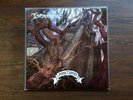
The LP jacket is in near mint minus condition! The jacket is tight and clean, with NO seam splits. The corners are solid, with just a bit of shelf wear the seams and corners. There are a couple of small stickers, one on the front and one on the back of the cover, as well as a name written in ink on the back cover. The colors on the jacket are sharp...just lovely (see pictures with this listing as they are of the actual item).
The LP is in near mint minus condition! We found that the vinyl looked superb on this vintage LP. There may be some light spider marks (caused by sliding the LP in and out of the inner sleeve), which may sound on some audio systems, depending on the sensitivity of your audio gear. However, the LP retains much of the original gloss and sheen! There are NO serious spindle marks on the record labels either. Just beautiful FRENCH made vinyl!A Short Note About LP GRADING -
- Mint = Only used for sealed items.
- Near Mint = Virtually flawless in every way.
- Near Mint Minus = Item has some minor imperfections, some audible.
- Excellent = Item obviously played and enjoyed with some noise.
- Very Good Plus = Many more imperfections which are noticeable and obtrusive.
For best results, always thoroughly clean your LPs before playing them.
LPs can be audiophile quality pressings (any collector of fine MFSL, half speeds, direct to discs, Japanese/UK pressings etc., can attest to the difference a quality pressing can make to an audio system).
Don't let this rarity slip by!!!price rating