PINK FLOYD Atom Heart Mother 1st Press "NO EMI" NM Audio AWESOME COPY
£
153
$
203


Favourite Auctions
To save auctions to your favourites, please login
If you don't have an account, please register
Description
A BREAKDOWN OF THE ARTIST/S :-
One of the most predominant and celebrated rock bands of all time, the origins of Pink Floyd can be traced to Cambridge High School in England. Syd Barrett (Born Roger Keith Barrett, 6 January 1946, Cambridge, England; guitar/vocals), Roger Waters (Born George Roger Waters, 9 September 1943, Great Bookham, Cambridge, England; bass/vocals) and David Gilmour (Born 6 March 1946, Cambridge, England; guitar/vocals) were pupils and friends there. Mutually drawn to music, Barrett and Gilmour undertook a busking tour of Europe prior to the former's enrolment at the Camberwell School Of Art in London. Waters was meanwhile studying architecture at the city's Regent Street Polytechnic. He formed an R&B-based band, Sigma 6, with fellow students Nick Mason (Born Nicholas Berkeley Mason, 27 January 1944, Downshire Hill, Birmingham, England; drums) and Rick Wright (Born Richard William Wright, 28 July 1945, London, England; keyboards). The early line-up included bass player Clive Metcalfe - Waters favoured guitar at this point - and (briefly) Juliette Gale (who later married Wright) but underwent the first crucial change when Brian Close (lead guitar) replaced Metcalfe. With Waters now on bass, the band took a variety of names, including the T-Set and the (Screaming) Abdabs. Sensing a malaise, Waters invited Barrett to join but the latter's blend of blues, pop and mysticism was at odds with Close's traditional outlook and the Abdabs fell apart at the end of 1965.
Almost immediately Barrett, Waters, Mason and Wright reconvened as the Pink Floyd Sound, a name Barrett had suggested, inspired by an album by Georgia blues' musicians Pink Anderson and Floyd Council. Within weeks the quartet had repaired to the Thompson Private Recording Company, sited in the basement of a house. Here they recorded two songs, "Lucy Leave", a Barrett original playfully blending pop and R&B, and a cover version of Slim Harpo's "I'm A King Bee". Although rudimentary, both tracks indicate a defined sense of purpose. Ditching the now-superfluous "Sound" suffix, the Pink Floyd attracted notoriety as part of the nascent counter-culture milieu centred on the London Free School. A focus for the emergent underground, this self-help organisation co-founded by John "Hoppy" Hopkins, Pete Jenner, Andrew King and Joe Boyd, inspired the founding of Britain's first alternative publication, International Times. The paper was launched at the Roundhouse in London on 15 October 1966; it was here Pink Floyd made its major debut. By December the band was appearing regularly at the newly founded UFO Club on Tottenham Court Road, spearheading Britain's psychedelic movement with extended, improvised sets and a highly-visual lightshow. Further demos ensued, produced by UFO-co-founder Boyd, which in turn engendered a recording deal with EMI Records. Surprisingly, the band's hit singles were different to their live sound, featuring Barrett's quirky melodies and lyrics. "Arnold Layne', a tale of a transvestite who steals ladies" clothes from washing lines, escaped a BBC ban to rise into the UK Top 20. "See Emily Play", originally entitled "Games For May" in honour of an event the band hosted at Queen Elizabeth Hall, reached number 6 in June 1967. It was succeeded by The Piper At The Gates Of Dawn which encapsulated Britain's "Summer of Love". Largely Barrett-penned, the set deftly combined childlike fantasy with experimentation, where whimsical pop songs nestled beside riff-laden sorties, notably the powerful "Interstellar Overdrive".
Chart success begat package tours - including a memorable bill alongside the Jimi Hendrix Experience - which, when combined with a disastrous US tour, wrought unbearable pressure on Barrett's fragile psyche. His indulgence in hallucinogenic drugs exacerbated such problems and he often proved near-comatose on-stage and incoherent with interviewers. A third single, "Apples And Oranges", enthralled but jarred in equal measures, while further recordings, "Vegetable Man" and "Scream Thy Last Scream", were deemed unsuitable for release. His colleagues, fearful for their friend and sensing a possible end to the band, brought Dave Gilmour into the line-up in February 1968. Plans for Barrett to maintain a backroom role, writing for the band but not touring, came to naught and his departure was announced the following April. He subsequently followed a captivating, but short-lived, solo career.
Although bereft of their principle songwriter, the realigned Pink Floyd completed Saucerful Of Secrets. It featured one Barrett original, the harrowing "Jugband Blues", as well as two songs destined to become an integral part of their live concerts, the title track itself and "Set The Controls For The Heart Of The Sun". Excellent, but flop singles, "It Would Be So Nice" (a rare Wright original) and "Point Me At The Sky" were also issued; their failure prompted the band to disavow the format for 11 years. A film soundtrack, More, allowed Waters to flex compositional muscles, while the part-live, part-studio Ummagumma, although dated and self-indulgent by today's standards, was at the vanguard of progressive space-rock in 1969. By this point Pink Floyd were a major attraction, drawing 100,000 to their free concert in London the following year. Another pivotal live appearance, in the volcanic crater in Pompeii, became the subject of a much-loved, late-night film.
Pink Floyd's first album of the 70s, the UK chart-topper Atom Heart Mother, was a brave, if flawed, experiment, partially written with avant garde composer, Ron Geesin. It featured the first in a series of impressive album covers, designed by the Hipgnosis studio, none of which featured photographs of the band. The seemingly abstract image of Meddle, is in fact a macro lens shot of an ear. The music within contained some classic pieces, notably "One Of These Days" and the epic "Echoes", but was again marred by inconsistency. Pink Floyd's festering talent finally exploded in 1973 with Dark Side Of The Moon. It marked the arrival of Waters as an important lyricist and Gilmour as a guitar hero. Brilliantly produced - with a sharp awareness of stereo effects - the album became one of the biggest selling records of all time, currently in excess of 30 million copies. Its astonishing run on the Billboard chart spanned well over a decade (it was the first of the band's American chart-toppers) and at last Pink Floyd had rid itself of the spectre of the Barrett era. Perhaps with this in mind, a moving eulogy to their former member, "Shine On You Crazy Diamond", was one of the high points of the follow-up Wish You Were Here. Barrett apparently showed at Abbey Road studio during the sessions, prepared to contribute but incapable of doing so. "Have A Cigar", however, did feature a cameo appearance by Roy Harper. Although dwarfed in sales terms by its predecessor, this 1975 transatlantic number 1 album is now regarded by some aficionados as the band's artistic zenith.
Pink Floyd's next album, Animals, featured a scathing attack on the "clean-up television" campaigner, Mary Whitehouse, while the cover photograph, an inflatable pig soaring over Battersea power station, has since passed into Pink Floyd folklore. However it was with this album that tension within the band leaked into the public arena. Two of its tracks, "Sheep" and "Dogs', were reworkings of older material and, as one of the world's most successful bands, Pink Floyd was criticised as an anathema to 1977"s punk movement. At the end of the year, almost as a backlash, Nick Mason produced the Damned's Music For Pleasure. Wright and Gilmour both released solo albums in 1978 as rumours of a break-up abounded. In 1979, however, the band unleashed The Wall, a Waters-dominated epic which has now become second only to Dark Side Of The Moon in terms of sales. A subtly-screened autobiographical journey, The Wall allowed the bass player to vent his spleen, pouring anger and scorn on a succession of establishment talismen. It contained the anti-educational system diatribe, "Another Brick In The Wall Part II', which not only restored the band to the British and American singles" charts, but provided them with their sole number 1 hit when it topped the UK list. The album topped the US charts for an impressive 15 weeks. The Wall was also the subject of an imaginative stage show, during which the band was bricked up behind a titular edifice. A film followed in 1982, starring Bob Geldof and featuring ground-breaking animation by Gerald Scarfe, who designed the album jacket.
Such success did nothing to ease Pink Floyd's internal hostility. Long-standing enmity between Waters and Wright - the latter almost left the band with Barrett - resulted in the bass player demanding Wright's departure. He left in 1980. By the early 80s relations within the band had not improved. Friction over financial matters and composing credits - Gilmour argued his contributions to The Wall had not been acknowledged - tore at the heart of the band. "Because we haven't finished with each other yet," was Mason's caustic reply to a question as to why Pink Floyd were still together and, to the surprise of many, another album did appear in 1983. The Final Cut was a stark, humourless set which Waters totally dominated. It comprised songs written for The Wall, but rejected by the band. Mason's contributions were negligible, Gilmour showed little interest - eventually asking that his production credit be removed - and Pink Floyd's fragmentation was evident to all. One single, "Not Now, John", did reach the UK Top 30, but by the end of the year knives were drawn and an acrimonious parting ensued. The following year Waters began a high-profile solo career. Mason and Gilmour also issued solo albums, but none of these releases came close to the success of their former band. The guitarist retained a higher profile as a session musician, and appeared with ex-Roxy Music singer Bryan Ferry at the Live Aid concert in 1985.
In 1987, Mason and Gilmour decided to resume work together under the Pink Floyd banner; Rick Wright also returned, albeit as a salaried member. Waters instigated an injunction, which was over-ruled, allowing temporary use of the name. The cryptically titled A Momentary Lapse Of Reason, although tentative in places, sounded more like a Pink Floyd album than its sombre "predecessor", despite the muted input of Wright and Mason. Instead Gilmour relied on session musicians, including Phil Manzanera of Roxy Music. A massive world tour began in September that year, culminating 12 months and 200 concerts later. A live set, Delicate Sound Of Thunder, followed in its wake but, more importantly, the rigours of touring rekindled Wright and Mason's confidence. Galvanised, Waters led an all-star cast for an extravagant adaptation of The Wall, performed live on the remains of the Berlin Wall in 1990. Despite international television coverage, the show failed to reignite his fortunes.
In 1994, Pink Floyd reconvened again to release The Division Bell, an accomplished and highly successful set (it was the year's bestselling UK album release and restored the band to the top of the UK and US charts) which may yet enter the Pink Floyd lexicon as one of their finest achievements. "It sounds more like a genuine Pink Floyd album than anything since Wish You Were Here", Gilmour later stated, much to the relief of fans, critics and the band themselves. With Wright a full-time member again and Mason on sparkling form, the band embarked on another lengthy tour, judiciously balancing old and new material. They also showcased their most spectacular lightshow to date during these performances. Critical praise was effusive, confirming the band had survived the loss of yet another nominally "crucial" member. Pulse cashed in on the success of the tours and was a perfectly recorded live album. The packaging featured a flashing LED, which was supposed to last (in flashing mode) for six months.
Following this burst of activity in the mid-90s, Gilmour, Wright and Mason put Pink Floyd on hold once again. A series of reissues kept the band in the public eye, however, most notably the 2003 Hybrid SACD release of Dark Side Of The Moon which allowed listeners the chance to hear the album in 5.1 Surround Sound. The legacy of those "faceless" record sleeves is irrefutable; Pink Floyd's music is somehow greater than the individuals creating it.
Discography:
The Piper At The Gates Of Dawn (EMI Columbia 1967)****, Pink Floyd US only (Tower 1967)***, Saucerful Of Secrets (EMI Columbia 1968)***, More film soundtrack (EMI Columbia 1969)**, Ummagumma (Harvest 1969)***, Atom Heart Mother (Harvest 1970)***, Meddle (Harvest 1971)****, Obscured By Clouds film soundtrack (Harvest 1972)**, Dark Side Of The Moon (Harvest 1973)*****, Wish You Were Here (Harvest/Columbia 1975)****, Animals (Harvest/Columbia 1977)****, The Wall (Harvest/Columbia 1979)***, The Final Cut (Harvest/Columbia 1983)**, A Momentary Lapse Of Reason (EMI/Columbia 1987)***, Delicate Sound Of Thunder (EMI/Columbia 1988)***, In London 1966-1967 (See For Miles 1990)***, The Division Bell (EMI/Columbia 1994)****, Pulse (EMI/Columbia 1995)**, Is Anybody Out There? The Wall Live (EMI 2000)***, Dark Side Of The Moon SACD edition (EMI 2003)*****.
Compilations:
Relics (Harvest 1971)****, A Nice Pair (Harvest 1973)****, First Eleven 11-LP box set (EMI 1977)***, A Collection Of Great Dance Songs (Harvest/Columbia 1981)**, Works (Capitol 1983)***, Shine On 8-CD box set (EMI 1992)***, Echoes: The Best Of Pink Floyd (EMI 2001)****.
THE HISTORY OF THE RECORD :- Atom Heart Mother is the fifth studio album by English progressive rock band Pink Floyd, released in 1970 by Harvest and EMI Records in the UK and Harvest and Capitol in the US. It was recorded at Abbey Road Studios, London, England, and reached #1 in the UK, and #55in the US chart, and went gold in the US in March 1994. A remastered CD was released in 1994 in the UK, and 1995 in the US.
This was the first Pink Floyd album to be specially mixed for 4-channel quadraphonic sound as well as conventional 2-channel stereo. The SQ quadraphonic mix was released on LP in a matrix format compatible with standard stereo record players. There was also a release of the quadraphonic version in the UK in fully discrete 4-channel form on the "Quad-8" format, a 4-channel variant of the stereo 8-track tape cartridge.
The title track was to have been called "The Amazing Pudding", though Ron Geesin's original score referred to it as "Epic". Its name was changed after Geesin—who co-wrote the piece and arranged the orchestration on the recording—pointed to a copy of the Evening Standard (dated Thursday 16 July 1970), and suggested to Roger Waters that he would find a title in there. The headline was: "ATOM HEART MOTHER NAMED", a story about a woman being fitted with a nuclear powered pacemaker.
The piece is a progression from Pink Floyd's earlier instrumental pieces such as "A Saucerful of Secrets" and even earlier, "Interstellar Overdrive". The "Atom Heart Mother" suite takes up all of side one, and is split into six parts, featuring a full brass section and choir which take most of the lead melody lines, while Pink Floyd mainly provide the backing tracks; a reverse of the 1960s pop music practice of using orchestration as the background, and putting the rock band in front. However, there is one section where a bluesy electric guitar solo by David Gilmour takes the lead.
Critical reaction to the suite has always been mixed, and all band members have expressed negativity toward it in recent times. However they appear to have been enthusiastic about the suite in the early 1970s, taking a full brass section and choir on tour just for the purpose of performing this piece; a move which caused the tour to lose money. A later arrangement without brass or choir, and pared down from 25 minutes to fifteen by omitting the "collage" sections and closing reprise of the main theme, remained in their live repertoire into 1972, performed in concerts that also previewed The Dark Side of the Moon.
June 2008 saw Ron Geesin perform "Atom Heart Mother" with Italian tribute band Mun Floyd over two nights as part of the Chelsea Festival. Geesin introduced it with a history and slide show. The performances featured full choir, brass and noted cellist Caroline Dale, who has worked with David Gilmour. The second night saw Gilmour join Geesin on stage for the performance. The song was extended to over 35 minutes and received many excellent reviews.
Side two opens with three five-minute songs: one by each of the band's three resident songwriters, and closes with a suite with sound effects primarily conceived by Nick Mason, but credited to the whole group (and based mostly on musical ideas by Gilmour). Therefore, this album's concept is similar to their previous Ummagumma album, in that it features the full band in the first half, and focuses on individual members in the second half. Roger Waters contributes a folk ballad called "If" which he would play frequently at live shows in support of his Radio K.A.O.. album, more than a decade later. This is followed by Rick Wright's brass-heavy "Summer '68", a critique of the "rock 'n' roll" lifestyle that would soon become characteristic of Pink Floyd. Next is Gilmour's "Fat Old Sun", for which a fifteen minute extended arrangement spent two years as a key part of the band's live set, and is a staple of Gilmour's various solo tours.
The final track, "Alan's Psychedelic Breakfast", is divided into three segments, each with its own descriptive title, joined by dialogue and sound effects of then-roadie Alan Stiles preparing, discussing, and eating breakfast. A slightly re-worked version was performed onstage only once on 22 December 1970 at Sheffield City Hall, Sheffield, England with the band members pausing between pieces to eat and drink their breakfast.
The original LP ends with the sound of a dripping tap which continues into the inner groove, and thus plays on indefinitely
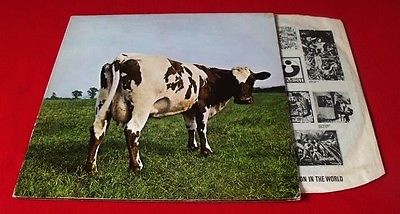
THE HISTORY OF THE COVER :- The original album cover, designed by art collective Hipgnosis, shows a cow standing in a pasture with no text nor any other clue as to what might be on the record. Some later editions have the title and artist name added to the cover. This concept was the group's reaction to the psychedelic space rock imagery associated with Pink Floyd at the time of the album's release; the band wanted to explore all sorts of music without being limited to a particular image or style of performance. They thus requested that their new album had "something plain" on the cover, which ended up being the image of a cow. Storm Thorgerson inspired by Andy Warhol's famous "cow-wallpaper," has said that he simply drove out into a rural area near Potters Bar and photographed the first cow he saw. The cow's owner identified her name as "Lulubelle III". More cows appear on the back cover, again with no text or titles, and on the inside gatefold. Also, a pink balloon shaped like a cow udder accompanied the album as part of Capitol's marketing strategy campaign. The liner notes in later CD editions give a recipe for Traditional Bedouin Wedding Feast on a card labeled "Breakfast Tips".
The album cover appears in Stanley Kubrick's film A Clockwork Orange. It is viewable on a shelf in the music shop scene. The album cover to The KLF's concept album, Chill Out was inspired by Atom Heart Mother.
THE COVER :- Single laminated sleeve
THE LABEL :- Fontana blue labels
THE VINYL VISUALLY :- The initial inspection of the vinyl before playgrading reveal no concerns atall. The vinyl is flat and warp free. I cannot see any marks, scratches or scuffs. Infact I could say that it may be unplayed but having owned it from new I know it has been played at the most 3 or 4 times. The sheen is deep and rich and has that just pressed sheen and feel. I would say it is in as good a shape as you'll find for a long time. I would grade them visualy as Near Mint condition.
THE VINYL PLAY GRADED :- The playgrading of the vinyl reveals no lessening in the sound quality. It lives up to its visual grading easily. You may hear the merest hint of light static crackle in the very quietest parts of the album such as the soft instrumental intro on the first track but it is almost as though it is just dust that has settled in that moment. I can't stress how hard it is to find these types of early prog albums without a lot of crackle as the multitude of soft passages and bridges are far more prevalent on these albums. I can honestly say though having played the album from start to finish that this one is as close as you could get to unplayed, Yes there is the tiniest amount of crackle here and there but even an unplayed one can have these areas. I have no hesitation in grading the playback as Near Mint.
THE SLEEVE FRONT CONDITION :- This is the very earliest 1st press Garrod & Lofthouse textured sleeve. The front of the sleeve is free from writing such as old prices or previous owners names. There are no creases to speak of apart from one thumb type handling crease at the opening, even this is not apparent untill it is tilted into the light. There is again only the very merest hint of ringwear at the top when tilted into the light. There are no grubby marks on the front and the colours are still deep and full of life. There is a small amount of corner storage wear in the bottom two corners but it is light and many people might not even mention it. There is the unavoidable seam rubbing but it is again something that may not be mentioned by someone else as it is very very light. There is a tiny bit of sticker residue in the top right corner. I'm not sure what was peeled from there as it was so long ago, maybe a small price tag. It has not broken or damaged the surface though and if wanted I'm sure it could be totally removed. I'll leave that for a steadier hand than mine though. As for a grade I would give it a strong Excellent condition and I think I am being quite conservative with that grading.
THE SLEEVE REAR CONDITION :- I would say that the rear of the sleeve is on a par with the front of the cover or maybe slightly better. There are no creases and no ringwear either. There is some corner wear in the top right and bottom left corners, this is a rubbing of the top surface rather than bumping. There does not seem to be any visable grubby marks and the colours are still fresh and bright. I can safely grade it as Excellent condition having toyed with the idea of grading it higher but I think Excellent is a fair grading.
THE INNER GATEFOLD CONDITION :- The inner of the gatefold is in a similar shape and carries on the theme of my previous grading. There are no areas of real concern. The sticker residue that was noted on the front is evident on the inner left of the gatefold also. Again if you're feeling confident this may very well come off leaving it spotless. There is the absolute merest amount of ringwear if the rub your hand gently over the right side but again this is barely there and I'm only trying to be as thorough as I can. There is some light corner wear again evident but very light. There does appear to be one tiny mark on the right side but I may be totally wrong at it could be part of the original print. All the text is bright and clear I would grade the inner of the gatefold as a strong Excellent condition
THE LABEL SIDE ONE CONDITION :- Original Harvest 1st Press label with no EMI in excellent order free from stickers or writing and with only one very very small graze under the "E" of Harvest. It looks bigger than it is on my superimposed photo but in reality it is barely noticeable. No real signs of play around the spindle hole. Near Mint condition.
THE LABEL SIDE TWO CONDITION :- Original Harvest 1st Press label with no EMI in excellent order free from stickers or writing and no damage at all. There is a very light mark around the "H" of Harvest but no signs of play around the spindle hole. Near Mint condition.
THE SPINE CONDITION :- The writing on the spine is mostly clear. There is some rubbing of the top surface where the catalogue number is printed which does render a couple of the numbers unreadable and there are a couple of other light patches of rubbing along thev length. Generally though in Near Excellent condition
THE INNER SLEEVE CONDITION :- The original EMI inner sleeve is present and in lovely condition. There is some light ringwear type discolouring but that is impossible to avoid. That apart there are no creases to speak of and no splits of the seam. Excellent condition.
THE EXTRAS :- No extras were given with this album
THE CATALOGUE NUMBER :- SHVL 781
THE YEAR OF RELEASE :- 1970
THE LABEL :- HARVEST
THE COUNTRY OF ORIGIN :- UK
PLAYING FORMAT :- STEREO
THE MATRIX NUMBERS :- SHVL 781 A-1G & SHVL 781 B-1G
STAMPERS :- RP 2& RO 2
TRACK LISTING :-
SIDE ONE :-
- a) FATHERS SHOUT
- b) BREAST MILKY
- c) MOTHER FORE
- d) FUNKY DUNG
- e) MIND YOUR THROATS PLEASE
- f) REMERGENCE
SIDE TWO :-
- 1) IF
- 2) SUMMER 68
- 3) FAT OLD SUN
- 4) ALANS PSYCHEDELIC BREAKFAST
- a) RISE AND SHINE
- b) SUNNY SIDE UP
- c) MORNING GLORY
WHAT WE PLAY THE RECORD ON :-
We use a Project 6 Perspex Turntable to play grade our records which delivers a rich authoritative sound and achieves a rich and weighty vibrancy unrivalled by the majority of decks within its price range
HOW WE CLEAN YOUR RECORD :-
We use a V.P.I. HW-16.5 record cleaning machine to clean your vinyl. "A highly recommended machine" as quoted by Stereophile magazine. This removes any excess dirt before playing
HOW WE PACKAGE YOUR RECORD :-
Your record will be package very securely to minimise any risk of damage during transit. We remove the record from the outer sleeve unless asked not to do so. This helps to minimise the risk of seam spliting. We use a high quality record mailer which is designed to give superior protection for your vinyl record. We place stiffeners either side of the record for added protection. The album will also be placed in a 450 gram Poly outer sleeve for even extra added protection
POSTAGE AND PACKAGING CHARGES FOR UK CUSTOMERS :-
We advise that items reaching over £50 in price to be insured and sent by Special Delivery. This protects both of us and ensures better handling of the parcel during transit.We are in no way out to make money from postage. The postage price includes the record mailer, stiffeners and plastic sleeve. We just want your item to reach you in the best possible condition. A breakdown of insured postal services are listed below. Please choose to use the relevant postal service for your own protection as once these rare records are lost they can quite often seldom be replaced
SECOND CLASS RECORDED (INSURED UP TO £50) :- FREE
FIRST CLASS RECORDED (INSURED UP TO £50) :- £0.45
SPECIAL DELIVERY NEXT DAY UPTO 500g :- £3.80
SPECIAL DELIVERY NEXT DAY FROM 500g - 1000g :- £5.00
(SPECIAL DELIVERY INSURES YOUR ITEM UPTO £500)
POSTAGE AND PACKAGING FOR THE EUROPEAN UNION :-
All records reaching under £15 are sent to the European Union by Airmail small packets. We will not ship abroad without insured post for items reaching over £15
AIRMAIL SMALL PACKETS :- £6.22 (For items under £15)
INTERNATIONAL SIGNED FOR :- £11.37 (For items £15 - £50)
INTERNATIONAL SIGNED FOR :- £13.97 (For items £50 - £500)
(These prices are based on a package weight of no more than 500g and can vary for heavier packages)
POSTAGE AND PACKAGING FOR THE USA AND CANADA :-
All records reaching under £15 are sent to the USA & Canada by Airmail small packets. We will not ship abroad without insured post for items reaching over £15
AIRMAIL SMALL PACKETS :- £8.78 (For items under £15)
INTERNATIONAL SIGNED FOR :- £13.93 (For items £15 - £50)
INTERNATIONAL SIGNED FOR :- £16.53 (For items £50 - £500)
(These prices are based on a package weight of no more than 500g and can vary for heavier packages)
POSTAGE AND PACKAGING FOR THE AUSTRALIA AND JAPAN AND ROW :-
All records reaching under £15 are sent to the Australia & Japan by Airmail small packets. We will not ship abroad without insured post for items reaching over £15
AIRMAIL SMALL PACKETS :- £9.06 (For items under £15)
INTERNATIONAL SIGNED FOR :- £14.21 (For items £15 - £50)
INTERNATIONAL SIGNED FOR :- £16.81 (For items £50 - £500)
(These prices are based on a package weight of no more than 500g and can vary for heavier packages)
PLEASE NOTE THAT WE DO NOT PROFIT FROM POSTAGE, THE PRICES WE QUOTE ARE QUITE ACCURATE AND INCLUDE THE PACKAGING MATERIALS AT COST PRICE
NOTE FOR INTERNATIONAL BUYERS:
PLEASE AWAIT AN INVOICE BEFORE PAYING SO WE CAN WORK OUT THE CORRECT POSTAGE/SHIPPING CHARGES
BUYERS OF MULTIPLE ITEMS :-
Postage prices and courier methods for multiple purchases will be calculated after the auction end. It is impossible for us at the pre auction stage to determine these prices as the final weight is unknown.If you are the winner of multiple items the please await contact from us or alternately contact us yourself for a breakdown of the shipping costs.You will only pay the stamp price + relevant packaging charges so there are big savings to be made with multiple purchases
HOW TO PAY FOR YOUR RECORD :-
We can accept the following payment methods
UK BUYERS :-
- PayPal
- Personal cheque (Please allow to clear)
- Bankers Draft
- Postal Order
OVERSEAS BUYERS :-
- Paypal only
TERMS AND CONDITIONS :-
We always try to appraise the record for sale as openly and honestly as possible and provide plenty of pictures for you to look at but please be aware that errors however rare do occur and not everyone has the same audio equipment. There is no problem that cannot be worked out in a civilised manner. We urge you to contact us so that we can discuss any small problems that may occur. We offer a refund of the purchase price for returned items within 7 days of purchase and are happy to help you with any questions or concerns you may have during the auction
SAVE US TO YOUR FAVOURITES LIST AS WE INTEND TO LIST MANY MORE RARE VINYL TREATS OVER THE COMING MONTHS AND YEARS
price rating