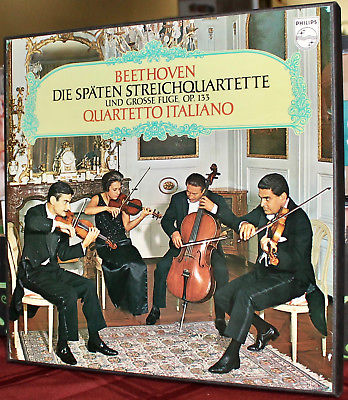
PHILIPS 4-LPs 6707-008: BEETHOVEN Late String Quartets - QUARTETTO ITALIANO 1976
$
70


$ 70
Sold For
Apr 4, 2018
Sold Date
Oct 28, 2017
Start Date
1
Number Of Bids
USA
Country Of Seller
eBay
Sold at
Favourite Auctions
To save auctions to your favourites, please login
If you don't have an account, please register
Description
****Welcome to our listing, thanks very much for looking!
****See our own website! We have lots of out of print and rare LPs and CDs! You can find us on the world wide web at -
hearthedifference.net
****Shipping cost is only an estimate - it depends on the actual weight and size of the package as well as the service required. We do not profit from shipping costs, so if we overcharge, we will refund the difference back to you. It's always best to wait for our invoice before paying for your item. We will combine shipping for multiple items purchased.
****Please see our other listings for more great LPs and CDs - new items added daily!
****To access our eBay store click on the little red door at the top right section of any of our eBay listings or, click on -
http://stores.ebay.com/Hear-The-Difference
Background -
The Quartetto Italiano (English: Italian Quartet) was a string quartet founded in Reggio Emilia in 1945. They made their debut in 1945 in Carpi when all four players were still in their early 20's. They were originally named Nuovo Quartetto Italiano before dropping the "Nuovo" tag in 1951. They are particularly noted for their recording of the complete cycle of Beethoven string quartets, made between 1967 and 1975. The quartet disbanded in 1980.The secretary and historian of the Quartet was Guido Alberto Borciani (Reggio Emilia, 20 October 1920 – 4 April 2008), mechanical engineer and talented pianist, Paolo's brother and founder in 1987 of the Premio Paolo Borciani.
Borciani, Pegreffi and Rossi met in 1940 at the Concorso Nazionale in La Spezia. In summer 1942 they met again at the Accademia Musicale Chigiana in Siena, where the cellist Arturo Bonucci (Sr.) (head of the chamber class, husband of Pina Carmirelli) put them together with the viola player Lionello Forzanti for the study session. They worked together on the Debussy quartet and performed it in September 1942.
In August 1945 the group began to study together again at the Borciani house in Reggio Emilia. Their debut followed on 12 November 1945 at the Sala dei Mori in Carpi, as the Nuovo Quartetto Italiano, in the inaugural concert of the Società degli Amici della Musica. By the end of the year they had also performed in Reggio Emilia and in Milan. In March 1946 they were winners at the Concorso of the Accademia Nazionale di Santa Cecilia, and also in the Concorso of the Accademia Filarmonica Romana. A performance for the Milan Quartet Society followed, and the first foreign engagement was at the Zürich Tonhalle.
In February 1947 Piero Farulli replaced Forzanti at the viola desk, and the first performance in the new (and permanent) company was in Mantua. Debuts followed that year in Austria, England, at the Venice International Festival, and at the Engadin Konzertwochen (where their collaboration with clarinettist Antoine de Bavier in the Mozart Quintet K.581 occurred - recorded for the Decca label). They also gave the world premiere of the Villa-Lobos Quartet No.9 at the Accademia Filarmonica Romana.
Appearances in Italy, England, Scotland, Spain and France followed in 1948, totalling 63 concerts, and the group began recording for Decca Records. Concerts rose to over 100 in 1949, with visits to Sweden, Czechoslovakia, Denmark, Norway and the Netherlands. At Stockholm Royal Academy they gave a series of lecture-recitals with Gerda Busoni, widow of Ferruccio Busoni. Another century of concerts was given in 1950.
In 1951 (having dropped the word “Nuovo” (i.e., new) from their name) the Quartet performed at the Edinburgh Festival and at the Salzburg Festival. It was at Salzburg that they had a long and very influential interview with Wilhelm Furtwängler, who urged them to work towards a much greater freedom of expression which would access for them the world of Grand Romanticism. This was much later acknowledged as a critical turning-point for the group.
In November they made their first U.S. tour, which was repeated in approximately alternate years until 1977. Virgil Thomson pronounced them “The finest string quartet, unquestionably, that our century has known.” In 1953, the year in which they transferred their recording programme to Columbia Records, they gave 59 concerts in the U.S. and Canada. In that year also, Elisa Pegreffi married Paolo Borciani.
Recordings which followed included (1954) the Darius Milhaud Quartet No.12, and (1956) the Debussy Quartet, which Robert Kemp described as “miraculous”. The group was then studying the six Mozart Quartets dedicated to Joseph Haydn, and performed them at venues including Milan and Fiesole. Important Festival appearances continued, at Lucerne (1955), the Maggio Musicale Fiorentino (1959), the Prague Spring Festival (1961) and the Berlin Musikwochen.
Through the later 1960s and early 1970s the group toured further afield, to Macedonia (1966), to South America (1968), to South Africa and Zambia (1970), and to Poland, the U.S.S.R. and Japan in 1973. Meanwhile, their recording projects for Philips Records, begun in 1965, were coming to fruition, with the Mozart integrale finished in 1972 and the Beethoven in 1973.
In this later period their collaboration with Maurizio Pollini took place. The completion of their recording work in Schubert did not occur until 1977. In their late concerts the group focussed especially upon Beethoven and Schubert, often devoting a recital to two works, a single masterpiece by each composer. In December 1977 Piero Farulli was obliged to retire from the group owing to illness, and was replaced by Dino Asciolla. However following a tour to Israel it was decided to bring the Quartet to an end in 1980.
The Quartetto Italiano have recorded the complete quartets by Beethoven, Mozart, Schumann, Brahms and Webern. They rarely collaborated with external members, but two notable recordings are Mozart's Clarinet Quintet with Antoine-Pierre de Bavier (Decca, early 1950s), and Brahms's Piano Quintet Op.34 with Maurizio Pollini (Deutsche Grammophon, 1979). They also planned to play Schubert's String Quintet with Pierre Fournier, and Mozart's Quintet with two violas (K.516) with Milan Škampa, violist of the Smetana Quartet, but neither project was realized, the first due to the impossibility of finding a concert date, the second due to a visa refusal from the Czechoslovakian authorities. Their complete recordings for Decca, Philips and Deutsche Grammophon were released in a 37-disc set by Decca in 2015.
Originally issued on separate LPs in the late '60s, Quartetto Italiano's legendary recordings of Ludwig van Beethoven's late string quartets occupied a prestigious place in Philips' catalog and fully warranted reissue on CD for their technical acumen, intellectual clarity, and expressive depth. All serious string quartets aspire to play these monumental works, which have proved to be more influential than any others in their genre; it's fair to say that most groups wish their performances could at least be equal to Quartetto Italiano's, both in terms of staying power and sublime musicality. It's difficult to choose one opus over another, since each has a distinctive character that demonstrates Beethoven's extremely wide range of moods, and Quartetto Italiano's interpretations are magnificent across the boards, without a single low point. - Blair Sanderson
Taken as a whole, this is music whose range is so great, whose substance is so varied and whose spiritual journeyings are so profound that they render the very concept of definitive performance absurd. Not even the greatest performance can possibly reveal the whole truth of any masterpiece, let alone so many. That said, some come conspicuously nearer than others. Beautifully (but not too beautifully) mastered, these justly famous performances deserve a place on anyone’s shelf. In precision of phrase and articulation, in purity of intonation and homogeneity of tone, they have few rivals. Indeed it’s a tribute to the integrity and spiritual variety of the playing that my mind was continually cast back to the still unsurpassed recordings of the Busch Quartet made some sixty years ago. To say that the Italians are not primarily interested in the more sensual aspects of quartet-playing here is not to suggest that there is anything ugly or abrasive in their approach as a whole, but to indicate, rather, that they never make beauty of tone an end in itself. They capture the roughness of Beethoven as well as the lyricism and ultimate sublimity. There’s no attempt to prettify him. At the same time, when Beethoven wants beauty, the Italians unstintingly oblige. Their sound is an impressive (and impressively varied) amalgam of polyphonic clarity and harmonic blend, full but never fulsome, rich in colour yet predominantly lean in character. Interpretatively, too, they strike an almost ideal balance between consummate professionalism, deep reflection and a sense of spontaneity which has all the exhilaration and awe of fresh discovery. Not once do they sound remotely routine. This is a set to be treasured. - Jeremy Siepmann
Ludwig van Beethoven's late string quartets are the following works:
• Opus 127: String Quartet No. 12 in E-flat major (1825)
• Opus 130: String Quartet No. 13 in B-flat major (1825)
• Opus 131: String Quartet No. 14 in C-sharp minor (1826)
• Opus 132: String Quartet No. 15 in A minor (1825)
• Opus 133: Große Fuge in B-flat major for string quartet (1826; originally the finale to Op. 130; it also exists in a piano four hands transcription, Op. 134)
• Opus 135: String Quartet No. 16 in F major (1826)
These six works are Beethoven's last major completed compositions. Although dismissed by the musicians and audiences in Beethoven's day, they are now widely considered to be among the greatest musical compositions of all time, and have inspired many composers and musicians. Igor Stravinsky described the Große Fuge as "an absolutely contemporary piece of music that will be contemporary forever". Richard Wagner, when reflecting on Op. 131's first movement, said that it "reveals the most melancholy sentiment expressed in music". The quartets have been performed and recorded by string quartets worldwide.
These quartets went far beyond the comprehension of musicians and audiences of the time. One musician commented that "we know there is something there, but we do not know what it is." Composer Louis Spohr called them "indecipherable, uncorrected horrors." Opinion has changed considerably from the time of their first bewildered reception: these six quartets (counting the Große Fuge) comprise Beethoven's last major, completed compositions and are widely considered to be among the greatest musical compositions of all time. The musicologist Theodor Adorno, in particular, thought highly of them, and Igor Stravinsky described the Große Fuge as "an absolutely contemporary piece of music that will be contemporary forever". Their forms and ideas inspired and continue to inspire musicians and composers, such as Richard Wagner and Béla Bartók. Wagner, when reflecting on Op. 131's first movement, said that it "reveals the most melancholy sentiment expressed in music". The last musical wish of Schubert was to hear the Op. 131 quartet, which he did on 14 November 1828, five days before his death. Upon listening to a performance of the Op. 131 quartet, Schubert remarked, "After this, what is left for us to write?" Of the late quartets, Beethoven's favorite was the Fourteenth Quartet, op. 131 in C? minor, which he rated as his most perfect single work.
-
LP made by PHILIPS Records, in the NETHERLANDS / HOLLAND / DUTCH
-
LP released in 1976
-
LP is recorded in STEREO
-
Record Catalog Number: 6707 008
-
Record Labels are primarily RED with SILVER lettering.
Beethoven // Quartetto Italiano
LP title and music on this rare item -
Die Spaten Streichquartette und Grosse Fuge, Op. 133
Tracks -1. Quartet for Strings no 12 in E flat major, Op. 127 by Ludwig van Beethoven
Orchestra/Ensemble: Quartetto Italiano
Period: Classical
Written: 1823-1825; Vienna, Austria
2. Quartet for Strings no 14 in C sharp minor, Op. 131 by Ludwig van Beethoven
Orchestra/Ensemble: Quartetto Italiano
Written: 1826
3. Quartet for Strings no 13 in B flat major, Op. 130 by Ludwig van Beethoven
Orchestra/Ensemble: Quartetto Italiano
Period: Classical
Written: 1825-1826; Vienna, Austria
4. Quartet for Strings no 16 in F major, Op. 135 by Ludwig van Beethoven
Orchestra/Ensemble: Quartetto Italiano
Written: 1826
5. Quartet for Strings no 15 in A minor, Op. 132 by Ludwig van Beethoven
Orchestra/Ensemble: Quartetto Italiano
Period: Classical
Written: 1825; Vienna, Austria
6. Grosse Fuge for String Quartet in B flat major Op. 133 by Ludwig van Beethoven
Orchestra/Ensemble: Quartetto Italiano
Period: Classical
Written: 1825-1826; Vienna, Austria
String Quartet Op. 127 In E Flat
1.A.1 Maestoso - Allegro
1.A.2 Adagio, Ma Non Troppo E Molto Cantabile
1.A.3 Scherzando Vivace
1.B.4 Finale
String Quartet Op. 135 In F Major
1.B.5 Allegretto
1.B.6 Vivace
1.B.7 Lento Assai, Cantante E Tranquillo
1.B.8 Der Schwer Gefasste Entschluss. Grave - Allegro - Grave Ma Non Troppo Tratto - Allegro
String Quartet Op. 130 In B Flat
2.A.1 Adagio Ma Non Troppo - Allegro
2.A.2 Presto
2.A.3 Andante Con Moto Ma Non Troppo. Poco Scherzando
2.A.4 Alla Danza Tedesca. Allegro Assai
2.A.5 Cavatina. Adagio Molto Espressivo
Grosse Fugue Op. 133 In B Flat
2.B.7 Overtura. Allegro - Meno Mosso E Moderato - Allegro - Fuga
2.B.6 Finale. Allegro
String Quartet Op. 131 In C Sharp Minor
3.A.1 Adagio Ma Non Tropp E Molto Espressivo
3.A.2 Allegro Molto Vivace
3.A.3 Allegro Moderato
3.A.4 Andante Ma Non Troppo E Molto Cantabile
3.B.5 Presto
3.B.6 Adagio Quasi Un Poco Andante
3.B.7 Allegro
String Quartet Op. 132 In A Minor
4.A.1 Assai Sostenuto - Allegro
4.A.2 Allegro Ma Non Tanto
4.B.3 Canzona Di Ringraziamento. Molto Adagio - Sentendo Nuova Forza. Andante
4.B.4 Alla Marcia, Assai Vivace - Piu Allegro - Presto
4.B.5 Allegro Appassionato
Performers / Credits -
• Cello – Franco Rossi
• Composed By – Ludwig van Beethoven
• Design – Tobie Goedewaagen
• Liner Notes – A. David Hogarth
• Strings [Quartet] – Quartetto Italiano
• Viola – Piero Farulli
• Violin [1] – Paolo Borciani
• Violin [2] – Elisa Pegreffi
Other Information -
Recorded: Switzerland, 6/1968 (Op. 127, Op. 135); 4/1969 (Op. 130, 133); 8/1967 (Op. 132); 7/1969 (Op. 131).
CONDITION Details:
The 4-LP box is in near mint minus condition! The box has NO splits or crushed corners - just gorgeous! The corners and seams are solid with just some light shelf wear. The colors on the box are sharp and clean (see pictures with this listing as they are of the actual item).
The set comes complete with a large format paper insert/libretto.
The 4-LPs are in near mint minus condition! We found that the vinyl looked superb on this vintage LP set. There are no significant marks and the LPs retain much of the original gloss and sheen - obviously well taken care of! They do have a bit of dust and perhaps a finger print or two on them so they should be cleaned before playing. There are NO serious spindle marks on the record labels either. Just beautifully made vinyl! That said, acquiring a vintage LP like this is for the performance and rarity of the LP, not necessarily for the sound quality.A Short Note About LP GRADING -
- Mint = Only used for sealed items.
- Near Mint = Virtually flawless in every way.
- Near Mint Minus = Item has some minor imperfections, some audible.
- Excellent = Item obviously played and enjoyed with some noise.
- Very Good Plus = Many more imperfections which are noticeable and obtrusive.
For best results, always thoroughly clean your LPs before playing them.
LPs can be audiophile quality pressings (any collector of fine MFSL, half speeds, direct to discs, Japanese/UK pressings etc., can attest to the difference a quality pressing can make to an audio system).
Don't let this rarity slip by!!!price rating