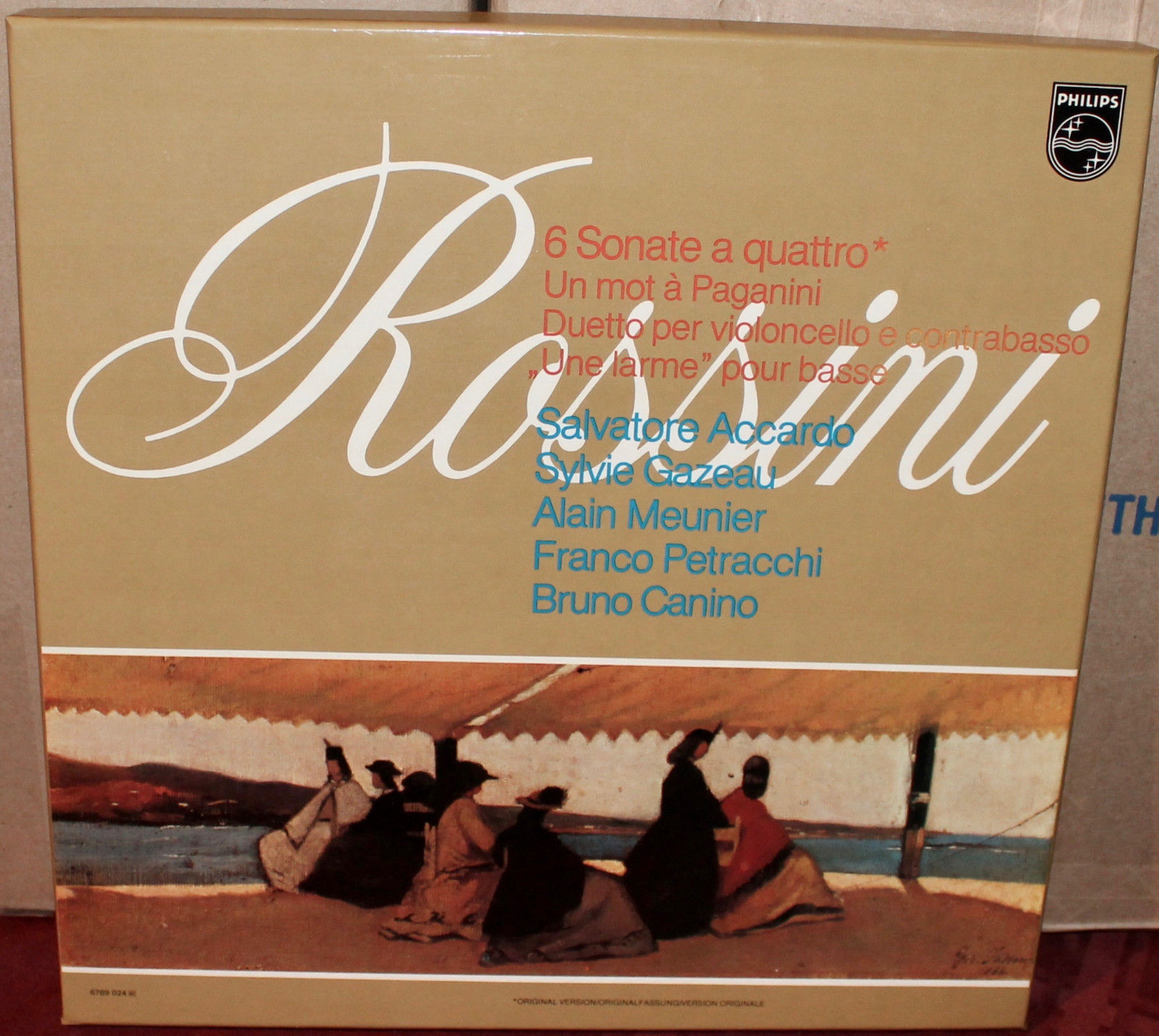
PHILIPS 2-LP Box 6769-024: ROSSINI - 6 Sonate a Quattro - ACCARDO - 1979 DUTCH
C$
1,000
$
725


Favourite Auctions
To save auctions to your favourites, please login
If you don't have an account, please register
Description
****Welcome to our listing, thanks very much for looking!
****See our own website! We have lots of out of print LPs and CDs! You can find us on the world wide web at -
hearthedifference.net
****Shipping cost is only an estimate - it depends on the actual weight and size of the package as well as the service required. We do not profit from shipping costs, so if we overcharge, we will refund the difference back to you. It's always best to wait for our invoice before paying for your item. We will combine shipping for multiple items purchased.****Please see our other listings for more great LPs and CDs - new items added daily.
****To access our eBay store click on the little red door at the top right section of any of our eBay listings or, click on -
http://stores.ebay.com/Hear-The-Difference
Background -
The original Philips recordings of these lovely works by Rossini, on the LP format, is one of the holy grails in classical music collecting. All serious classical collections must have a copy of this reference performance!
In 1803, when he was only 11, Gioacchino Rossini befriended the wealthy Malerbi family in Lugo. He had access to their rich music library and took singing lessons from Canon Giuseppe Malerbi. Under Malerbi's guidance, Rossini also developed the foundations of what was to become his own unique style of composition. In addition to singing, he played the harpsichord and was able to decipher and interpret much of the music of his time, particularly the works of Mozart and Haydn, which were to leave a permanent mark on his style.
The six sonate a quattro for two violins, cello and double bass were composed by Rossini for the landowner and merchant Agostino Triossi, in the summer of 1804. It is noteworthy to mention that the unusual composition of the score — the absence of violas — was not a deliberate choice by Rossini but was rather determined by the absence of viola players among his friends, generally the prospective interpreters of his works. The six sonatas display a remarkable mastery of form and tonal contrasts for a 12-year-old composer. They also show an instinctive feel for rhythm, where good humor is accompanied by a rich lyricism. Moreover, they reveal his rising opera buffa style, of which he will make such perfect use in the operatic masterpieces to follow.
Later in his life, Rossini was fond of writing ironic attestations on his old autograph manuscripts. On these youthful sonatas he wrote this charming comment: "First violin, second violin, violoncello and contrabass parts for six terrible sonatas composed by me at the country house (near Ravenna) of my friend and patron Agostino Triossi, and this at a most youthful age, not having even received a lesson in thorough bass. They were all composed and copied in three days and performed in a doggish manner by Triossi, contrabass; Morini (his cousin), first violin; the latter's brother, violoncello; and the second violin by myself, who was not the least of the dogs in the group.” Despite the apparent denigration this statement may contain, the numerous corrections and the new versions he would publish over the years proved the importance Rossini would lend to his first works. It comes as no surprise that he criticized the first performance of these sonatas, considering their great technical difficulties. The virtuoso passages are played in turn by the first and the second violins; we can assume that Rossini, playing second violin, went along with this game out of pure bravado.
In order to accurately restore this "duel” between the first and the second violins during the recording, the second violins were placed to the right and the first violins, to the left. This positioning produces a most startling and natural stereophonic effect. - Gilles Potvin, Raymond Dessaints
In the 1940s, composer Alfredo Casella discovered a set of six string sonatas written by Gioachino Rossini. The parts were discovered in the Library of Congress in Washington, D.C., and cleared up many unknown facts about the pieces. It was known that Rossini had composed instrumental chamber music early in life, but the only existing pieces were an out-of-print set of string quartets published by Schott in 1823. This set of quartets had been arranged anonymously into traditional string quartet instrumentation and also existed in a configuration for woodwinds. As it turns out, the original parts (on which the published parts were based) were actually written for the extremely unconventional string quartet form of two violins, a cello, and a double bass.
From Rossini's own handwriting, we know that the pieces were written in 1804 near Ravenna, Italy, when he was still quite young. If we are to believe his comments, which he added to the manuscripts much later in life, he says that he was only 12 years old when he composed these "horrendous" sonatas. He also states that he had no formal training in harmony and that he composed the complete set and performed them in three days. The pieces were written for his friend, Agostino Triossi, who was an accomplished amateur bassist. Triossi, Morini (Triossi's violinist cousin), Morini's cellist brother, and Rossini performed the pieces, apparently in a less-than-stellar fashion. Rossini says his playing (on the second violin part) was the worst of all.
Each of the sonatas follows a similar three-movement format (fast-slow-fast). The second movements contain many soloistic, lyrical passages that foreshadow the style of the composer's great operatic arias; the Andante from Sonata No. 3 is especially striking for the somber quality of the melodic motive. The third movement of No. 3 is a lively theme with variations. The third movement of No. 6 is marked "Tempesta" and depicts music of a stormy nature, a musical predecessor to Rossini's "sturm" operatic style.
It is known that Rossini studied the quartets of Haydn and Mozart in his younger years, but the musical qualities of his string sonatas are not especially characteristic of these compositional influences. The voicing of harmonies is at times clumsy and problematic, no thanks to the strange instrumentation which doubles the lower strings and omits the viola. The pieces are, however, imaginative and lively, carrying Rossini's own stamp of originality. Each instrumental part contains numerous solo passages that require virtuosic skill from the performers -- even the oft-neglected bass. The individual parts have a lot of melodic independence, and the pervading lyrical quality of these works suggests more of an Italianate influence than an Austrian one. The string sonatas are performed today not only in their original string quartet form, but also by chamber orchestras. - Emily Stoops
Rossini claimed to have composed this and its five companion pieces in 1804, when he was 12, while staying in the country house of a family friend, for performance by Rossini and his benefactor's family. Because of the limitations of the available talent, the original scoring was for two violins, cello, and double bass. In 1823, Rossini spruced up this and four of the other pieces (minus one that too heavily depends on the bass) for publication in conventional string quartet format (with viola). Today, this string symphony, which Rossini clearly intended as chamber music, is generally performed by string orchestras, with bass part restored.
The first string symphony, like those to follow, is based very vaguely on Austrian models, especially the early three-movement string divertimenti of Mozart, although it's not known how Rossini could have been familiar with those particular works. The notion of harmony or accompaniment here is rudimentary. This is a series of good tunes, in the popular Italianate manner of the time.
The Moderato movement begins with a playful, descending figure for violins that spins off into a longer-lined melody and is succeeded by several busy but lyrical tunes, including one that features the cellos, and some of which actually take off from figures in the opening theme. Before long the violins take up an extended section of passagework that seems like embryonic material for an undeveloped Rossini crescendo. A very brief development section is really not much more than a contrasting episode in a minor key, and this is followed by a repeat of the entire first section. Thus, Rossini is relying more on the ABA song pattern than the sonata-allegro structure of a true Classical symphony of his period.
The Andantino is a nocturnal serenade begun in the lower and middle reaches of the orchestra, although the violins eventually slip in with complementary material that soon dominates the score. Next, they play a quiet, angular theme over sustained lines in the middle of the ensemble and pizzicato notes at the bottom. The movement progresses through an unsettled episode sounding rather like minor Mozart quartet-writing, then returns to the opening melody in fuller instrumentation. The concluding Allegro opens with a quick whistling tune, a melody that could serve in a popular song or an operetta aria. This forms the basis of a little rondo, alternating with busier, more "instrumental" writing, including a witty passage for double bass. - James Reel
• According to the Cambridge Companion to Rossini, Part 7, Rossini later added to the autograph manuscript:
First violin, second violin, violoncello, and contrabass for six horrendous sonatas composed by me at the country house (near Ravenna) of my friend and patron, Agostino Triossi, at the most youthful age, having not even had a lesson in thorough-bass. They were all composed and copied in three days and performed in a doggish way by Triossi, contrabass; Morini (his cousin), first violin; the latter's brother, violoncello; and the second violin by myself, who was, to tell the truth, the least doggish.
• However, the first published edition, from 1825-6, was for the standard string quartet. There is no extant evidence that they were arranged by someone else, so either Rossini decided, or the publisher convinced him, that the standard quartet instrumentation would be better. Interestingly, only five of the sonatas were published; no.3 was left out.
• These are also known in a version for wind quartet (flute, clarinet, horn, and bassoon), but this was an arrangement of all six quartets made during Rossini's lifetime by a clarinetist named Friedrich Berr (1794-1838).
Salvatore Accardo (born 26 September 1941 in Turin, northern Italy) is an Italian violinist and conductor, who is known for his interpretations of the works of Niccolò Paganini.
Accardo studied violin in the southern Italian city of Naples in the 1950s. He gave his first professional recital at the age of 13 performing Paganini's Capricci. In 1958 Accardo became the first prize winner of the Paganini Competition in Genoa.
He has recorded Paganini's 24 Caprices (re-recorded in 1999) for solo violin and was the first violinist to record all six of the violin concerti by Paganini. He has an extensive discography of almost 50 recordings on Philips, DG, EMI, Sony Classical, Foné, Dynamic, and Warner-Fonit. Notably, he has recorded an album of classical and contemporary works in 1995 on Paganini's Guarneri del Gesù 1742 violin, Il Cannone.
Accardo founded the Accardo Quartet in 1992 and he was one of the founders of the Walter Stauffer Academy in 1986. He founded the Settimane Musicali Internazionali in Naples and the Cremona String Festival in 1971, and in 1996, he re-founded the Orchestra da Camera Italiana (O.C.I.), whose members are the best pupils of the Walter Stauffer Academy. Some of the most famous pupils are: Vincenzo Bolognese, Alessio Bidoli, Myriam Dal Don, Francesca Dego, Federico Guglielmo, Sergej Aleksandrovi? Krylov, Gabriele Pieranunzi, Laura Marzadori, Massimo Quarta, Sonig Tchakerian, Anna Tifu, Marco Misciagna and Anastasiya Petryshak. He performed the music of Paganini for the soundtrack of the 1989 film Kinski Paganini. In the 1970s he was a leader of the celebrated Italian chamber orchestra "I Musici" (1972-1977).
After he was a student in Accademia Musicale Chigiana in Siena, he taught there from 1973 to 1980. In 2004, he came back to Siena, and now he teaches in Accademia Musicale Chigiana.
Accardo owns one Stradivarius violin, the "Hart ex Francescatti" (1727) and had the "Firebird ex Saint-Exupéry" (1718).
Rossini started the life of a musician as an expert triangle player at the age of six, a harpsichordist by the age of 9 and able to play the violin, cello, piano and horn by the time he wrote these six sonatas at the grand old age of 12. They are amongst the more startling examples of precocity in a period that had included the famously precocious Mozart and, entirely within Rossini's own lifetime, Mendelssohn. The players he had available to him were two violinists, a cellist and a double-bassist, so that was how he scored these eighteen lively and tuneful movements. They are not merely skillful, they include the earliest example of a Rossini 'storm' in the final movement of No.6, a lovely andante in No.3 and some sul ponticello effects in No.5. The mature Rossini was a touch embarrassed by these early works and refers to the 'doggish' playing to which they were subjected, including by himself - though less doggish, apparently, in his case.
It must be said that Salvatore Accardo is not a period violinist in the modern sense (is that an oxymoron?) and he plays these pieces with lyrical tone and no attempt to control his vibrato. That being so, he is still a great violinist and he plays everything as if it matters. His fellow players play with similar gusto and a special note has to be made of the double-bassists, both of them, who play beautifully as if their instrument is merely a big cello.
The sonatas are beautifully recorded. Delightful! - Dave Billinge
This is an OPENED, Near Mint 2-LP box set issued by "PHILIPS Records" in 1979, and long out of print. A super RARE audiophile title, highly sought after by collectors and music lovers alike!
The 2-LP boxed set was made by PHILIPS - this is a highly collectible title from their catalog - a superb CLASSICAL title featuring the music of the -
Rossini
Performers -
Salvatore Accardo, violinSylvie Gazeau, violin
Alain Meunier, cello
Franco Petracchi, double bass
Bruno Canino, piano
2-LP Title -
6 Sonate a Quattro
Track Listing -
1. Sonata a quattro no 1 in G major by Gioachino Rossini
Performer: Salvatore Accardo (Violin), Franco Petracchi (Double Bass), Sylvie Gazeau (Violin),
Alain Meunier (Cello)
Period: Romantic
Written: circa 1804; Italy
Performer: Salvatore Accardo (Violin), Franco Petracchi (Double Bass), Sylvie Gazeau (Violin),
Alain Meunier (Cello)
Period: Romantic
Written: circa 1804; Italy
3. Sonata a quattro no 3 in C major by Gioachino Rossini
Performer: Salvatore Accardo (Violin), Franco Petracchi (Double Bass), Sylvie Gazeau (Violin),
Alain Meunier (Cello)
Period: Romantic
Written: circa 1804; Italy
4. Sonata a quattro no 4 in B flat major by Gioachino Rossini
Performer: Salvatore Accardo (Violin), Franco Petracchi (Double Bass), Sylvie Gazeau (Violin),
Alain Meunier (Cello)
Period: Romantic
Written: circa 1804; Italy
5. Sonata a quattro no 5 in E flat major by Gioachino Rossini
Performer: Salvatore Accardo (Violin), Franco Petracchi (Double Bass), Sylvie Gazeau (Violin),
Alain Meunier (Cello)
Period: Romantic
Written: circa 1804; Italy
6. Sonata a quattro no 6 in D major by Gioachino Rossini
Performer: Salvatore Accardo (Violin), Franco Petracchi (Double Bass), Sylvie Gazeau (Violin),
Alain Meunier (Cello)
Period: Romantic
Written: circa 1804; Italy
A1 No. 1 G-dur : Moderato
A2 No. 1 G-dur : Andantino
A3 No. 1 G-dur : Allegro
A4 No. 2 A-dur : Allegro
A5 No. 2 A-dur : Andantino - Allegro
B1 No. 3 C-dur : Allegro
B2 No. 3 C-dur : Andantino
B3 No. 3 C-dur : Moderato
B4 No. 4 B-dur : Allegro Vivace
B5 No. 4 B-dur : Andantino
B6 No. 4 B-dur : Allegretto
C1 No. 5 Es-dur : Allegro Vivace
C2 No. 5 Es-dur : Andantino
C3 No. 5 Es-dur : Allegretto
C4 No. 6 D-dur : Allegro Spiritoso
C5 No. 6 D-dur : Andante Assai
C6 No. 6 D-dur : Tempesta (Allegro)
D1 Duett D-dur Für Violoncello Und Kontrabass : Allegro
D2 Duett D-dur Für Violoncello Und Kontrabass : Andante Molto
D3 Duett D-dur Für Violoncello Und Kontrabass : Allegro
D4 Un Mot A Paganini
D5 Une Larme
More Information -
Original recording made in 1979.
The title is from the ultra-rare PHILIPS series of audiophile LPs.
- PHILIPS RECORDS
- LPs made in the NETHERLANDS (Holland / Dutch)
- Pressings are in STEREO
- Made with heavy vinyl, comes in a luxurious boxed set, with libretto
- Record vintage = out of print, made in 1979
- LP catalog # 6769 024
CONDITION Details:
The 2-LP box is in near mint minus condition! The box has NO splits or crushed corners! The corners and seams are solid with some very light shelf wear. The colors on the box are sharp and clean, but it does have a little bit of writing on the back panel of the box (see pictures with this listing as they are of the actual item).
The set comes complete with a paper insert/libretto.
The 2-LPs are in near mint minus condition! We found that the vinyl looked superb on this vintage LP set. There are no significant marks and the LPs retain much of the original gloss and sheen - obviously well taken care of! They do have a bit of dust and perhaps a finger print or two on them so they should be cleaned before playing. There are NO serious spindle marks on the record labels either. Just beautifully made vinyl! That said, acquiring a vintage LP like this is for the performance and rarity of the LP, not necessarily for the sound quality.
A Short Note About LP GRADING -
- Mint = Only used for sealed items.
- Near Mint = Virtually flawless in every way.
- Near Mint Minus = Item has some minor imperfections, some audible.
- Excellent = Item obviously played and enjoyed with some noise.
- Very Good Plus = Many more imperfections which are noticeable and obtrusive.
For best results, always properly clean your LPs before playing them.
The LP is an audiophile quality pressing (any collector of fine MFSL, half speeds, direct to discs, Japanese/UK pressings etc., can attest to the difference a quality pressing can make to an audio system).
Don't let this rarity slip by!!!
price rating