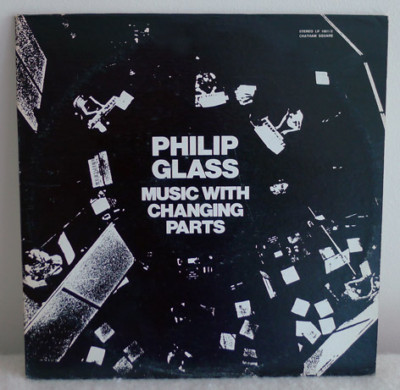
PHILIP GLASS music w changing parts 2LP 1971 avant rare
$
45


Favourite Auctions
To save auctions to your favourites, please login
If you don't have an account, please register
Description
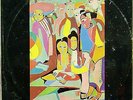
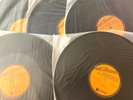
Philip Glass "Music with Changing Parts" LP privately issued by the composer for his Chatam Square Productions (1001/2) in USA, 1971. Gatefold cover. ****** 2xRec:m- / Cov:ex ****** Original 1st press of Philip Glass masterpiece, privately issued by the composer for his Chatham Square Records in the early 1970s. In his book All American Music, John Rockwell writes lyrically of a 1973 Soho performance of Philip Glass's "Music With Changing Parts": "Glass's ensemble that night played with the spirit and precision that only years together can bring. The music danced and pulsed with a special life, its motoric rhythms, burbling, highly amplified figurations and mournful sustained notes booming out through the huge black windows and filling up the bleak industrial neighborhood. It was so loud that the dancers Douglas Dunn and Sara Rudner, who were strolling down Wooster Street, sat on a stoop and enjoyed the concert together from afar. A pack of teenagers kept up an ecstatic dance of their own. and across the street, silhouetted high up in a window, a lone saxophone player improvised in silent accompaniment like some faded postcard of fifties Greenwich Village Bohemia. It was a good night to be in New York City". It is likely that many of Glass's admirers are unfamiliar with his work, one of the composer's most significant and attractive. "Music With Changing Parts" was issued only on LP (two discs, packaged in an inexpensively made, grainy black and white cover, produced by Glass's own semi-private Chatham Square label) and it has been out of print since the late 1970s. By the time Glass completed "Music With Changing Parts", in early 1970, he had been performing with an early — and still metamorphosing — version of the Philip Glass Ensemble for about two years. "Music With Changing Parts" is constructed with the techniques Glass had developed in earlier works such as "Music In Fifths", "Contrary Motion" and "Music In similar Motion". The score is broken into brief modules; Glass, from the keyboard, "conducted" the ensemble with nods of his lead indicating it was time to move from one module to the next. Like most of the early pieces for the Philip Glass Ensemble, "Music With Changing Parts" was written in open score, with no specific orchestration. Instead, what Glass calls "unassigned lines" of music were divided up in rehearsals. The listener will notice some unfamiliar timbres (unfamiliar, that is, for the Glass ensemble) in this recording: the late Robert Prado is heard on trumpet and the composer Barbara Benary plays violin. While Glass would later assign the violin an important part in both "Einstein on the Beach" and "The Photographer", it is used there in a soloistic manner quite different from the way it is blended among the winds and keyboards in "Music With Changing Parts". Besides Benary, several other players in the ensemble (notably Jon Gibson and Dickie Landry, both of whom would be associated with the group for many years) were composers and Glass remembers occasions when performances were joined by, among others, Anthony Braxton, James Tenney, Richard Teitelbaum and Frederic Rzewski. "Music With Changing Parts" is about as close as Glass would ever come to two very different styles of music: modern jazz and New Age. Glass carefully controlled the improvisation in "Changing Parts" (as he did in Part IV of "Music In Twelve Parts" and the Building scene in "Einstein on the Beach", the last of which remains far and away his jazziest piece) but it is there, nonetheless. We find in "Music With Changing Parts" evolve from the same source as the improvisation: Glass's discovery, during a 1969 runthrough of "Music In Similar Motion", that sustained overtones and undertones were following the patterns played by the ensemble like an aural shadow. "In those days, we'd play in the center of a hall, with our speakers placed in the four corners of the room", Glass recalled in 1993. "And during one rehearsal we noticed sustained sounds emerging from the repeated beats of the music. I stopped and asked who was singing. and nobody was singing; it was just a psycho-acoustical effect of the music". And so, in his next piece, "Music With Changing Parts", Glass decided to augment what was already occurring naturally. Toward the end of this new composition, he added in long tones, allotted to wind instruments and voices, held for the length of a breath, to support the notes that emerged from the keyboard patterns, with the rule that a player could reinforce any tone emerging from the whirl. However, the creation of actual melodies — of "solos" — was discouraged. Glass and the ensemble took "Music With Changing Parts" on tour throughout the United States and Europe in the early '70s; one English audience included David Bowie and Brian Eno, who heard Glass's music for the first time that night (and would collaborate with him some two decades later on the Low Symphony). A use of drones and repetition similar to that found in "Music With Changing Parts" would manifest itself in Eno's work as early as 1973, with the release of the first Fripp/Eno album, "No Pussyfooting" and, thus reconstituted, would have a tremendous influence on much popular music of the '70s and '80s. Glass himself was never particularly interested in following the implications of "Music With Changing Parts". "It was a little too spacey for my tastes", he says now. "We don't play it much anymore. But it was very important to my development. I proved to myself that the music I was making could sustain attention over a prolonged period of time, an hour or more. And that led directly to "Music In Twelve Parts" and then on to the operas". Original music composed by Philip Glass. Philip Glass: electric organ, alto flute. Barbara Benary: electric violin, voice. Steve Chambers: electric organ. Jon Gibson: electric organ, soprano saxophone, flute, voice. Dickie Landry: soprano saxophone, tenor saxophone, piccolo, flute, voice. Kurt Munkacsi: engineer, electronics. Arthur Murphy: electric piano. Robert Prado: trumpet, flute, voice. From the Chatham Square Productions recording. Produced by Philip Glass and Klaus Kertess. Recorded 1971 at Martinson Hall of the Public Theatre, NYC by Butterfly Productions,Inc. Engineers: Bob Fries and Kurt Munkacsi. Your chance to own now a piece of history! ****** The records look like they have never been played. Very minimal ring wear on front and back cover (see photo). ****** Please check my other auctions for Philip Glass "Music in Similar Motion" rare original LP on Chatham Square.****** Please wait to receive my invoice before sending the payment after the auction ends. Attention! Real postage costs are not USD 4 as all the items are located in Doha, Qatar (which has a very safe and professional post system). Postage costs registered up to 1 Kilo (generally 3 LPs): to Europe and Japan is USD 16,50 / to America and Oceania is USD 22,50. Postage costs registered up to 2 Kilos: to Europe and Japan is USD 28,00 / to America and Oceania is USD 34,00. Thank you for your kind attention and good luck with your bids.
price rating