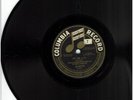
PARAMOUNT 78 RPM Record 33065 will Ferera and Franchini “Honolulu Bay”/” Hilo -
$
22


Favourite Auctions
To save auctions to your favourites, please login
If you don't have an account, please register
Description
PARAMOUNT 78 RPM Record 33065 will Ferera and Franchini “Honolulu Bay”/” Hilo - Hawaiian March” E+ Visible Condition, beautiful record on a very desirable label. The first issues of Paramount were vertical cuts which were replaced in 1919 by the 33,000 series that were lateral cuts. This record and the other Paramount that I have listed were both released in 1919 during the U. S. craze for all things Hawaiian.
Anthony John Franchini (August 2, 1898 – September 17, 1997) was an American guitarist, most known for his Hawaiian guitar partnership with Frank Ferera, making him one of the most-recorded musicians of all time. After his time with Ferera, his career was remarkably varied, playing with symphony orchestras and country and western bands, often simultaneously, and also working in additional genres before retiring in his mid-90s
Antonio Giuseppe Franchini was born to Ercole, a fishmonger, and Genney Franchini in Naples, Italy, on August 2, 1898. As per Italian custom at the time, he began his formal education at age two. His family moved to Boston, United States, in 1903. In Boston he attended Elliott Grade School, and began formal violin lessons under private tutelage the following year. He taught himself mandolin and guitar as he worked out currently popular songs in recreational pursuit. He began his musical career at the age of eight in Boston. He did not finish grade school, dropping out in the eighth grade.
In 1914, Franchini joined Tony Colucci and Gus Sullo in a trio of stringed instruments. The highlight of their act was to interchange instruments, in the midst of performing, while playing "Maple Leaf Rag". They toured the Keith Circuit as "French, Fields and Foley". The act ended in 1917, as Colucci chose to relocate to New York.
Franchini joined the United States Army in June 1917, even though he was not yet a citizen of the United States.. He was placed in Battery F, 5th Division of the 19th Field Artillery Regiment, where he operated a 70mm gun.. He spent ten months in training at a base near Leon Springs, Texas. Sent overseas, he landed in Brest, France, and conditioned there before being sent to the Vosges for combat. He spent eight months in combat, participating in the battles of Saint-Mihiel and Château-Thierry. As part of the occupation he was assigned to Koblenz and remained there until he was discharged on October 18, 1919.
With Frank Ferera
Franchini lived in a hotel in New York City upon arriving back to the States. There, he met up again with Colucci and Sullo and the three held a jam session in Franchini's room. Frank Ferera, who resided in a room above Franchini's, overheard the music and was impressed to the point that he requested that Franchini make a record with him. Thus Franchini began recording with Ferera in 1919, a few months before Helen Louise Greenus (Ferera's wife and recording partner) disappeared at sea. Ferera asked Franchini to be his recording partner in 1920. Together they became one of most popular recordings artists in the 1920s. Labels that released Ferrera and Franchini duets include Brunswick, Columbia, Emerson, Gennett, Lyric, Okeh, Pathé, Paramount, and Victor. During their association, the duo of "Ferera and Franchini" typically recorded four to six sessions every single day. Besides records released under their names they also recorded behind Anna Case, Vernon Dalhart, Ernest Hare, Billy Jones, and Bert Williams. Altogether, more than 3500 sides were recorded by Ferera and Franchini. On top of this, he was also an active session musician in his own right, accompanying Dalhart on some of Dalhart's early country music recordings. and diversely performing Spanish music in Victor's ethnic catalog. This period of activity was financially a time of great prosperity for Franchini.
Franchini did more than make phonograph records. Ferera and Franchini worked tirelessly to learn material, it took extra time as Ferera could not read music. Fortunately Franchini was a good cook, and liked to make Itialian dishes when practicing at Ferera's living quarters. Franchini took a break from recording activities in 1924 to conduct the Nat Martin Orchestra which was supporting the Marx Brothers in the revue I'll Say She Is. In 1926 he formed a school of music in which was to last through the late 1940s, serving as its director.
Ferera abruptly decided to leave the music business in 1927, and a seven-and-a-half year partnership ended amicably. Franchni signed as a composer to the Irving Berlin publishing company. From 1928 to 1932 he was musical arranger for the RKO Pictures program on WEAF. At the same time, he was musical director for Paramount's Koko the Clown. However, the period was financially disastrous for Franchini. Previously wealthy, he lost his fortune in the Wall Street Crash of 1929, and as record and publishing sales subsequently dried up in the following Great Depression, so did his formerly lucrative royalty income.
Columbia matrix 79197. Honolulu Bay / Ferera and Franchini
Title Source
Honolulu Bay (Primary title) Disc label
Authors and Composers Notes
Frank Ferera (composer)
Composer information source: Disc label.
Personnel Notes Hide Additional Titles
Ferera and Franchini (Musical group)
Anthony J. Franchini (instrumentalist : guitar)
Frank Ferera (instrumentalist : steel guitar)
Description: Steel guitar and guitar duet (Hawaiian)
Category: Instrumental
Master Size: 10-in.
Notes
It is not confirmed that all issues originate from both takes 2 and 3.
It is not confirmed that it is Ferera who plays the steel guitar.
Source(s): Rigler-Deutsch Index; disc.
Take Date and Place Take Status Label Name/Number Format Note Hide Additional Titles
5/21/1920 New York, New York 1 Unknown
5/21/1920 New York, New York 2 Master Columbia A3316 10-in.
5/21/1920 New York, New York 2 Master Harmony 621-H 10-in.
5/21/1920 New York, New York 3 Master Columbia A3316 10-in.
5/21/1920 New York, New York 3 Master Harmony 621-H 10-in.
If possible we gladly combine shipping items to lessen postage and will hold for you if you are bidding on additional items.PLEASE don't use eBay auto pay I will invoice you for shipping costs which will be easier and cheaper for you:
The scratches on the left of every photo are my broken glass on scanner – not on item. Images of artists etc. are for information only and not included in auction, record & sleeve only.
We will pack securely but are not responsible for shipping company damage if uninsured.
1 record - $4.70 Add $1 for each additional record (+ insurance if required). (USA ONLY) (Int?l use eBay calculator and I will adjust to get cheapest rate)
E++, Visibly nearly new with no visible signs of wear or damage.
E+, Looks and plays like new with only few signs of handling and play.
E Still very shiny, near new looking, with slight visible signs of wear and a few nearly inaudible scuffs and scratches
E- Still shiny but without the luster of a new record, few scuffs that have little or no effect on play, some light scratches.
E- - Mostly shiny but with even less of the luster of an E- record, more scuffs than E-that have little or no effect on play, light scratches with some light noise.
VG+, Slightly above average condition 78 in which scuffs and general use has dulled the finish somewhat. Wear is moderate but playing is generally free from distortion. Surface noise not overly pronounced.
VG, An average condition 78 - moderate wear throughout, but still very playable and enjoyable. Surface somewhat dull with noise and scratches audible but not intrusive.
VG-, Quite playable still, but with some distortion and may have some graying in loud passages. Music remains loud in most passages. Surface noise and scratches well below music level.
VG- - Quite playable still, but with distortion and most have some graying in loud passages. Music remains loud in most passages. Surface noise and scratches noticeable and may be loud at times.
G+ Quite worn and scratched, but music level is still higher than surface noise. Grey may be throughout but still serviceable. Music begins to sound muffled.
G Not so good. Wear and scratch damage extensive. Listening can become uncomfortable as music and surface noise probably blending. Lowest level music can be understood.
G-, Music barely audible over surface noise & listening is uncomfortable. Record is borderline unplayable.
P Used only for high dollar space fillers like Black Patti, Okeh blues, etc. Music covered by surface noise, scratches, and needle digs, label may be trashed, & listening is almost if not definitely impossible. Record is basically unplayable. What you keep because you can?t bear to toss ? while you look for that E+ copy of Robert Johnson on Vocalion at the local flea markets for $1 (Good Luck!)See Description, A wildcard grade that can be used when standard grading does not apply or when a record (or item) has special attributes (or defects) that can affect how the item is assigned a grade.
price rating