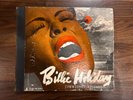
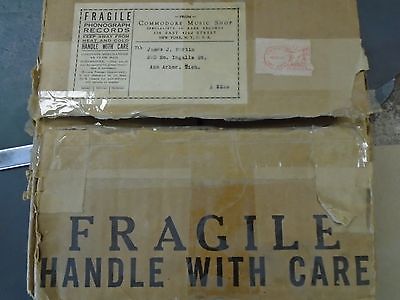
Original 78 JAZZ COMMODORE RECORD SHOP BOX 1943 Billie Holiday
$
20


Favourite Auctions
To save auctions to your favourites, please login
If you don't have an account, please register
Description
ORIGINAL COMMODORE RECORD SHOP BOX FROM 1943
COULD OF HAD BILLIE HOLIDAY RECORDS IN THE BOX NOT SURE
OWN A PIECE OF RECORD HISTORY
Milt Gabler began working in his father’s business, the rather grandly named Commodore Radio Corporation on 42nd Street in the 1920s. Gabler renamed the family store the ‘Commodore Music Shop’ and in 1933 began to license old jazz recordings from the major labels and reissue them. The store also became a magnet for the New York jazz crowd, whether fans or musicians. In 1937, Gabler opened a new shop on 52nd Street and around the same time began holding gigs in a club, Jimmy Ryan’s, which was almost next-door.
Commodore released records by artists as diverse as Coleman Hawkins, Sidney Bechet, Ben Webster, Teddy Wilson, and Willie “The Lion” Smith. In April 1939, Commodore recorded what is arguably the label’s most important release, Billie Holiday’s ‘Strange Fruit.’ The session was at World Broadcasting Studios and Frank Newton and his Café Society Orchestra backed Lady Day. The record company executives from Billie’s own label found the subject matter of the song so sensitive – the lynching of a young black man in the southern states – that they refused to release it and Gabler seized the moment.
When Alfred Lion, the founder of Blue Note Records arrived in New York City January 1936 and found an apartment in midtown Manhattan. Gravitating to Commodore Records, he became friendly with Gabler and his brother-in-law, Jack Crystal (the father of comedian Billy Crystal), who worked at the shop and helped run the gigs. Years later, Alfred Lion would recall the huge challenge Blue Note faced in establishing their business: “There was nothing in ’39. No {music trade] books where you could check out things. Nothing. You had to go by your wits.” Through his friendship with Milt Gabler, Lion persuaded Commodore Music Shop to sell Blue Note’s first record releases. H. Royer Smith on Walnut Street Philadelphia, trading since 1907 and one of America’s oldest record stores, also agreed to take them, as did David Dean Smith in New Haven, Connecticut.
Gabler later went on to work for Decca Records, where he recorded Bill Haley and the Comets and Louis Armstrong, and the Commodore record label ceased to be – Decca released their recordings. At the same time Alfred Lion made Blue Note one of the most important record labels in jazz. The Commodore shop closed in 1959.
The shop front was taken sometime in the 1940s. The interior is from 1947 and was taken by William Gottlieb, w
price rating