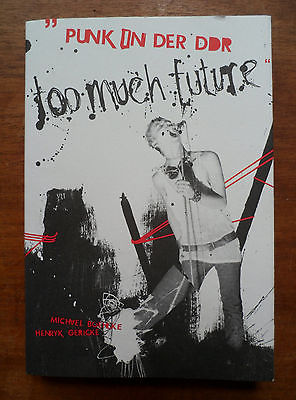
OSTpunk - Too Much Future – Punk in der DDR (Verbrecher Verlag 2007) : NEU
€
23
$
26


Favourite Auctions
To save auctions to your favourites, please login
If you don't have an account, please register
Description
Attention please!
Within Germany I prefere assign/transfer! Paypal is possible.
International payment only per paypal.
Herausgeber: Michael Boehlke & Henryk Gericke
Titel: "OSTpunk - Too Much Future – Punk in der DDR" (Punk In The GDR)
Genre: Popkultur/ Musik/ Gesellschaft/ Punkrock
Format: Buch – 22 x 15 cm (Broschur mit Umschlag-Poster, 224 Seiten,
viele Abbildungen, Deutsch/Englisch)
Ercheinungsjahr: 2007
Verlag: Verbrecher Verlag
Zustand: neu
PRIVATVERKAUF – KEINE GARANTIE UND RÜCKNAHME!
PRIVATESALE – NO GUARANTEE AND TAKING BACK!
deutsch:
Textschwerpunkte sind Ostberlin und Leipzig, allerdings unter Einbeziehung von Punk außerhalb seiner Zentren, also z.B. auch Erfurt und Weimar. Der Katalog verbindet Fakten und Anekdoten und versucht so, der reinen Aufarbeitung die bizarre Seite von Ost-Punk entgegenzusetzen. So zum Beispiel in einem Beitrag zur wahrscheinlich einmaligen Konstellation von Punk und Kirche in der DDR, die alles andere als weihevoll war. Oder in dem Bericht eines Punks, der bei einem Stasiverhör zwar auf die Fresse kriegt, seine Peiniger letztlich aber schwer auf die Schippe nimmt, was ein reproduzierter Verhörbericht belegt.
Der Katalog ist üppig bebildert mit Fotos und Reproduktionen von Dokumenten, Flyern, Grafiken etc.
Texte und Fotos werden zusammengehalten durch ein gewagtes Layout, das den Begriff der Punk-Bewegung aufgreift. Die Texte werden auch mal aus dem Blocksatz gerissen, kippen, rotieren, überlagern sich oder werden von Balken und Schwarzflächen wie in einen Schraubstock gespannt. Natürlich wird so auch eine tradierte Punkästhetik zitiert, sie ist jedoch angereichert durch Anleihen beim Scherenschnitt, Tapecover Art, Korrekturfahnen, Samisdat-Typografie und einem offensichtlichen Faible für eine Ausschußästhetik. Eine Gratwanderung zwischen Experiment und Konsumierbarkeit – Postpunk eben.
Teil des Katalogs ist ein Bandregister von beinahe 100 DDR-Punkbands, ihres jeweiligen Line-ups und ihrer Herkunft.
Das Exemplar ist druckfrisch und nicht gebraucht!
english:
The first edition of this catalogue was published in 2005 as part of the too much future exhibition in Berlin, and sold out within days. The second revised and extended edition was published in April 2007, again as a bilingual version in German and English.
The main focus of the featured texts is on Berlin and Leipzig, though the punk phenomenon outside it’s main centres, in cities such as Dresden, Erfurt and Weimar, gets also covered.
All contributing authors had direct or indirect connections with the scene. The featured texts examine the beginning stages of the punk movement, the strange coalition between the punk movement and the church in the GDR, the history of Stasi oppression, as well as the impact punk
had on the art underground.
The catalogue is richly illustrated with photos and reproductions of documents, flyers, graphic works etc. The book also contains a band index listing almost 100 GDR punk bands with line-up and origin.
The outrage caused by punks in the GDR lasted for ten years between 1979 and 1989. Whilst the social misery of English teenagers exploded with the outcry “No Future”, the socialist misery of a planned out GDR youth is best described with “Too Much Future”. Compulsorily drafted as “reserve troops of the party”, suddenly 16 to 18 year olds were claiming liberties unthinkable in the GDR up until then. They challenged the state in a reckless manner, and the state enraged by the extremely exuberant rage of its juveniles left some of them with extreme biographies. Punks were writing a bizarre chapter in GDR history – outrageous in its non-conformist eccentricity, gloomy through its prosecution by the State Security. They certainly did not cause the demise of the disciplinarian regime of the GDR but they added to a nervous balance of the system – that could no longer be kept up by 1989.
The loaded relationship between punks and the party was based on the tension between subculture and dictatorship. The released energy – free from the rules of the market as well as the official doctrine of “Socialist Realism” – spread from basements and the rare hangouts of the scene to the studios of young artists. Thereby Punk influenced the work and life of artists in the making, finally haunting – in the shape of counter-cultural moods – the sites of socialist highbrow culture, its academies and universities.
Artists or not, their time as punks in the GDR was a transit space for many who were involved. Their biographies didn’t come to an end when they went into exile or after the end of the GDR – they continued in various directions and in various modes of living.
price rating