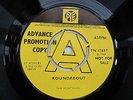
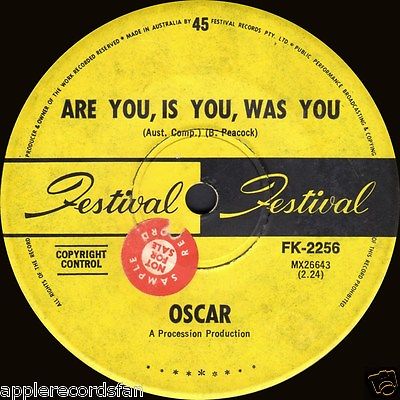
OSCAR "Are You, Is You, Was You/Motorboat" Librettos PROCESSION 1968 OZ Psych 45
A$
50
$
33


Favourite Auctions
To save auctions to your favourites, please login
If you don't have an account, please register
Description
" Are You, Is You, Was You" c/w "Motorboat" FESTIVAL FK-2256
" RARE" 1968 Australia Original Issue......(Ex Librettos...(Australian) Playboys...Procession....featuring Brian Peacock...later of Western Flyer and manager of the Dugites)
Procession (band)
From Wikipedia, the free encyclopedia Jump to: navigation, search This article needs additional citations for verification. Please help improve this article by adding citations to reliable sources. Unsourced material may be challenged and removed. (June 2014)Procession was a jazz-tinged "progressive pop" band, formed in Melbourne in October 1967. The group is most notable for including English guitarist Mick Rogers who later joined Manfred Mann’s Earth Band. Drummer Craig Collinge was later a member of British proto-punk band Third World War, and briefly played drums in the notorious "fake" Fleetwood Mac in 1973.
Contents
[hide]- 1 Early years
- 2 Procession relocates to London, Mike Hugg produces
- 3 After disbanding
- 4 Sources
- 5 Trivia
- 6 References
Early years[edit]
Procession was formed by members of two earlier Australasian groups, Normie Rowe's long-time backing band The Playboys, and New Zealand group The Librettos. The Librettos included singer/songwriter and bass player Brian Peacock (born 27 June 1946 in Levin, New Zealand), guitarist Rod Stone (who subsequently joined The Groove) and drummer Craig Collinge (born 24 August 1948 in Sydney, Australia).
The Librettos had recorded four singles for HMV in New Zealand during 1964 and 1965 before transplanting to Australia later that year and issuing three singles for the Sunshine label, including a cover of Paul Revere & The Raiders’ "Kicks". The Librettos broke up in June 1966 when Peacock and Stone joined The Playboys. Collinge formed the heavy rock-trio, The Knack.
Apart from Peacock and Stone, The Playboys line up also included drummer Graeme Trottman and keyboard player Phil Blackmore. In November 1966, this line up relocated to London and hooked up with Australian singer Normie Rowe. In March 1967, Blackmore returned to Australia and Trevor Griffin (born 22 December 1944 in Birmingham, England) joined from The Question Marks (formerly The John Bull Breed, which included future Moody Blue, John Lodge). A month later, another Englishman, ex-Adam Faith sideman, Mick Rogers (born Michael Oldroyd, 20 September 1946 in Dovercourt, Essex, England) replaced Stone.
While still with Rowe, The Playboys signed to Andrew Loog Oldham’s Immediate label and recorded a one-off single, “Black Sheep R.I.P” c/w “Sad”, which came out in August 1967. By then, Rowe and The Playboys had returned to Australia. In October, the group split from Rowe, and Collinge replaced Trottman on drums.
Renamed as Procession, the group made its much-heralded live debut at Sebastians disco in Melbourne on 17 December and then played at another local club, Berties from 19-26 December. After further shows at Sebastians from 27-31 December, Procession returned to Berties to play from 1-17 January 1968.
Having signed to the Festival label, Procession’s debut single, Peacock and Rogers’ a cappella “Anthem” backed by the Rogers-Griffin collaboration, “Take Time” came out on 18 December 1967 but was only a minor hit. Three months later, a second single, coupling Peacock and Rogers’ “Listen” with “Minuet For Moderns” only reached the lower rungs of the charts, despite being the first Australian disc to be recorded on newly installed eight-track equipment.
Throughout this period, the group became a weekly fixture on the national television rock show “Uptight”, which was produced by the band’s manager, David Joseph. The group played at Berties on 28 April before setting off on an Australia-wide tour.
However, when the group’s debut LP “Procession ‘Live’ at Sebastians” (recorded on 3 April 1968) failed to chart, the group decided to relocate to the UK in search of a wider audience. The band's final Australian show was at the Royale Ballroom on 18 June 1968 alongside The Twilights and The Virgil Brothers.
Procession relocates to London, Mike Hugg produces[edit]
Arriving in London, Procession soon found their feet on the burgeoning live scene and became a popular and regular attraction at the Marquee during early-mid 1969. The band signed to Philips/Mercury and a second eponymous LP, produced by Mike Hugg of Manfred Mann attracted rave reviews but poor sales. In the U.S., this LP was released on Mercury's subsidiary label, Smash, with catalogue number SRS 67122. The track listing is as follows:
Side One:
You-Me / Gently Does It / Essentially Susan / Signature Tune / Adelaide, Adelaide / Take Time.
Side Two:
Every American Citizen / Sweet Simplicity / Automobile / September In July / Mind Magician / Anthem.
Likewise, two singles, Peacock’s “Every American Citizen” c/w “Essentially Susan” and a re-recording of “Anthem” as “One Day Every Week” backed by Peacock's “Wigwam City”, released in October 1968 and December 1968 respectively, also flopped.
In March 1969, Collinge left to join Manfred Mann Chapter Three and former Cat Stevens sideman Chris Hunt (born 15 November 1945 in Hillingdon, Middlesex, England) joined on drums. The following month, Peacock brought his friend, singer-songwriter Ross Wilson (born 18 November 1947, Armadale, Victoria, Australia), formerly of The Pink Finks and Party Machine, over from Australia. Wilson took over from Rogers as the lead singer, although the move was resented by both Rogers and Hunt.
In late May or early June the group recorded several new songs at Olympic Studios, including Rogers’s "Surrey" and Wilson’s "Papa’s In The Vice Squad" and "I Wanna Be Loved", but these were never released. They reportedly also featured another of Wilson's new compositions, "Make Your Stash", in their set-list, but never recorded it. According to Wilson, his song - which was based on a melody from Gustav Holst's The Planets - in turn became the basis for the abortive 1973 Manfred Mann's Earth Band album Masque (which was abandoned when the group was unable to secure the rights to use Holt's music from the trustees of his estate).
Although the band was now nearing its end, Wilson's brief stint with Procession provided an unexpected side-benefit - it was during this period that he read a British newspaper article about the history of "juke joints" in the American south, and the accompanying photo, which showed dancers performing "The Eagle Rock and the The Pigeon Wing" provided the inspiration for Wilson's breakthrough hit with his next band. Procession's final engagement was a month-long student cruise from London to New York. By this time manager David Joseph had largely lost interest in the band and was concentrating on The New Seekers. The group officially disbanded in September 1969. Wilson returned to Australia and formed a new group, Sons of the Vegetal Mother, which later evolved into the popular Australian rock'n'roll band Daddy Cool, who scored an Australian #1 hit with the single "Eagle Rock".
After disbanding[edit]
Peacock returned to Australia and played with Gerry and The Joy Band in late 1971. He later played with Western Flyer before moving into rock management. He currently lives on Victoria coast.
Griffin also moved back to Australia and joined Wilson in The Sons of Vegetal Mother but dropped out of the scene early on. Griffin later wrote "Love Is Like Oxygen" for Sweet. He currently lives in Memphis.
Collinge remained in the UK and subsequently recorded with Manfred Mann Chapter Three, Third World War and Shoot. He was also involved in the bogus Fleetwood Mac band put together in autumn 1973. After returning to Australia he was the drummer in the Marcia Hines band for some time. He currently lives in Sydney. His replacement Chris Hunt subsequently worked with Lonnie Donegan.
Rogers also briefly worked with Manfred Mann Chapter III, then returned to Australia for some time, where he played with Doug Parkinson and the shortlived power trio Bulldog in 1970. On his return to England he joined Manfred Mann’s Earth Band, recording with the group from 1971-1975. After another short spell back in Australia with Eclipse and Renée Geyer, he returned to the UK in 1977 to tour with Greenslade. He subsequently recorded with Aviator and subsequently rejoined Manfred Mann’s Earth Band.
The Librettos (band)
From Wikipedia, the free encyclopedia Jump to: navigation, search The Librettos The LP Let's Go with The Librettos (HMV), showing the 1965 lineup of the band: (L-R) Lou Parun, Dave Diver, Rod Stone, Brian Peacock Background information Origin Wellington, New Zealand Genres pop, R&B Years active 1960-1966 Labels HMV Records (NZ/Australia), Sunshine Records (Australia), EMI Associated acts Procession, The Groove, Normie Rowe Past members See Personnel section belowThe Librettos was a New Zealand pop/R&B group, active from 1960 to 1966. They were one of New Zealand's most popular bands in 1964-65, and after relocating to Sydney they gained recognition in Australia for their polished live performances and their 1966 version of the Paul Revere & The Raiders song "Kicks". Several members of the group went on to other notable bands of the 1960s and 1970s - bassist Brian Peacock co-founded the highly regarded Anglo-Australian "progressive pop" band Procession, Rod Stone joined popular Australian '60s soul group The Groove, and drummer Craig Collinge (the only Australian-born member) later played with Manfred Mann Chapter Three and UK 1970s "proto-punk" band Third World War.
Contents
[hide]- 1 Career history
- 2 After The Librettos
- 3 Personnel
- 4 Discography
- 5 References
Career history[edit]
The Librettos formed in 1960 while its original members were attending Rongotai College in Wellington, and they reportedly chose their name by sticking a pin at random into the page of a dictionary.[1] The original lineup was Roger Simpson (lead vocal), Dave Clark (piano), Rod Stone and Johnny England (guitars), Paul Griffin (bass) and Andy Shackleton (drums), who was later replaced by Gordon Jenkins. They played regularly around Wellington for some time before landing a residency at the city's leading pop venue "Teenarama". They built up a solid following in the city during 1963, and their profile was further boosted by a support slot on the 1964 NZ national tour by British Merseybeat acts Billy J. Kramer & The Dakotas and Cilla Black. They became nationally popular after being spotted by television producer Kevan Moore, who hired them as the resident band on his nationally televised pop show Let's Go.
Gordon Jenkins quit in December 1963, prior to their TV work, and he was replaced by Christchurch drummer Dave Diver. England left soon after, as he didn't want to be a full-time musician at the time. He subsequently released a single, "Jezebel"/"Linda Lu", in 1965 as Johnny England & The Titans (on which he was backed by popular Wellington band The Premiers). He was replaced by pianist/singer Lou Parun, who had already established himself as a solo performer and had released four singles on the Lexian Records label in 1962 and 1963.
Paul Griffin also left during 1964 and he was replaced by Brian Peacock (bass, vocals), who had previously played with Christchurch band The Downbeats. When Roger Simpson left he was not replaced, leaving Rod Stone as the only member from the original line-up. Peacock's arrival saw the group change their style to a more R&B-oriented sound, and he soon began co-writing original material with Rod Stone. Later in 1964 the group was signed to the New Zealand branch of HMV Records and they released four singles: "Funny Things" b/w "I'll Send It Your Way", "Young Blood" b/w "That's Alright With Me", "Baby It's Love" (a Peacock-Stone original) b/w "Great Balls Of Fire", and "It's Alright" b/w "Walkin' The Dog".
In 1964 they also recorded and released their only LP, Let's Go With The Librettos, which combined popular covers from their set with six Peacock-Stone originals. It includes their cover of the Ventures number "Let's Go", which was the theme for the TV show, and was probably their best known song in New Zealand, although it was never released as a single. In 1965 they were offered another season with the Let's Go show, but turned it down in favour of going to Australia, like many other NZ acts of the time.
The band relocated to Sydney in March 1965, but found it hard going - arriving at the peak of the "Beat Boom" in Australia, they found themselves competing with literally hundreds of other similar groups. Three days into a residency at the Sylvania Hotel in Sydney's south, the band was sacked for playing too many Beatles covers and "mod music", and they were forced to take part-time jobs to make ends meet.[2] Despite these setbacks, they were able to record two more singles - HMV released an Australian-only single, "Great Balls Of Fire"/"Twilight Time", while in New Zealand they released "Ella Speed"/"I Want Your Love", which was recorded in Sydney in September.
Dave Diver quit in September 1965 and returned to New Zealand, where he joined The Countdowns. He was replaced by Australian drummer Craig Collinge. By November 1965 The Librettos were starting to gain wider popularity. They made several appearances on TV pop shows including Sing Sing Sing (hosted by Johnny O’Keefe), Saturday Date, Ten on the Town and TV Tonight, took over a residency at Suzie Wong's, recently vacated by legendary Sydney band The Missing Links and then began getting regular work at the popular Sydney CBD venue The Bowl, run by Brisbane-based pop impresario Ivan Dayman.
Later in the year The Librettos featured in a package tour of artists from Dayman's Sunshine booking company and record label, backing fellow New Zealander Jim McNaught, and Australian singers Marcie Jones, Peter Doyle (later a member of Virgil Brothers and The New Seekers) and Graeme Chapman, and they headlined an extended tour of rural New South Wales and Victoria. They returned to New Zealand over the Christmas period, to undertake a small tour, which played to packed houses, and they were acknowledged as being New Zealand's best group in 1965.
Returning to Australia in early 1966 they were offered the chance to record on Dayman's Sunshine label with the label's house producer Pat Aulton. The first single released was "I Cry" / "She's A Go-Go", followed by a cover of the Fontella Bass hit "Rescue Me" b/w "What Do You Want To Make Those Eyes At Me For", but both singles flopped. Following these chart failures Lou Parun quit in April 1966 - he returned to New Zealand, and retired from the music industry. Peacock took over as lead vocalist, and the remaining members considered replacements, but eventually decided to stay as a three piece, and relocated to Melbourne. There they recorded their final single, "Kicks"/"Whatcha Gonna Do About It", which received good airplay in Melbourne (notably from leading DJ Stan "The Man" Rofe") but didn't sell well.
In late 1966 Australian solo star Normie Rowe (who was the Sunshine label's most successful act) was preparing to relocate to London in an attempt to break into the British pop scene, but before departure two members of his backing band The Playboys opted to stay in Australia for family reasons, so Rowe approached Brian Peacock and Rod Stone to replace them. In August 1966, The Librettos made one last recording at Festival Studios in Sydney, "It's Loving Time" (which remained unreleased until 1997). The LIbrettos played their last gig at Melbourne disco Pinocchio's that month, and the revamped lineup of The Playboys with Peacock and Stone left for the UK in November. Following the split, Craig Collinge formed a trio, The Knack, which played consistently around Sydney during 1967 but did not record.
After The Librettos[edit]
Normie Rowe's English sojourn was ultimately unsuccessful, and although it yielded several singles that were major hits back in Australia (on which he was backed by professional British session players), the cost of underwriting the venture reportedly precipitated the financial collapse of Dayman's Sunshine group. While Rowe was overseas, the lineup of the Playboys changed again - keyboardist Phil Blackmore had to return to Australia for family reasons, and Rod Stone quit soon after, reportedly after a disagreement with the other band members. He returned to Australia, where he subsequently joined up with another New Zealander, Peter Williams (ex-Max Merritt and the Meteors) to form The Groove, who scored several hit singles in Australia, and later returned to the UK after The Groove won the 1967 national final of the Hoadley's Battle of the Sounds.
Trottman and Stone were replaced by two English musicians, organist Trevor Griffin and guitarist Mick Rogers and The Playboys continued as Rowe's backing group for live performances until he returned to Australia in mid-1967. Before leaving England the Playboys scored a one-off single deal with the recently formed Immediate Records, for whom they cut two original numbers, "Sad" / "Black Sheep R.I.P." Although the single was not successful at the time, it gained a cult following among collectors and was later included in several major anthologies of 1960s pop, including Lenny Kaye's Nuggets" series.
The Playboys returned to Australia with Rowe in July 1967. Later in the year they went back on the road with Normie, but a planned eleven-week national tour was dramatically cut short on 20 September, just as they arrived in Perth, when Rowe received his call-up notice for compulsory national service in the Australian Army. With Rowe due to start his army stint in January 1967, The Playboys had already decided to go out on their own; they had initially opted to wait until they completed Normie's scheduled Australian/New Zealand farewell tour, but after a fight with Rowe at Pinocchio's in Melbourne on 25 October, they quit the tour. Graham Trottman opted to leave at this point, so Peacock contacted his former Librettos bandmate Craig Collinge, who broke up The Knack and moved to Melbourne to join the quartet, which was renamed Procession.
In 1997 EMI released a Librettos CD anthology, which compiled almost all of their studio recordings, including all the tracks from their 1965 Let's Go With The Librettos album and all of their HMV and Sunshine tracks, except their final Sunshine 45 ("Rescue Me"/"What Do You Want To Make Those Eyes At Me For").
Personnel[edit]
- Roger Simpson (lead vocal), 1960–64
- Dave Clark (piano), early 1960s
- Rod Stone (guitar, vocals) 1960-66
- Johnny England (guitar) 1960-63
- Paul Griffin (bass) 1960-64
- Andy Shackleton (drums) 1960-61?
- Gordon Jenkins (drums) 1961-1963
- Lou Parun (piano, vocals) 1963-66
- Dave Diver (drums) 1963-65
- Brian Peacock (bass, vocals) 1964-66
- Craig Collinge (drums, vocals) 1965-66
price rating