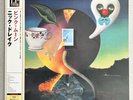
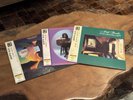
Nick Drake Bryter Layter LP Japan 2007 200g 1000 pressRichard Thompson Very Rare
$
350


Favourite Auctions
To save auctions to your favourites, please login
If you don't have an account, please register
Description
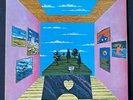
Nick Drake Bryter Layter LP Japan 2007 200g 1000 pressed Richard Thompson John Cale Very Rare
Excellent sounding pressing of this record - worth tracking down.
Archival Sleeve
Japanese reissue. Limited to 1000 copies on heavyweight 200 gram vinyl from original master tapes.
Artwork, gatefold sleeve and label as exact copies of original 1st pressing.
Drake ended his studies at Cambridge nine months before graduation and in late 1969 moved to London. His father remembered "writing him long letters, pointing out the disadvantages of going away from Cambridge ... a degree was a safety net, if you manage to get a degree, at least you have something to fall back on; his reply to that was that a safety net was the one thing he did not want."Drake spent his first few months in London drifting from place to place, occasionally staying at his sister's Kensington flat but usually sleeping on friends' sofas and floors. Eventually, in an attempt to bring some stability and a telephone into Drake's life, Boyd organised and paid for a ground floor bedsit in Belsize Park, Camden.
On 5 August 1969, Drake pre-recorded four songs for the BBC's Night Ride show presented by John Peel ("Cello Song", "Three Hours", "River Man" and "Time of No Reply" ), which were broadcast after midnight on 6 August. Nick subsequently recorded "Bryter Layter" for another BBC radio broadcast, in April 1970. A month after the initial BBC recordings, on 24 September, he opened for Fairport Convention at the Royal Festival Hall in London, followed by appearances at folk clubs in Birmingham and Hull. According to the folk singer Michael Chapman, the audiences did not appreciate Drake and wanted "songs with choruses". Chapman said: "They completely missed the point. He didn't say a word the entire evening. It was actually quite painful to watch. I don't know what the audience expected, I mean, they must have known they weren't going to get sea-shanties and sing-alongs at a Nick Drake gig!"
The experience reinforced Drake's decision to retreat from live appearances; the few concerts he did play were usually brief, awkward, and poorly attended. Drake seemed reluctant to perform and rarely addressed his audience. As many of his songs were played in different tunings, he frequently paused to retune between numbers.Although Five Leaves Left attracted little publicity, Boyd was keen to build on what momentum there was. Drake's second album, Bryter Layter (1971), again produced by Boyd and engineered by John Wood, introduced a more upbeat, jazzier sound.Disappointed by his debut's poor sales, Drake sought to move away from his pastoral sound and agreed to Boyd's suggestions to include bass and drum tracks. "It was more of a pop sound, I suppose," Boyd later said. "I imagined it as more commercial." Like its predecessor, the album featured musicians from Fairport Convention, as well as contributions from John Cale on two songs: "Northern Sky" and "Fly". Trevor Dann noted that while sections of "Northern Sky" sound more characteristic of Cale, the song was the closest Drake came to a release with chart potential.
Bryter Layter was a commercial failure, and reviews were again mixed; Record Mirror praised Drake as a "beautiful guitarist—clean and with perfect timing, [and] accompanied by soft, beautiful arrangements", but Melody Maker described the album as "an awkward mix of folk and cocktail jazz". Soon after its release, Boyd sold Witchseason to Island Records and moved to Los Angeles to work with Warner Brothers to develop film soundtracks. The loss of his mentor, coupled with the album's poor sales, led Drake into further depression. His attitude to London had changed: he was unhappy living alone, and visibly nervous and uncomfortable performing at a series of concerts in early 1970. In June, Drake gave one of his final live appearances at Ewell Technical College, Surrey. Ralph McTell, who also performed that night, remembered: "Nick was monosyllabic. At that particular gig he was very shy. He did the first set and something awful must have happened. He was doing his song 'Fruit Tree' and walked off halfway through it."
Island Records urged Drake to promote Bryter Layter through interviews, radio sessions, and live appearances. Drake refused. Disappointed by the reaction to Bryter Layter, he turned inwards and withdrew from family and friends.
Nicholas Rodney Drake (19 June 1948 – 25 November 1974) was an English musician. An accomplished acoustic guitarist, Drake signed to Island Recordsat the age of twenty while still a student at the University of Cambridge. His debut album, Five Leaves Left, was released in 1969, and was followed by two more albums, Bryter Layter (1971) and Pink Moon (1972). While Drake did not reach a wide audience during his brief lifetime, his music found critical acclaim and he gradually received wider recognition following his death.
Drake suffered from depression and was reluctant to perform in front of live audiences. Upon completion of Pink Moon, he withdrew from both performance and recording, retreating to his parents' home in rural Warwickshire. On 25 November 1974, Drake was found dead at the age of 26 due to an overdose of anti depressants.
Drake's music remained available through the mid-1970s, but the 1979 release of the retrospective album Fruit Tree allowed his back catalogue to be reassessed. Drake has come to be credited as an influence on numerous artists, including Robert Smith of the Cure, Peter Buck of R.E.M., Kate Bush, Paul Weller, Aimee Mann, Beck, Robyn Hitchcock and the Black Crowes. The first Drake biography in English appeared in 1997; it was followed in 1999 by the documentary film A Stranger Among Us.
price rating