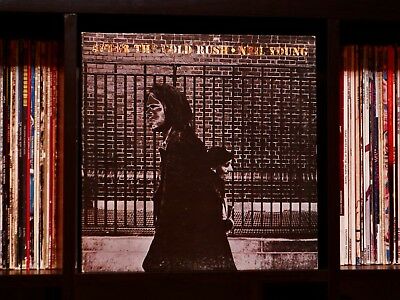
Neil Young ? After the Gold Rush ? Rare 1970 Reprise Records Vinyl LP w/NM Cover
$
20


Favourite Auctions
To save auctions to your favourites, please login
If you don't have an account, please register
Description
Welcome to Classic Cadillac Records! My goal is to provide each and every customer with the best possible buying experience, no matter the size of the order. Unlike most sellers, I advertise all my items clearly and in as much detail as possible, without shouting at you in all caps. I take multiple high quality pictures and never use stock photos, so you know exactly what you’re buying. I take great pride in my work and go the extra mile, which can clearly be seen in my listings compared to other sellers that put minimal effort into theirs. I visually grade all my records as accurately as possible and will never grade anything above Near Mint unless it’s still sealed. Please note that a visual grade can differ from a play grade, and am happy to spot check a record upon request. All orders are shipped within 1 business day (usually sooner) and packed with extra care to ensure fast, safe arrival. I combine shipping on multiple orders to save you money and gladly ship worldwide. Please look closely at all pictures, read all relevant details and ask any questions you may have before buying. I offer a full 30-day return policy on everything I sell, so buy with confidence! And most importantly, thanks for looking!
After the Gold Rush Studio album by Neil Young Released September 19, 1970 Recorded Winter 1969 – June 1970Sunset Sound, Hollywood, CA
Sound City, Van Nuys, Los Angeles
Redwood Studios, Topanga, CA Genre Roots rock, country rock, folk rock Length 35:10 Label Reprise Producer Neil Young, David Briggs with Kendall Pacios Neil Young chronology Everybody Knows This Is Nowhere
(1969) After the Gold Rush
(1970) Harvest
(1972) Singles from After the Gold Rush
- "Only Love Can Break Your Heart"
Released: September 19, 1970, October 19, 1970 (U.S. 7" single) - "When You Dance I Can Really Love"
Released: September 19, 1970
After the Gold Rush is the third studio album by Canadian musician Neil Young. Released in September 1970 on Reprise Records, it is one of four high-profile albums released by each member of folk rock collective Crosby, Stills, Nash & Young in the wake of their chart-topping 1970 album Déjà Vu. Gold Rush consists mainly of country folk music, along with the rocking "Southern Man", inspired by the Dean Stockwell-Herb Bermann screenplay After the Gold Rush.
After the Gold Rush peaked at number eight on the Billboard Top Pop Albums chart; the two singles taken from the album, "Only Love Can Break Your Heart" and "When You Dance I Can Really Love", made it to number 33 and number 93 respectively on the Billboard Hot 100. Despite a mixed initial reaction, it has since appeared on a number of "greatest albums" lists.
Production
Initial sessions were conducted with backing band Crazy Horse at Sunset Sound Studios in Los Angeles amid a short winter 1970 tour that included a well-received engagement with Steve Miller and Miles Davis at the Fillmore East. Despite the deteriorating health of rhythm guitarist Danny Whitten, the sessions yielded a smattering of released tracks, including "I Believe In You," "Oh, Lonesome Me," "Birds" (issued as a B-side) and "When You Dance I Can Really Love". Most of the album was recorded at a makeshift basement studio in Young's Topanga Canyon home during the spring with Crosby, Stills, Nash, & Young bassist Greg Reeves, drummer Ralph Molina of Crazy Horse, and burgeoning eighteen-year-old musical prodigy Nils Lofgren of the Washington, DC-based band Grinon piano. The incorporation of Lofgren was a characteristically idiosyncratic decision by Young, as he had not played keyboards on a regular basis prior to the sessions. Along with fellow Young stalwart Jack Nitzsche, he would join an augmented Crazy Horse sans Young before enjoying his own group and solo cult success alternating with a 25-year membership in Bruce Springsteen's E Street Band. The Young biography Shakey claims Young was intentionally trying to combine Crazy Horse and CSNY on this release, with members of the former band appearing alongside Stephen Stills (who contributed backing vocals to "Only Love Can Break Your Heart") and Reeves. The cover art is a solarized image of Young, walking past New York University School of Law, passing an old woman. The picture was taken by photographer Joel Bernstein and was reportedly out of focus. It was because of this he decided to mask the blurred face by solarizing the image. The photo is cropped, the original image includes Young's friend and occasional collaborator Graham Nash of CSNY.
Songs on the album were inspired by the Dean Stockwell-Herb Bermann screenplay for the unmade film After the Gold Rush. Young had read the screenplay and asked Stockwell if he could produce the soundtrack. Tracks that Young recalls as being written specifically for the film are "After the Gold Rush" and "Cripple Creek Ferry." The script has since been lost, though has been described as "sort of an end-of-the-world movie." Stockwell said of it, "I was gonna write a movie that was personal, a Jungian self-discovery of the gnosis... it involved the Kabala (sic), it involved a lot of arcane stuff."
According to the Neil Young Archives, After the Gold Rush was released on September 19, 1970.
Reception
Professional ratings Review scores Source Rating Allmusic Pitchfork Media (10/10) Rolling Stone Robert Christgau A+Critics were not immediately impressed; the 1970 review in Rolling Stone magazine by Langdon Winner was negative, with Winner feeling that, "none of the songs here rise above the uniformly dull surface." Critical reaction has improved with time; by 1975, Rolling Stone was referring to the album as a "masterpiece", and Gold Rush is now considered a classic album in Young's recording career.
Accolades
After the Gold Rush has appeared on a number of greatest albums lists. In 1998 Q magazine readers voted After the Gold Rush the 89th greatest album of all time. It was ranked 92nd in a 2005 survey held by British television's Channel 4 to determine the 100 greatest albums of all time. In 2003, Rolling Stone named the album the 71st greatest album of all time, his highest ranking on this list. Pitchfork Media listed it 99th on their 2004 list of the "Top 100 Albums of the 1970s". In 2006, Time Magazine listed it as one of the 'All-TIME 100 Albums'. It was ranked third in Bob Mersereau's 2007 book The Top 100 Canadian Albums. Its follow-up album, Harvest, was named the greatest Canadian album of all time in that book. In 2005, Chart Magazine readers placed it fifth on a poll of the best Canadian Albums. In 2002, Blender Magazine named it the 86th greatest "American" album. New Musical Express named it the 80th greatest album of all time in 2003.
Publication Country Accolade Year Rank The Guardian United Kingdom 100 Best Albums Ever 1997 47Track listing
All songs written by Neil Young except where noted.
Side one No. Title Length 1. "Tell Me Why" 2:54 2. "After the Gold Rush" 3:45 3. "Only Love Can Break Your Heart" 3:05 4. "Southern Man" 5:31 5. "Till the Morning Comes" 1:17 Side two No. Title Length 6. "Oh, Lonesome Me" (Don Gibson) 3:47 7. "Don't Let It Bring You Down" 2:56 8. "Birds" 2:34 9. "When You Dance I Can Really Love" 4:05 10. "I Believe in You" 3:24 11. "Cripple Creek Ferry" 1:34price rating