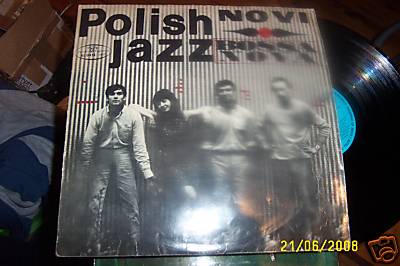
NOVI SINGERS Bossa Nova orig POLISH LP very rare muza
$
70


Favourite Auctions
To save auctions to your favourites, please login
If you don't have an account, please register
Description
Polish Jazz vol 13 Muza XL 0415
14 tracks
record is in excelent minus conditon with some needle marks - plays ex - no skips jumps or surface noise
a very rare find indeed recorded in warsaw, june 1967
synopsis:
Novi Singers - A Selection
"There is this epidemic of labeling, everybody labels everybody - seems some people can't sleep at night without having everything neatly classified. I don't give a damn if somebody says I sing church music, and somebody says it's military marches and somebody says it's nursery rhymes, and somebody else wonders if it's jazz. (...) I don't care what it's going to get called, I just want it to be good." (Bernard Kawka of the Novi Singers in: Jazz Forum 1/1971)
With their absolute technical perfection and their musical approach, the vocal jazz ensemble Novi Singers were at the time often compared to Lambert-Ross-Hendricks or Les Double Six. The story of the Novi Singers begins in 1964 when Bernard Kawka, a student at the Warsaw Music Conservatory, decides to found his own jazz group with other students, choosing the voice as an ideal instrument. The original members of the group are Ewa Wanat (violin), Janusz Mych (flute), Waldemar Parzynski (percussion), Aleksander Gluch and Bernard Kawka (violin), all of whom both sang and played their respective instruments.
On this compilation you will find a remarkable selection of tracks from several different albums that span the creative output of the Novi Singers from the 60's to the 70's (1965-1975). You will hear how their vocal artistry has been influenced by many different musical movements from Modern Jazz to Bossa Nova.
We start our little musical journey with two tracks Torpedo (B. Kawka) and All Together (B. Kawka), both taken from one of the most innovative albums of the group, Torpedo (1969). The name Torpedo shouldn't frighten you off. As they put it themselves: "Torpedo - the mysterious device specially designed to obliterate musical orthodoxy, heartless craftmanship, the smug self-confidence of those who clutch well-worn ideas and tread well-worn trails". That's a clear statement.
The very gifted songwriter and arranger Bernard Kawka left the Novi Singers, the group he had founded in 1972 and took his over ten years of vocal experience to the mother country of jazz, the USA. In fact, the vocal arrangements and performances of many Michal Urbaniaks releases on Arista, such as "Funk Factory" (1975) are those of Kawka and his new group, the BK-Singers - a sample favourite with the Beastie Boys.After Kawka left the group, the remaining three members of the Novi Singers were joined by the pianist and arranger Tomasz Ochalski, who had already contributed several arrangements to previous albums. Ochalski stayed in the group until 1977. The Album "Five, Four, Three" (1974) was cut in the trio formation without Kawka. The album name documents the development of the orginal group "Five, Four, Three" from a quintet to a trio. The Novi Singers sound changed slightly after Kawka left. Rock and electronic sounds entered the spectrum, as you will hear on the track Five, Four, Three with its electronically manipulated scats.
on this compilation Jeansy (B. Kawka, 1965) comes from the same debut single as Christine and already proves the great potential of the group. Again we recognize the initial unorthodox jazz approach of the Novi Singers with a complex rhythmic structuring and harmonic voice-layering.
Beside the material presented here, it might be of interest to know that the Novi Singers also produced two albums with vocal interpretations of Chopin compositions Novi Singers sing Chopin (1971) and Chopin up to date (1977). They were naturally big with the Polish due to Chopins national popularity. Before the group broke up, a late album Novi Singers pay Tribute (1980) was produced for the Polish Radio with a very nice interpretation of Jobims One-Note Samba.
Liner Notes bv Daniel W. Best, Feb. 1999