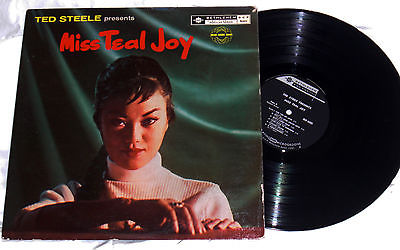
Miss TEAL JOY Ted Steel presents Bethlehem Microgroove 1958 EX+ Misirlou RARE
$
40


Favourite Auctions
To save auctions to your favourites, please login
If you don't have an account, please register
Description
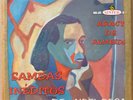
TED STEELE presents
Miss Teal Joy
BETHLEHEM HIGH FIDELITY / POPULAR SERIES BCP 5001
MICRO COSMIC SOUND
DEEP GROOVE LABELS
Original 1958 USA issue in EX/EX+ condition
tracks :
LET'S FALL IN LOVE
EASY TO REMEMBER
SINCE I FELL FOR YOU
MISIRLOU
DON'T WORRY ABOUT ME
'DEED I DO
FOR YOU MY LOVE
THAT OLE DEVIL CALLED LOVE
WHO'S SORRY NOW
COME BACK TO SORRENTO
AUTUMN LEAVES
EL CUMBANCHERO
“I can’t help but wonder whether the genuine sophistication of Miss Teal Joy went right over the heads of the people listening to records in the late 1950s and early 60s—whether rock n roll blew her kind of music out of the water.”
People often drift in and out of your life. This is even more the case for performers. Sometimes you hear a song sung so beautifully by someone whose name you don’t know—and not even the incredible resources of the internet can tell you what it was. Sometimes you hear of someone who, for whatever reason, you missed when you were younger—someone perhaps who left few traces behind but who now fascinates. A friend of mine asked me, “Have you ever heard of Teal Joy?” I hadn’t. Since he had an extra copy of her first LP, Ted Steele Presents Miss Teal Joy, he sent it to me. I thought it was astonishing. It had been released in 1958 on Bethlehem Records. Teal Joy made a second LP, Mood in Mink on the Seeco label, a few years later, in the early 60s. Not, I think, through any fault of hers, it was less astonishing.
“Instead, she seems to have disappeared.
I don’t even know whether she is still alive.”
Ted Steele was a composer, arranger, performer and orchestra leader who appeared extensively on radio and television during the late 40s and 50s. He hosted The Chesterfield Supper Club on radio and Cavalcade of Bands on television, and he worked with artists such as Perry Como and Frank Sinatra. About Teal Joy, Steele writes, “I have never been so positive of greatness as I am now”: “New superlatives must be found to describe the talent and versatility of Miss Teal Joy…This young lady was singing in the Bamboo Club in Atlantic City, practically on the doorstep of the recording center of the world and virtually unnoticed, when I happened in. Now I am so grateful that I was the one to come along and be completely stunned by her immeasurable talent and taste…Teal Joy is a rarity in that she has the emotional and technical ‘feel’ for every kind of music, as demonstrated in the variety of songs chosen for this album. Born in Seattle, Washington, Teal is of Japanese, French, and Peruvian descent, which I am sure imparts to her interpretation of these songs much of the rich emotional color and understanding, delicacy, and mystery of many cultures…Because of her amazing versatility I felt that we needed three distinctly different sounds to showcase Teal properly. Three different orchestras, comprised of the outstanding names in the music world, were called in to do this album.” Steele gleefully quotes a remark made “by a normally unconcerned engineer” who worked on recording Teal Joy: “This album will bring back music.” Steele’s prose seems hyperbolic until you have listened to the LP, at which point you tend to agree with him. The LP is tremendously exciting and tremendously varied. Joy sings in Japanese, Yiddish, Italian, French, and Spanish as well as in English. Her version, in Italian (the original language) of “Come Back to Sorrento” is one of the highlights of the LP. Others include “Misirlou” (Yiddish) and “El Cumbanchero” (Spanish). She sings “’Deed I Do” in English and then, surprisingly, in Japanese. When she sings in English, her intonations sometimes remind you of Billie Holiday (Joy covers Holiday’s hit of the 1940s, “That Old Devil Called Love”), but at other moments she recalls Eartha Kitt and, surprisingly, Edith Piaf. (Joy has a big voice.) In the liner notes to her second and, presumably, last LP, Mood in Mink, Les Keats writes that Miss Teal Joy was “a much played album…made a few years back.” One suspects that Mood in Mink was a much less played album. All of the songs here are in English, and many of pianist Jack Quigley’s arrangements don’t so much complement Joy’s voice as they compete with it. The songs are good, and the voice is certainly still there, but Quigley’s first attempt at arranging-conducting is not a success. Joy is at times treated like the “girl singer” in a big band; the music is the main point and she is only a momentary diversion in the overall effect. If the music—jazz-based—were better, the album would have been better. But alas, it isn’t, and the LP is neither a good showcase for Joy nor a good showcase for Quigley’s music. Though certainly a bit dated, Ted Steele’s arrangements for Miss Teal Joy managed to give us a good sense of her extraordinary range and versatility—and of the emotional subtlety she gave to her renditions. Sadly, most of that is gone from Mood in Mink. Her singing is fine and there is some subtlety in it, but the total effect is disappointing. Perhaps that’s why no one these days has heard of Teal Joy. I don’t know. I don’t know why Ted Steele had nothing to do with that second album or why she changed labels. The woman with what Steele called “the greatest new voice in the last decade” did not go on to become a star. Instead, she seems to have disappeared. I don’t even know whether she is still alive. Or what she did after that second album—if she did anything at all. Perhaps she went back to Seattle and settled into an ordinary life, far away from the music business. Perhaps she married someone and stopped singing. I can’t help but wonder whether the genuine sophistication of Miss Teal Joy went right over the heads of the people listening to records in the late 1950s and early 60s—whether rock n roll blew her kind of music out of the water. (One can imagine Elvis Presley singing one of the songs she sings on Miss Teal Joy: Paul Gayten’s “For You My Love”—a great R&B hit from 1949.) Whatever momentum she had gained with the first album seems to have been pretty much stopped by the second. And yet, here she is still singing with great joy, verve, and expressiveness on this remarkable first LP—available, with a little difficulty, from sources on the internet. Whatever the events of her subsequent life, the aliveness of her spirit still pours forth from these ancient grooves.- JACK FOLEY
condition
vinyl: EX Clean vinyl, nice shine. Deep groove labels. A few light hairlines don't affect play. Warm mono mix sounds great!
cover: EX+ All seams intact. No cut-out marks. No bar code. {
U. S. S H I P P I N G R A T E S
$4.00 for MEDIA
$8.00 for PRIORITY
I N T E R N A T I O N A L S H I P P I N G R A T E S
$16.00 for INTERNATIONAL FIRST CLASS
C A N A D A A N D M E X I C O S H I P P I N G R A T E S
$8.00 for INTERNATIONAL FIRST CLASS
International Bidders Welcome! Seller ships worldwide.
SELLER WILL COMBINE SHIPPING CHARGE FOR MULTIPLE ITEMS ORDERED.
...................................
FAST SHIPPING! Ships same or next day after payment is received.
· All records are carefully packed in custom cardboard mailers for safe shipment.
· Record and inner sleeve removed from cover and placed in poly-sleeve.
· Seller accepts Paypal.
View Seller's other items
L O O K I N G F O R R A R E
R E C O R D S O R C D s ?
Visit my eBay Store: My Vinyl Wife
price rating






![Stop loving you (1988) [Vinyl Maxi Single] Toto:](https://www.popsike.info/php/thumbnail.php?url=https://www.popsike.pics/pix/20241129/305942079437.jpg)