Mercury Living Presence - Russian Recordings - 5 LPs - New/Mint
$
200


Favourite Auctions
To save auctions to your favourites, please login
If you don't have an account, please register
Description
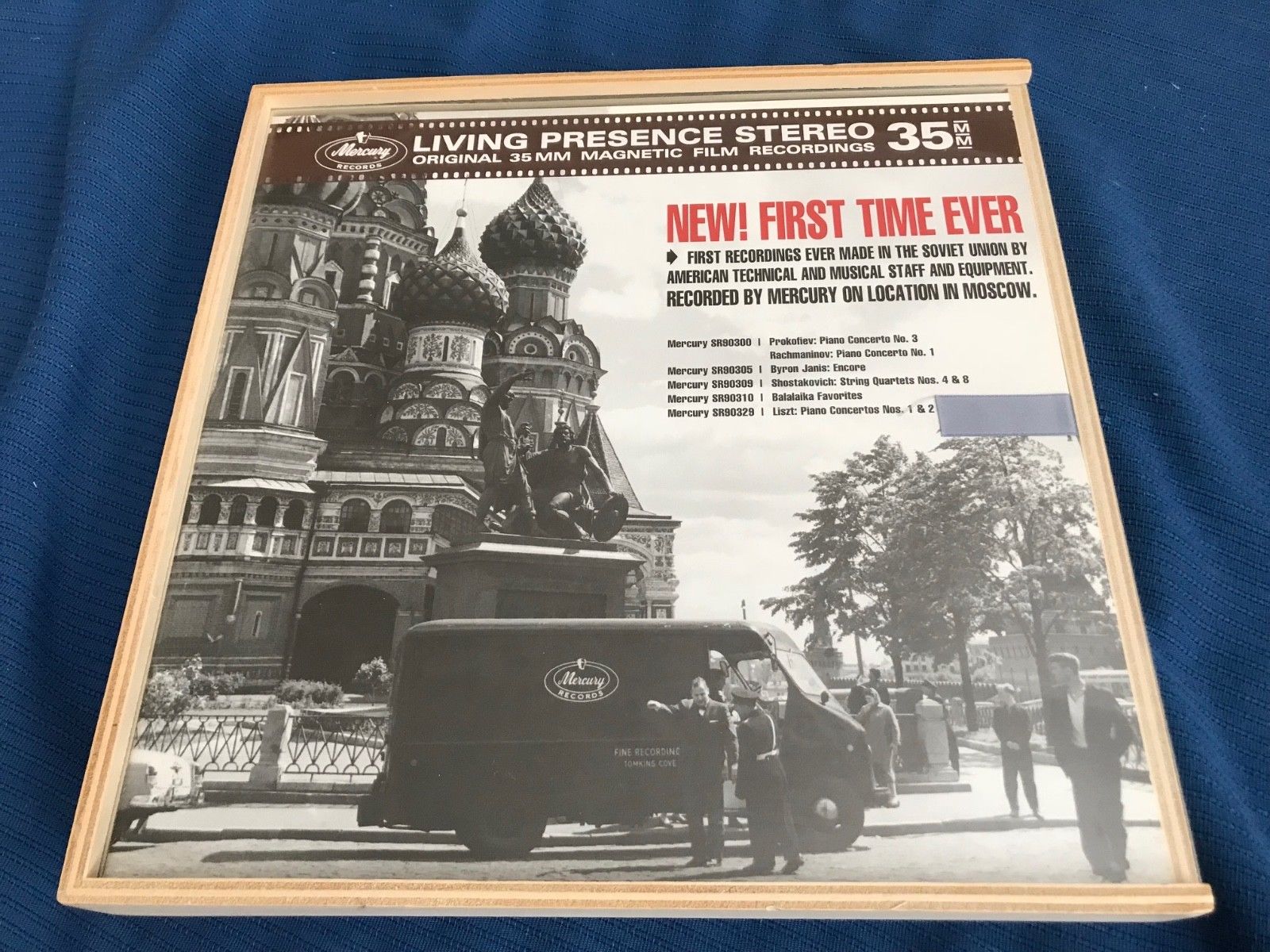
Speakers Corner Wood Box 5-LP set - New/Mint
The history of the Mercury Living Presence label is full of innovations and remarkable events. One of these was a trip in June 1962 to the Soviet Union to record, on location, Russian and American artists and orchestras. What makes this so outstanding is the fact that Mercury shipped its own recording truck and staff from the U.S. to Moscow – right at the height of the Cold War. Nobody had achieved this before, and actually, nobody did after. The records made from those recordings are all well known and have become classics. This box set bundles all five of the resulting LPs.
The packaging for this set is the most sumptuous one Speakers Corner has ever published. It includes a wooden box with a transparent sliding top. The enclosed booklet features photographs never printed before and interviews with participants of the tour: Bob Eberenz (vice president of Fine Recordings), Harold Lawrence (musical director of Mercury Living Presence) and Brice Somers (international director of Mercury Living Presence). This set will, and we are very confident of this, become a collector's item.
Prokofiev: Piano Concerto No.3; Rachmaninov: Piano Concerto No.1
In contrast to his tremendously popular Second and Third Piano Concertos, Rachmaninov's First could be likened to a rare orchid in that it is seldom found on a concert program. Why is that? Is it that it lacks the sweet sultriness of the later works? Or could it be that no one is aware of the 17-year-old composer's talents? Or can he be accused of walking in Tchaikovsky's harmonic footsteps? This recording has an answer to all these questions. In spite of reaching back to such genial examples as Schumann, Beethoven and Grieg, Rachmaninov reveals his own personality in his early work. The thematic ideas are extremely impressive; they are developed skillfully and are treated to such a masterly orchestration that one is tempted to dub this work "The Underestimated."
Prokofiev's Third Piano Concerto was spared such a fate. Its folk-like character, coupled with amazing virtuosity, guarantee that the work remains immensely popular – but it also places the highest demands upon the performers. It remains a matter of speculation as to whether the presence of the American recording team spurred on the Moscow Philharmonic Orchestra and the pianist Byron Janis to newer and greater heights, such as are heard here.
Byron Janis: Encore
It is an unwritten rule of concert life, signalized by the continuous applause of an enthusiastic audience, that no good soloist is allowed to leave the platform before he has given at least one encore. Whether the virtuoso pulls a contemplative, lyrical or thrilling piece out of his hat is entirely up to him or her to decide. But one thing is absolutely imperative: an encore must be short and popular. Twelve such little gems, all of them different in their own way, have been chosen by Byron Janis for this coupling. They are all well-loved – from the technically demanding Sixth Rhapsody and the frisky "Valse oubliee" by Liszt, to Schumann's seemingly weightless Romance in F sharp major and his energetic Novelette with its cascades of chords. Byron Janis displays his deft finger technique in Prokofiev's furious "Toccata," while tender sentimentality pervades Mendelssohn's "Lied ohne Worte." Pinto's three sparkling "Scenes from Childhood" are played with humor and nicely round off this musical potpourri.
Shostakovich: String Quartets Nos. 4 & 8
The stony path towards artistic freedom which led through the thicket of the Soviet dictatorship appeared to have become somewhat smoother for Shostakovich with this recording. It was something of a small sensation that a recording team from the West was permitted to travel to Moscow to tape and thus preserve music by a contemporary composer for the western market. And that the Mercury team brought back a recording (along with other tapes) that would stand on an exalted platform even in times of a political thaw is a stroke of luck. The Borodin String Quartet approaches Shostakovich's modernistic, personal style methodically and with great expression, bedded as it is in romantic musical tradition. Although it isn't done to draw attention to the performance of one player over the remaining three, one really must mention the cellist Berlinski who plays his part in the Quartet No. 4 with breathtaking cantabile and assurance. The Quartet No. 8 is special for a quite different reason: Shostakovich dedicated this piece to himself as a sort of personal requiem by working his initials DSCH (D, E flat, C, B natural in German notation) into the score and also included numerous citations from earlier works such as the First Symphony and Clarinet Trio op. 67. In this way both the music and the recording guarantees a very personal confrontation with the composer.
Balalaika Favorites
The balalaika is not a difficult instrument to describe: it has a triangular body, three strings and a fretted neck. It is far more difficult to describe the inherent values of this national instrument, of which there is a whole family with sizes ranging from the piccolo and alto to the bass and double bass. Accordingly, a wide variety of timbral coloring can be achieved, which – together with a broad repertoire – is exploited to the full by a traditional ensemble such as the Osipov Orchestra. With their performances of arrangements of well-known, romantic Russian pieces, popular adaptations and waltzes, this professional orchestra gives us an insight into the spirited and highly entertaining world of a living musical culture. No different from a classical orchestra, the arrangements are rich in soloistic interludes. Alongside the domra, an instrument with three or four strings, we hear a xylophone, ancient wind instruments and the sonorous, rippling bajan (button accordion). This recording goes back to the roots of Russian music and rightly occupies and important position in this Russian Edition.
Liszt: Piano Concertos Nos. 1 & 2
Liszt's Piano Concertos occupy a special position in the genre for several reasons. Firstly, they mirror the amazing keyboard virtuosity of the composer, and secondly they point the way to modern music through their daring harmonies and free treatment of traditional compositional forms. Any pianist who tackles the mighty E flat major Concerto, which was premiered by Liszt himself under the baton of Berlioz in 1855, soon realizes that he has taken on a mammoth task. Instead of an over-dimensional, weighty performance, Byron Janis and the Moscow Philharmonic present a compact reading of this tightly-knit composition. Janis, a pupil of Horowitz, displays his bravura in the appropriate places but also knows how to use his technical prowess – perfected in his early years – to produce finely-chiseled keyboard poetry, freeing the work from its often-cited bulkiness. This is particularly effective in the intoxicating Finale, where the pianist's brilliance amalgamates with triumphal orchestral playing. In the Second Concerto, too, it is clear that great care has been taken with the score. Beginning with the elegiac entry, via the pulsating Agitato up to the expressive melodic playing, Byron Janis and Gennadi Rozdestvensky fill this visionary symphonic poem with wonderful timbral coloring which is brought to a climax in the sparkling Finale. When music from the New German School sounds like it does here by means of Russian hands, then it certainly deserves a place in this Russian Edition.
price rating