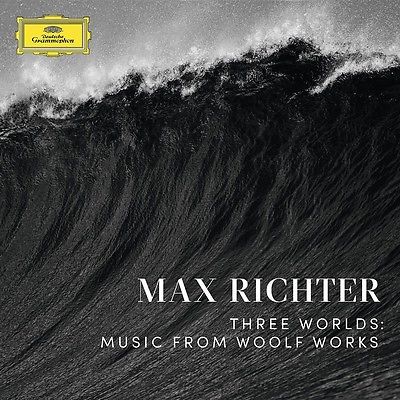
Max Richter - Max Richter: Three Worlds – Music from Woolf Works
€
22
$
26


Favourite Auctions
To save auctions to your favourites, please login
If you don't have an account, please register
Description
Allgemein
Artikel Name: Max Richter: Three Worlds – Music from Woolf WorksGenre: Sonstige Klassik Produkt Typ: LP (Vinyl) Label: DGG Titelanzahl: 17
Trackliste LP - 1
1. RICHTER MAX - Words 2. RICHTER MAX - In the Garden 3. RICHTER MAX - War Anthem 4. RICHTER MAX - Meeting Again 5. Richter, Max - Memory Is the Seamstress 6. RICHTER MAX - Modular Astronomy 7. Richter, Max - Entropy 8. RICHTER MAX - Transformation RICHTER MAX - Morphology (Orlando) 3:07Trackliste LP - 2
9. RICHTER MAX - Morphology 10. Richter, Max - Tyranny of Symmetry 11. RICHTER MAX - Explorers 12. Richter, Max - Persistence of Images 13. Richter, Max - Genesis of Poetry 14. Richter, Max - Possibles 15. RICHTER MAX - Love Songs 16. TuesdayBeschreibung
Beschreibung
Three Worlds – Music from Woolf Works presents music from Woolf Works, an award-winning ballet triptych that reunited Max Richter with his Infra collaborator, choreographer Wayne McGregor. Like Infra, which paid tribute to T.S. Eliot's The Waste Land and Schubert's Winterreise, Woolf Works is an homage to three of Virginia Woolf's greatest novels: Mrs. Dalloway, Orlando, and The Waves. And, like his previous collaboration with McGregor, Three Worlds is a striking testament to how eloquently Richter translates the work of an artist working in another medium into compelling music. As he captures the depth and breadth of the worlds Woolf created with her writing, he reflects on his own body of work. Following an excerpt of "Craftsmanship," the only surviving recording of Woolf's voice (and another reminder of how deftly Richter combines spoken word and found sounds into his music), Three Worlds begins with Dalloway-inspired pieces. The interplay of strings and piano on "Meeting Again" is quintessentially Richter, the tension between structure and aching emotions echoing his breakthrough The Blue Notebooks; meanwhile, the flowing sweetness of "In the Garden" is as imbued with poignant details as the novel that inspired it. Later, "War Anthem" evokes the novel's tragic World War I veteran Septimus Smith with its distant -- but still ominous -- drums. Richter's flair for incorporating electronics into his music comes to the fore on the Orlando portion of Three Worlds, arguably the album's most exciting stretch. He echoes the daring, unexpected life of the novel's gender-swapping protagonist with short, brisk pieces that move with too much purpose to be merely whimsical: "Modular Astronomy" sounds like it's streaking through time and space, while the arpeggios on "The Genesis of Poetry" trace clearly defined arcs. The Orlando pieces also show off Richter's impressive range, spanning the echoing drones of "Morphology" and the elegantly futuristic mesh of electronics and strings on "The Explorers." This part of Three Worlds could easily be an album in its own right, something that could also be said of its final section, The Waves. Prefaced by a reading of Woolf's suicide note by Gillian Anderson, "Tuesday" closes the album with slowly unfolding strings, brass, and vocals that are somehow unsettling in their steadiness, mirroring the concept of shared consciousness in the novel. While the album's finale may lose something without the ballet's visuals, it's still impressive. Coming after the epic length and ambition of Sleep, Three Worlds could seem like a more minor work, but in its own right, it's another triumphant reminder of Richter's brilliance as a translator and creator. ~ Heather Phares
Heather Phares
Beschreibung
German-British composer Max Richter has been known mostly for his film scores. One of the best of them, that for Arrival, was heard by millions of people and was ideally timed to attract listeners to some of Richter's non-cinematic music. Three Worlds -- Music from Woolf Works was abridged from a ballet entitled Woolf Works, which consisted mostly of short chunks that work reasonably well in abstract form. Each of the work's three sections begins with a spoken quotation from Virginia Woolf herself, the first of them consisting of an actual recording of Woolf's voice from 1937; the other two are read by actresses. The rest of the movements are instrumental and are connected to a greater or lesser degree to the three novels named in the titles of the three sections, Mrs Dalloway, Orlando, and The Waves. Only the Woolf quotation for Orlando comes from the novel named in its section title. The music in that section consists of a set of variations on the Baroque-era-ground La Folia, and the medium is constantly shifting: from full orchestra to chamber instruments, solo groups, and electronic variations (the music is performed by Richter himself on piano and synthesizer, plus the Deutches Filmorchester Babelsberg and assorted other musicians). You wouldn't guess Virginia Woolf if you heard it cold, but the music is not quite like anything else you will have heard. The final section, by contrast, has a powerfully direct emotional impact. The opening reading, spoken by Gillian Anderson, is taken from Woolf's suicide note, and although Richter indicates that the rest of the music evokes the poetic mood of The Waves, its intense climax (unlike the rest of the music, this is a lengthy movement of more than 20 minutes) seems to keep the suicide note in the listener's mind. Although the work as a whole is not a film score, it has the flavor of one, and it opens up intriguing possibilities for the expansion of that language to other settings. Certainly recommended for anyone who has noticed and liked the music for Arrival.
James Manheim
Mitwirkende
- Artist: Max Richter
- Composer: RICHTER MAX
- Record Label: Deutsche Grammophon
price rating





![Gaudi - Magnetic [New Vinyl LP]](https://www.popsike.info/php/thumbnail.php?url=https://www.popsike.pics/pix/20170626/142427194606.jpg)