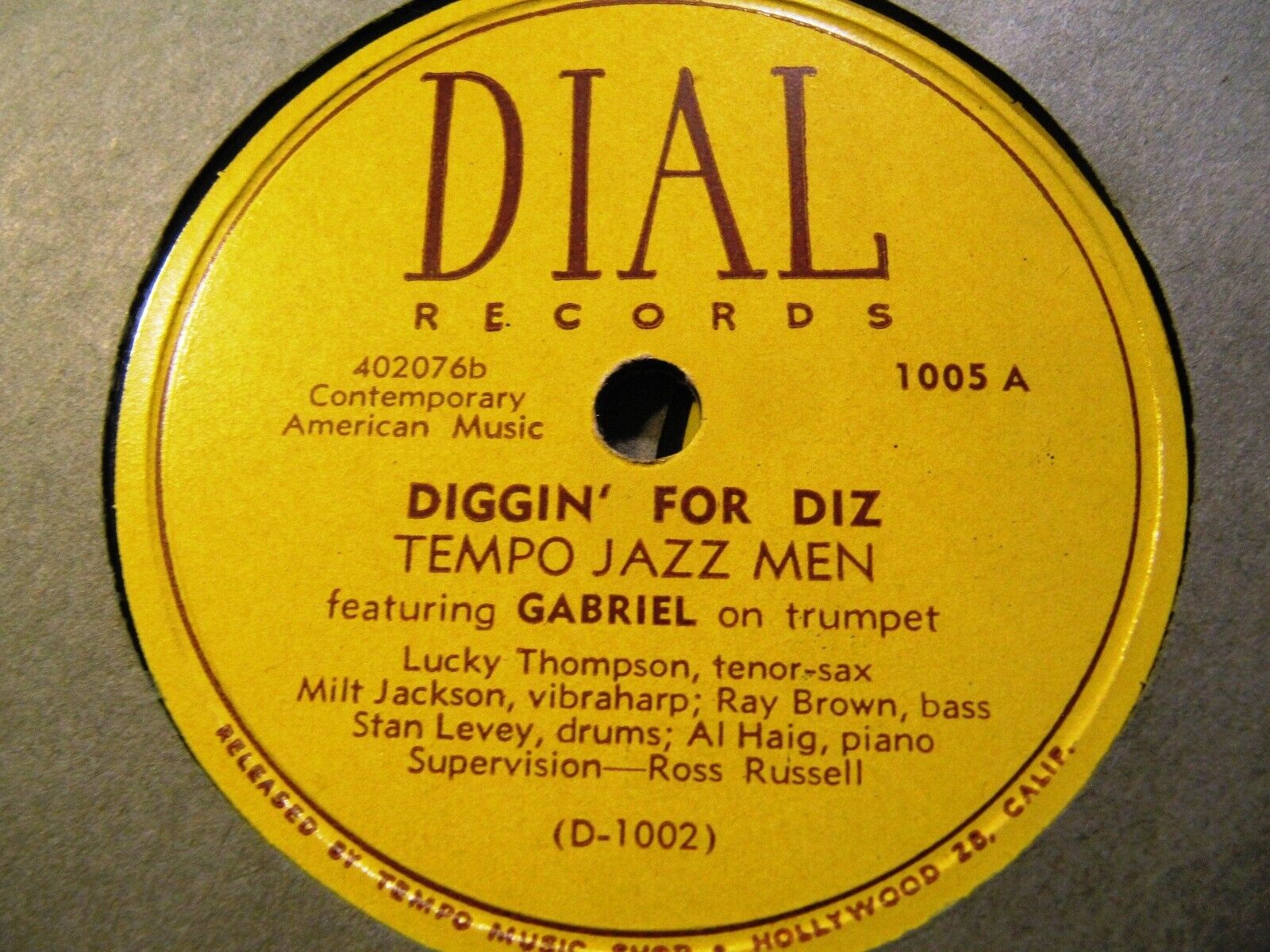
MINT Copy DIZZY GILLESPIE Bebop Improvisation Diggin for Diz Tempo Jazz Men DIAL
$
75




Favourite Auctions
To save auctions to your favourites, please login
If you don't have an account, please register
Description
A series of great JAZZ, Ragtime and Swing Records from early Ragtime to Beb-Bop on 78 rpm Victrola Records
Click this link for more great Jazz and Vocal Records in my other listings!
DIZZY GILLESPIE Trumpet in a great Bebop Improvisation under the Pseudonym "Gabriel"
Alternate Takes Gillespie's Diggin' Diz first take was issued on DIAL 1004
Tempo Jazz Men / Howard McGhee Jam Band – Diggin' For Diz / Trumpet At Tempo
Label: Dial Records (3) – 1005
Format:
Shellac, 10", 78 RPM
Country: US
Released: Nov 1946
Genre: Jazz
Style: Bop
A Tempo Jazz Men– Diggin' For Diz
Bass – Ray Brown
Drums – Stan Levey
Piano – Al Haig
Supervised By – Ross Russell
Tenor Saxophone – Lucky Thompson
Trumpet – Gabriel = Dizzy Gillespie
Alias used by Dizzy Gillespie when appearing on labels he wasn't contracted to.
Vibraphone – Milt Jackson
B Howard McGhee Jam Band– Trumpet At Tempo
Bass – Dingbod*
Drums – Roy Porter
Piano – Jimmy Bonn*
Supervised By – Ross Russell
Trumpet – Howard McGhee
Written By – Howard McGhee
Dizzy Gillespie is listed as "Gabriel" for contractual reasons
Label lists Jimmy Bunn as "Jimmy Bonn"
A-Side Electro Broadcast Studios, Glendale, CA, February 7, 1946
B-Side C.P. MacGregor Studios, Los Angeles, CA, July 29, 1946
Vibraphone – Milt Jackson
Written-By – Dizzy Gillespie (tracks: A/ B)
Alternate Takes Gillespie's Diggin' Diz first take was issued on DIAL 1004
NOS Stock unplayed from the stock of an LA area Jukebox Operator
10" 78 rpm record
Condition:
NEAR MINT, plays E+ EXCEPTIONALLY QUIET
Read below the 1947 THE Gramophone review
John Birks "Dizzy" Gillespie (October 21, 1917 – January 6, 1993) was an American jazz trumpeter, bandleader, singer, and composer. He was born in Cheraw, South Carolina, the youngest of nine children.Dizzie's father was a local bandleader, so instruments were made available to Dizzy. He started to play the piano at the age of 4. Together with Charlie Parker, he was a major figure in the development of bebop and modern jazz.
In addition to featuring in these epochal moments in bebop, he was instrumental in founding Afro-Cuban jazz, the modern jazz version of what early-jazz pioneer Jelly Roll Morton referred to as the "Spanish Tinge". Gillespie was a trumpet virtuoso and gifted improviser, building on the virtuoso style of Roy Eldridge but adding layers of harmonic complexity previously unknown in jazz. In addition to his instrumental skills, Dizzy's beret and horn-rimmed spectacles, his scat singing, his bent horn, pouched cheeks and his light-hearted personality were essential in popularizing bebop, which was originally regarded as threatening and frightening music by many listeners raised on older styles of jazz. He had an enormous impact on virtually every subsequent trumpeter, both by the example of his playing and as a mentor to younger musicians.
He also used a trumpet whose bell was bent at a 45 degree angle rather than a traditional straight trumpet. According to Gillespie's autobiography, this was originally the result of accidental damage caused during a job on January 6, 1953, but the constriction caused by the bending altered the tone of the instrument, and Gillespie liked the effect. Gillespie's biographer Alyn Shipton writes that Gillespie likely got the idea when he saw a similar instrument in 1937 in Manchester, England while on tour with the Teddy Hill Orchestra. Gillespie came across an English trumpeter who was using such an instrument because his vision was poor and the horn made reading music easier. According to this account (from British journalist Pat Brand) Gillespie was able to try out the horn and the experience led him, much later, to commission a similar horn for himself. Whatever the origins of Gillespie's upswept trumpet, by June, 1954, Gillespie was using a professionally manufactured horn of this design, and it was to become a visual trademark for him for the rest of his life
Early life and career
Dizzy's first pro job was with the Frank Fairfax orchestra in 1935, after which he joined the Teddy Hill orchestra, replacing his main influence Roy Eldridge as first trumpet in 1937. In 1939, Gillespie joined up with Cab Calloway's orchestra, with which he recorded one of his earliest compositions, the instrumental "Pickin' The Cabbage" , in 1940 (originially released on the Vocalion label, #5467, on 78rpm - said 78rpm record backed with a co-composition with Cab's drummer at the time Cozy Cole entitled "Paradiddle"). After Dizzy left Calloway in late 1941, he freelanced with a few bands - most notably being Ella Fitzgerald's orchestra, comprised of members of the late Chick Webb's band, in 1942. In 1943, Gillespie then joined up with the Earl Hines orchestra. The legendary big band of Billy Eckstine gave his unusual harmonies a better setting, and it was as a member of Eckstine's band that he was reunited with Parker, after earlier being members of Earl Hines's more conventional band.
[edit] The rise of bebop
With Charlie Parker, Gillespie jammed at famous jazz clubs like Minton's Playhouse and Monroe's Uptown House, where the first seeds of bebop were planted. Gillespie's compositions like "Groovin' High" , "Woody n' You" , "Salt Peanuts" , and "A Night in Tunisia" sounded radically different, harmonically and rhythmically, than the Swing music popular at the time. One of their first (and greatest) small-group performances together was only issued in 2005: a concert in New York's Town Hall on June 22, 1945. Gillespie taught many of the young musicians on 52nd Street, like Miles Davis and Max Roach, about the new style of jazz. After a lengthy gig at Billy Berg's club in Los Angeles, which left most of the audience ambivalent or hostile towards the new music, the band broke up. Unlike Parker, who was content to play in small groups and be an occasional featured soloist in big bands, Gillespie aimed to lead a big band himself; his first attempt to do this came in 1945, but it did not prove a success.
Dizzy Gillespie statue in Cheraw, South CarolinaAfter his work with Parker, Gillespie led other small combos (including ones with Milt Jackson, John Coltrane, Lalo Schifrin) and finally put together his first successful big band. He also appeared frequently as a soloist with Norman Granz's Jazz at the Philharmonic.
price rating