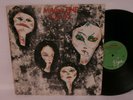
MINT 1966 Orig "RAIN" / 'PAPERBACK WRITER' The BEATLES REVOLVER era PSYCH GEM
$
104


$ 104
Sold For
Jan 10, 2021
Sold Date
Jan 5, 2021
Start Date
$ 10
Start price
21
Number Of Bids
USA
Country Of Seller
eBay
Auctioned at
Favourite Auctions
To save auctions to your favourites, please login
If you don't have an account, please register
Description
- TOP COPY ~ BEAUTIFUL ~~ ORIGINAL 1966 FIRST PRESS ..|/\|...............................................|/\|..
- = THE BEATLES =
- PAPERBACK WRITER
- B/W
- RAIN
- ..|/\|...............................................|/\|..
- USA - CAPITOL RECORDS -5587
- ! MINTY ~~ TOP FINAL COLLECTION COPY !
- BEAUTIFUL 1966 ORIGINAL with SHARP CLEAN SLEEVE!
- TWO SIDED WINNER !
- PAPERBACK WRITER
- b/w
- RAIN
WIDE GROOVED "LOUD CUT" 45 MIXES : CONTAINS SUPERIOR AUDIO OVER THE 12 INCH ALBUM VERSION
The Beatles recorded "Paperback Writer" at EMI Studios in London on 13 and 14 April 1966. "Paperback Writer" is marked by the boosted bass guitar sound throughout, partly in response to John Lennon demanding to know why the bass on a certain Wilson Pickett record exceeded the bass on any Beatles records. This changed with the "Paperback Writer" single.
The Beatles in 1965
"'Paperback Writer' was the first time the bass sound had been heard in all its excitement," said Beatles' engineer Geoff Emerick in Mark Lewisohn: "Paul played a different bass, a Rickenbacker. Then we boosted it further by using a loudspeaker as a microphone. We positioned it directly in front of the bass speaker and the moving diaphragm of the second speaker made the electric current."
Further, McCartney's playing was more melodic and busy than on previous tracks.
According to McCartney, the harmony vocals on the track were arranged during the recording session. George Martin, the Beatles' producer, later commented: "The way the song itself is shaped and the slow, contrapuntal statements from the backing voices – no one had really done that before." In their backing vocals over the third verse, Lennon and George Harrison sing the title of the French nursery rhyme "Frère Jacques".
Emerick stated that the "Paperback Writer" / "Rain" single was cut louder than any other Beatles record up to that time, due to a new piece of equipment used in the mastering process, referred to as "Automatic Transient Overload Control", which was devised by the EMI maintenance department.
b-side:
" RAIN " The inspiration for "Rain" is agreed by John Lennon describing the band's arrival in Sydney, Australia, marked by rain and poor weather. Lennon said, "I've never seen rain as hard as that, except in Tahiti", and later explained that "Rain" was "about people moaning about the weather all the time". Another interpretation is that the song's "rain" and "sun" are phenomena experienced during a benign LSD trip.Recording began on 14 April 1966, in the same session as "Paperback Writer", and concluded on 16 April, with a series of overdubs before mixing on the same day.At that time, the Beatles were enthusiastic about experimenting in the studio to achieve new sounds and effects. These experiments were showcased in their seventh album, Revolver. Geoff Emerick, who was the engineer for both sessions, described one technique he used to alter the sonic texture of the track by recording the backing track "faster than normal". When played back, slightly slower than the usual speed, "the music had a radically different tonal quality." The opposite technique was used to alter the tone of Lennon's lead vocal: it was recorded with the tape machine slowed down, making Lennon's voice sound higher when played back.
The last verse of "Rain" includes backwards vocals, the first use of this technique on a record. (The hit novelty song "They're Coming to Take Me Away, Ha-Haaa! ", where side B is side A played backwards, was released later that year of 1966). The backwards vocals are Lennon singing the lyrics of the song: "When the sun shines", "Rain", and "If the rain comes, they run and hide their heads." Both Lennon and producer George Martin claimed credit for the idea. Lennon said:
After we'd done the session on that particular song – it ended at about four or five in the morning – I went home with a tape to see what else you could do with it. And I was sort of very stoned and tired, you know, not knowing what I was doing, and I just happened to put it on my own tape recorder and it came out backwards. And I liked it better. So that's how it happened.
Emerick confirmed Lennon's creative accident, but Martin remembered it differently:
I was always playing around with tapes and I thought it might be fun to do something extra with John's voice. So I lifted a bit of his main vocal off the four-track, put it on another spool, turned it around and then slid it back and forth until it fitted. John was out at the time but when he came back he was amazed.
Later, Lennon claimed:
I got home from the studio and I was stoned out of my mind on marijuana and, as I usually do, I listened to what I'd recorded that day. Somehow I got it on backwards and I sat there, transfixed, with the earphones on, with a big hash joint. I ran in the next day and said, 'I know what to do with it, I know ... Listen to this!' So I made them all play it backwards. The fade is me actually singing backwards with the guitars going backwards. [Singing backwards] Sharethsmnowthsmeaness ... [Laughter] That one was the gift of God, of Jah, actually, the god of marijuana, right? So Jah gave me that one.
Regardless of who is credited for the technique, "from that point on," Emerick wrote, "almost every overdub we did on Revolver had to be tried backwards as well as forwards."
The "Paperback Writer" / "Rain" single was the first release to use a new device invented by the maintenance department at Abbey Road called "ATOC" for "Automatic Transient Overload Control". The new device allowed the record to be cut at a louder volume, louder than any other single up to that time. On the final mix of the single, Lennon played a 1965 Gretsch Nashville, Paul McCartney a 1964 Rickenbacker 4001S bass, Harrison a 1964 Gibson SG, and Ringo Starr used Ludwig drums
- CONDITION:
- The cover: rated: M- A beauty! Sharp and clean everywhere ... you may not ever find a better copy. There are no delete marks, no split seams, no bends, and no writing ...
- The vinyl: Rated: M- TOP COPY; plays with MINTY CLEAN AUDIO
- both Capitol labels are clean
A cool addition to anyone's music library!
SEE: SELLERS OTher items for similar cool sounds for "head" people... EFFICIENT/CAREFUL GRADING All imperfections are noted both cover & record NOTE: All Items backed by money back guarantee! IF you have a problem PLEASE let us solve for you BEFORE leaving ANY negative feedback. Thanks! GRADING SCALE: M, M-, EX, VG++,VG+, VG, VG- M Completely clean, no marks M- Carefully used, looks clean, plays clean, shiny gloss, no marks EX Faint scuff or superficial mark, near M-, high gloss, plays clean VG++ Glossy with minimal scuffing or light mark playing very nice, clean VG+ a bit more scuff or markls still plays well with very minimal surface at worse VG more marks/scratches only minor, nothing deep, no loud clicks or pops this grade is abused by many, VG here does not mean "trashed" VG- surface noise present, will not have skips or jumps ALL PAYMENTS SHOULD BE MADE WITHIN 5 DAYS Of AUCTIONS END BIDDERS PLEASE = Do Not Bid If You Are Not Serious About Following Through The Transaction! ALL ITEMS GUARANTEED FOR WINNING BID - LESS SHIPPING!
price rating