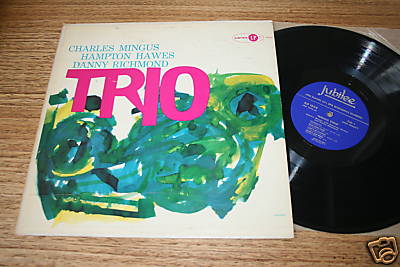
"MINGUS THREE" CHARLES MINGUS, ORIG. '58 MONO JUBILEE
$
43


Favourite Auctions
To save auctions to your favourites, please login
If you don't have an account, please register
Description
hathillgallery Store
MINGUS THREE
CHARLES MINGUS
Charles Mingus is the volcanic, inflammably honest bass virtuoso, composer and Jazz Workshop leader whose strength of musical personality has made his playing and writing instantly identifiable, however intermittently controversial. Hampton Hawes, Los Angeles-born and almost thirty, has been welcomed by several critics and a number of musicians as an unusually earthy and deeply swinging representative of mainstream modernism that flows directly from Charlie Parker whom Hawes acknowledges as his primary influence. The drummer is Danny Richmond, a regular member of Mingus' Jazz Workshop unit.
Yesterday's is a head arrangement in which the memories are collected at a brisker tempo than is usual in approaching the standard. Back Home Blues is Mingus', and it was his evident goal to create a down home feeling and particularly, as he explains it, "to make Hamp play even more basic blues than he has been accustomed to."
I Can't Get Started, a song that Mingus has been attracted to for some time is played within the framework of Mingus' alteration of the changes. Hamp's New Blues, described by Mingus as "bebop blues" illustrates a comment by English critic, Alun Morgan, about Hawes and the blues to the effect that "Hawes continues to extract freshness and beauty from this timeless material."
Mingus' intense plunge into Summertime is based, he acknowledges, "on a pedal point suggested by Lee Kraft, who was supervisor of the date, Dizzy Moods came into existence because Mingus admired Dizzy Gillespie's Woodyn' You. He altered the original chord pattern, wrote an original melody on that altered sequence, called Dizzy on the phone, played him the song, arid obtained Dizzy's benediction. Laura exemplifies that no matter how often a listener may have heard a song (and Laura has been one of the most ubiquitous wraiths in music in many years) jazzmen of intractable individuality like Mingus can transmute the most familiar music into quite an unexpected, self-startling experience. This trio session is considerably different from most trio dates. Two strong personalities are present in Mingus and Hawes, and although there is an overall feeling of fusion, of tempered rapport, this as much as dialogue between Mingus and Hawes with punctuation from Richmond as it is a group expression.
Mingus and Hawes are contrasting spirits, musically and off the stand. Hawes is rather diffident and disinclined to verbalize about music. When three Down Beat critics once reviewed his trio and invited him to answer their reviews, one of which was fiercely negative, he never replied to any of the several requests for a statement made to him. Mingus, on the other hand, is a celebrated writer of open letters to the music magazines, and is the Tom Paine of modern jazz in his polemical zeal to make his positions clear. Had the same three critics reviewed Mingus, it might have taken most of an issue to print his answers. In music, Hawes, as indicated previously, is in the direct Parker line with a partial indebtedness to Bud Powell, among others. His source of most impressive strength is his beat and his propelling assurance in the blues. Whether he will ever develop a commanding-ly individual voice that will in turn influence others irremediably is difficult to predict as of this writing, because there are personal as well as musical factors involved in the working out of Hawes' future. He is, in any case, already an accepted professional by other jazzmen, and is an emotionally stimulating, fiercely candid player who is easily assimilable and who intends to keep the basic jazz language and direction , as he conceives them, alive and meaningful.
Mingus' self-expressive needs are more impatient of convention than Hawes' and yet even more plungingly appreciative of tradition. Mingus' roots go far back into blues and old church music (as do Hawes whose father was a preacher and whose earliest musical memories are spirituals) but also into the cries and musical earth of other cultures as well. As a composer, he is a blazing believer in form following function, and he never composes except from an urgent desire to communicate a feeling, a lifeview, an anger or a joy. As articulate as Mingus is verbally, he feels-and rightly-that his most viable and self-revealing form of communication is through music. There are his intimately explosive bass solos in which the instrument becomes so annealed to him that, to paraphrase Yeats, a mesmerized listener may not know instantly where the bass begins and Mingus ends; and there is composed music, much of it transmitted orally and aurally to his side-men, a body of music that is as searingly personal and yet universally aware of and defiant of mortality as any body of composed work in written jazz.
The meeting of the two in this album is provocative, all the more so because both-health and wars willing-have the major section of their futures ahead of them. Hawes continues to move in the main road; Mingus, having absorbed the map, backwards and to the present, of the main route, is striking out on his own path. In ten years, they might well meet: or that main road may have been widened, in part by Mingus' impact, so that he has become conventional; or he may have, as I believe, been found to have been in the mainstream all along-except that he was swimming deeper than most.
- Nat Hentoff (co-editor, Hear Me Talkin' to Ya and Jazz Makers (Rinehart)
ORIGIN: USA.
LABEL: 1958 Jubilee Records #Mono JLP 1054.
CONDITION OF COVER: EX; nice cover with strong seams, light spine wear and discolouration.
CONDITION OF RECORD: EX+; few very light hair-line marks, plays near-mint.
RECORD GRADING DEFINITIONS
MINT: Never opened, still in original shrink wrap.
NM: Opened, appears unplayed.
EX: A few very light surface hair-line marks with no major deterioration to the sound quality.
VG: A few light scratches and/or scuffs creating audible background noise. There is no skipping or jumping on this record unless indicated in the condition description.
A plus or minus (+ or -) denotes slightly better or slightly less than a grade.
Shipping
International postage rate via air mail.
Asia/Pacific: Air Mail = US$13.00 or registered US$18.00 plus US$5.00 for each additional LP.
USA/Canada/Middle East: Air Mail = US$15.00 or registered US$20.00 plus US$7.00 for each additional LP.
UK/Europe/South America/Africa: Air Mail = US$18.00 or registered US$24.00 plus US$9.00 for each additional LP.
AUSTRALIA: AUD$8.00.
Notes
International customers we accept: Paypal.
Australian customers we accept: Paypal.
Mac/Windows/Linux Auction Listings by Cycline3.com
price rating