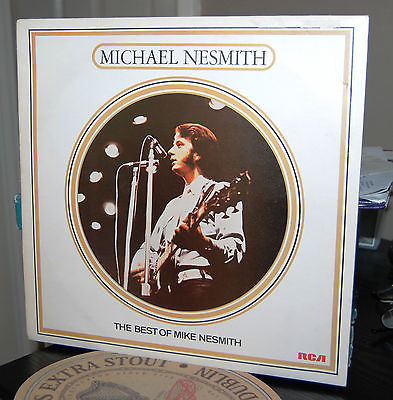
MICHAEL NESMITH. "THE BEST OF MIKE NESMITH" RCA UK 1976 LP. ORIG. EX.
£
20
$
27


Favourite Auctions
To save auctions to your favourites, please login
If you don't have an account, please register
Description
Michael Nesmith ?– The Best Of Mike Nesmith
Label: RCA ?– RS 1064 Format: Vinyl, LP, CompilationCountry: UK Released: 1976 Genre: Rock Style: Soft Rock
Tracklist
A1 Silver Moon A2 Different Drum A3 Harmony Constant A4 Two Different Roads A5 Mana Nantucket A6 Conversations A6 Joanne B1 Bonaparte's Retreat B2 Some Of Shelly's Blues B3 Rainmaker B4 Listen To The Band B5 Grand Ennui B6 I've Just Begun To Care (Propinquity) B7 Nevada FighterArtist Biography by John Bush
The comparatively level-headed member of '60s teen sensation the Monkees, Michael Nesmith was the most proficient instrumentalist in the group and wrote their best in-house songs, rootsy pop numbers like "Papa Gene's Blues," "You Told Me," "You Just May Be the One," and "Tapioca Tundra." In fact, he had written many songs before even joining the group, and one of his compositions, "Different Drum," was a hit for Linda Ronstadt and the Stone Poneys in 1968. After he left the Monkees one year later, it wasn't a surprise that he became the only one of his bandmates to sustain a solo career; in fact, his dozen (or so) '70s LPs were among the most groundbreaking country-rock recordings of the era. Throughout the 1970s and into the '80s, Nesmith continued to record sporadically, though his communications company Pacific Arts began taking up more of his time by the early '80s. Pacific Arts proved to be an important pioneer in the development of music video, the concept he had furthered in the rough-and-tumble pace of the Monkees' TV show.
Nesmith, born in 1942 in Houston, listened to the blues and played saxophone while growing up. After spending two years in the Air Force, however, Nesmith became fascinated with folk music and learned to play the guitar. He played around the area, but then moved to Memphis to play backup on recordings for Stax-Volt. Nesmith was in Los Angeles by the mid-'60s, and formed the folk-rock duo Mike and John with John London. He also recorded several singles as a solo act before auditioning to join the Monkees in 1965.
Almost immediately -- and even before their show premiered on TV -- the Monkees became one of the biggest pop groups of the late '60s. By the end of 1966, the band had notched two number one singles ("Last Train to Clarksville," "I'm a Believer") with the first two Monkees LPs spending more than 30 weeks at number one during 1966-1967. The TV show was a big hit as well, but the group's fabricated origins and subservience to songwriting teams and session musicians betrayed them in the eyes of the rock & roll intelligentsia. While the rock community became smarter every day about the machinations of the music industry, Nesmith led the fight to have the Monkees play instruments on and write songs for their own albums. The band's record label Colgems acquiesced, and on 1967's Headquarters the Monkees played their own instruments, wrote eight of the 14 selections, and produced the album (with a little help from their friend Chip Douglas). Headquarters reached number one (though with no obvious hits) and the Monkeesappeared ready to finally enter the rock elite, artistically as well as commercially. Critics and older listeners weren't impressed with the transformation, however, and the album ended up as something of an artistic peak instead of the beginning of a gradual ascent. Nesmith soothed his wounds in 1968 by recording his first solo album, Wichita Train Whistle Songs, which featured new arrangements of his best-knownMonkees songs. He continued with the Monkees for one more year, but then left the band in 1969. Nesmith's first act independent of the Monkees was the formation of the First National Band, with old friend John London on bass, John Ware on drums, and one of country music's best steel guitarists, Red Rhodes. the First National Band signed to RCA Victor and released two albums in 1970, Magnetic South and Loose Salute. The single "Joanne" hit the pop Top 25, and "Silver Moon" also charted later in the year. Nesmith added several members for 1971's Nevada Fighter, and credited it to the Second National Band. The title track skirted the bottom of the charts for several weeks, but Nesmith proved his pop savvy yet again by providing the Nitty Gritty Dirt Band with their hit, "Some of Shelly's Blues." The following year, the National Band released Tantamount to Treason. Nesmith dropped the group credit later that year, recording And the Hits Keep Comin' as a solo artist -- though Red Rhodes continued to play with him. Nesmith's 1973 album Pretty Much Your Standard Stash was his last for RCA Victor, as he formed the music/communications label Pacific Arts in 1974. The following year he released The Prison and co-wrote Olivia Newton-John's hit "Let It Shine." Nesmith re-entered the charts with 1977's From a Radio Engine to a Photon Wing; the single "Rio" was a hit in the U.K., and a filmed version of the song helped develop the concept of music video. In 1977, Nesmith furthered his efforts in the field of music video by creating a TV chart show called Popclips. When Warner bought the idea from him several years later, the company then developed it into MTV. A stop-gap live album (Live at the Palais) appeared in 1978, while Infinite Rider on the Big Dogma, Nesmith's last solo album for 13 years, was released the following year. During the '80s, Pacific Arts became the most important video publishing company in America, and Nesmith moved into film and TV production as well, winning the first video Grammy award in 1981 for Elephant Parts. He returned to the music business in 1989, appearing with the Monkees once on stage during their reunion tour. Nesmith also released a compilation of rare solo tracks called The Newer Stuff for England's Awareness Records. Rhino Records followed two years later with the best of his early-'70s material, The Older Stuff. In 1992,Nesmith released his first album of new material in 13 years, ...Tropical Campfires... Four years later, he reunited with the Monkees again to record Justus, the first Monkees album since 1968 to feature all four original members.Strictly Graded - RECORD COLLECTOR Grading System.
Grading System: In order to assist everyone who buys and sells rare discs, Record Collector magazine has originated a set of standards for the condition of second-hand records, I have added a (+) or (-) to my gradings where applicable.
MINT: The record itself is in brand new condition with no surface marks or deterioration in sound quality. The cover and any extra items such as the lyric sheet, booklet or poster are in perfect condition. Records advertised as Sealed or Unplayed should be Mint.
EXCELLENT: The record shows some signs of having been played, but there is very little lessening in sound quality. The cover and packaging might have slight wear and/or creasing.
VERY GOOD: The record has obviously been played many times, but displays no major deterioration in sound quality, despite noticeable surface marks and the occasional light scratch. Normal wear and tear on the cover or extra items, without any major defects, is acceptable.
GOOD: The record has been played so much that the sound quality has noticeably deteriorated, perhaps with some distortion and mild scratches. The cover and contents suffer from folding, scuffing of edges, spine splits, discoloration, etc.
FAIR: The record is still just playable but has not been cared for properly and displays considerable surface noise; it may even jump.
The cover and contents will be torn, stained and/or defaced.
POOR: The record will not play properly due to scratches, bad surface noise, etc. The cover and contents will be badly damaged or partly missing.
BAD: The record is unplayable or might even be broken, and is only of use as a collection-filler.
POSTAGE DISCOUNTS FOR MULTIPLE PURCHASES.REQUEST INVOICE PRIOR TO PAYMENT SO YOU BENEFIT.
price rating