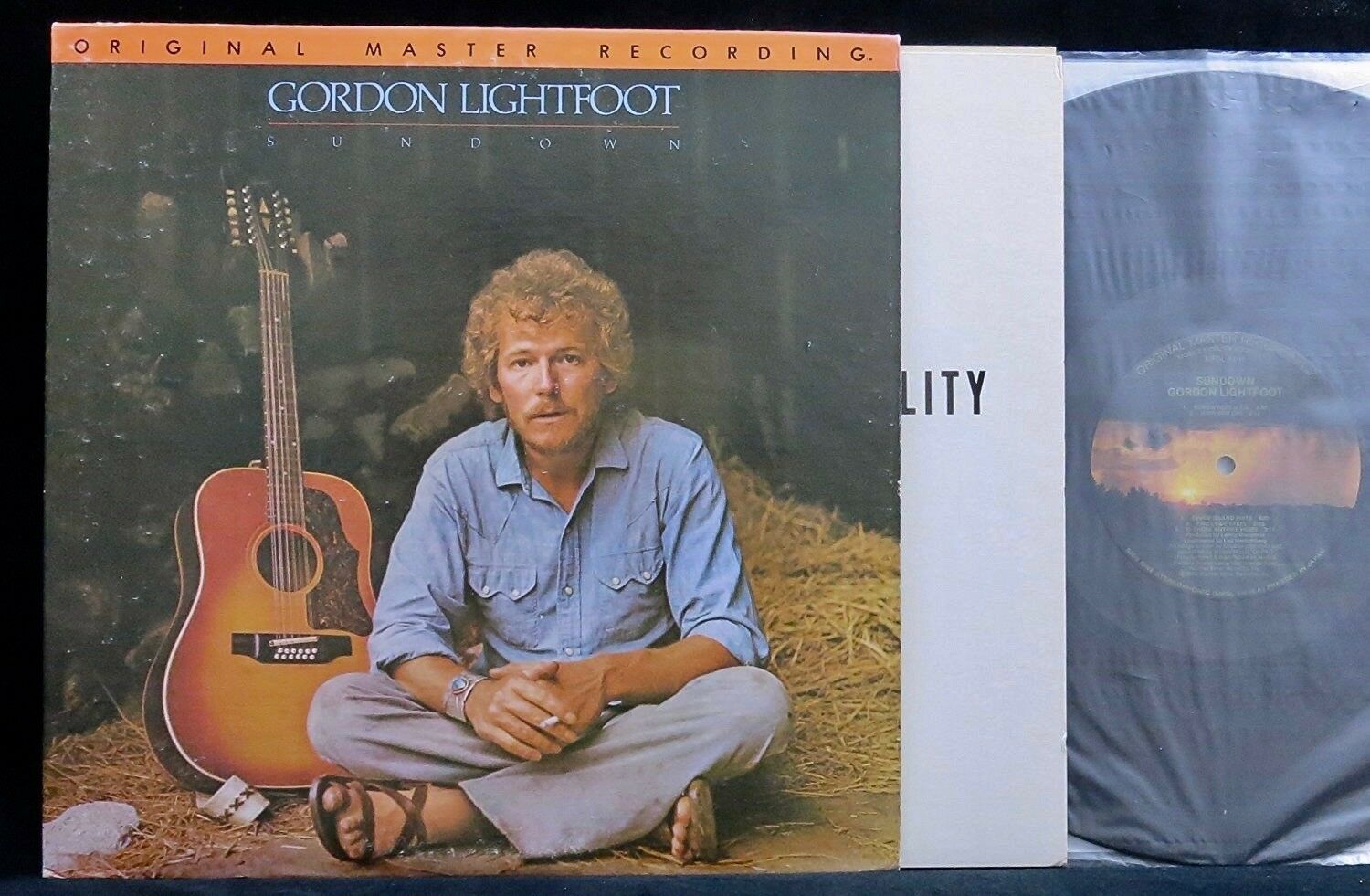
MFSL LP 1-018 LP: Gordon Lightfoot - Sundown - JAPAN 1979 Near MINT MOFI
C$
80
$
58


C$ 80
Sold For
Oct 10, 2019
Sold Date
May 21, 2018
Start Date
1
Number Of Bids
Canada
Country Of Seller
eBay
Sold at
Favourite Auctions
To save auctions to your favourites, please login
If you don't have an account, please register
Description
****Welcome to our listing, thanks very much for looking!
****See our own website! We have lots of out of print LPs and CDs! Find us on the web at -
hearthedifference.net
****Shipping cost is only an estimate - it depends on the actual weight and size of the package as well as the service required. We do not profit from shipping costs, so if we overcharge, we will refund the difference back to you. It's always best to wait for our invoice before paying for your item. We will combine shipping for multiple items purchased.
****Please see our other listings - new items added daily.
****To access our eBay store click on the little red door at the top right section of any of our eBay listings or, click on -http://stores.ebay.com/Hear-The-Difference
Background -
One of the leading singer/songwriters of the 1960s and '70s, Gordon Lightfoot was Canada's most successful contemporary folk artist, establishing himself as an important songwriter in the mid-'60s and going on to become a major international recording star in the following decade. Lightfoot's songs are literate but down to earth, and deal with personal matters as well as global issues in a manner that's poetic yet accessible, and his rich, strong voice is a superb vehicle for his material, though his songs are versatile enough that many artists have enjoyed success with his tunes.Lightfoot was born in Orilla, Ontario on November 17, 1938. His mother had an interest in music and recognized her son's talent at an early age; he was singing in church at the age of five, and came in second in a local talent competition when he was ten. At 12, Lightfoot began studying piano and voice, learning the rudiments of both pop and classical styles, and after winning a Toronto Kiwanis Festival music contest in 1951, he performed as part of a special concert at Toronto's Massey Hall (widely regarded as Canada's equivalent to New York's Carnegie Hall in terms of prestige). After Lightfoot's voice changed, he taught himself to play guitar and began performing with a folk group called the Teen Timers, and also took up drumming and singing with a barbershop quartet. After graduating from high school, he moved to California to study orchestration and jazz composition at the Westlake College of Music. While Lightfoot found work singing on demo recordings and commercial jingles in Hollywood, he didn't care for life in California, and returned to Toronto to focus his efforts on folk and country music. In 1960, he became a member of the Swinging Eight, the in-house vocal group on the popular Canadian television series Country Hoedown, a position he held for two years, and formed a duo with fellow singer Terry Whalen called the Two Tones. While the Two Tones were popular enough to play at Canada's celebrated Mariposa Folk Festival and release an album in 1962, the duo was short-lived, and Lightfoot gave Europe a try in 1963, spending some time in Great Britain and hosting an eight week BBC-TV series, The Country & Western Show. By this time, Lightfoot had begun playing occasional solo dates, and had a regional hit in Canada with the single "Remember Me (I'm the One)," a moody pop ballad.
In 1963, Lightfoot discovered the work of Bob Dylan and began approaching his songwriting in a new and more personal style. Ian & Sylvia Tyson, the popular Canadian folk duo, heard Lightfoot performing some of his new material at a club in Toronto, and were impressed enough that they added some of his songs to their repertoire. Ian & Sylvia also brought Lightfoot's songs to the attention of their manager, Albert Grossman, who signed Lightfoot to a management contract. A number of major artists began recording Lightfoot's material, most notably Peter, Paul & Mary (who enjoyed hits with "Early Morning Rain" and "For Lovin' Me") and Marty Robbins (he topped the country charts with "Ribbon of Darkness"). In 1966, Lightfoot signed a recording contract with United Artists Records, and his first solo album, simply called Lightfoot!, earned favorable reviews and was a modest commercial success. Between 1967 and 1969, Lightfoot would record three more studio albums and a live LP for United Artists, and he became a major star in his native Canada, where his albums often spun off hit singles, and he began headlining annually at Massey Hall to sold-out crowds. But in the United States, his songs were best known in recordings by others.
In 1970, after Lightfoot's contract with United Artists ran out, he broke ties with Grossman and signed a new record deal with the Reprise label. Lightfoot's first album for Reprise, Sit Down Young Stranger, boasted a more polished and sophisticated production than his UA material, and it spawned a long-overdue U.S. hit, "If You Could Read My Mind." The single rose to the Top Five of the pop charts, and after the album was retitled If You Could Read My Mind, it reached the Top Ten. While Lightfoot had finally achieved international success, he continued to live and base his operations in Canada, and his next album, 1971's Summer Side of Life, featured several tunes focused on life in his homeland. In 1972, Lightfoot released two albums, Don Quixote and Old Dan's Records, but he was forced to cut back on his touring commitments after he was diagnosed with Bell's Palsy. In 1974, he returned with the album Sundown, which included the title tune and "Carefree Highway," both of which became major hit singles, and his next two albums would also feature pop hits -- Summertime Dream included the modern-day folk narrative "The Wreck of the Edmund Fitzgerald," and Cold on the Shoulder included "Rainy Day People." Lightfoot's United Artists material had been reissued on a regular basis since "If You Could Read My Mind" became a hit, but he'd become disenchanted with the production and performances on his early albums, and the 1975 collection Gord's Gold featured new recordings of ten songs from his days at UA as well as 12 more recent hits. From 1978 onward, Lightfoot's presence on the singles charts began to fade, and while he continued to record and tour regularly, his stardom in the United States declined, though his annual run of shows at Massey Hall confirmed he still had a large and loyal audience at home. Lightfoot also began devoting more time to benefit shows for various charitable concerns, including world hunger and the environment, and he dabbled in acting, starring in the 1982 films Harry Tracy and Desperado, and playing a country singer on the short-lived American television series Hotel in 1988. In 1986, he was inducted into the Canadian Music Hall of Fame.
Lightfoot began experiencing a creative revival in the '90s, recording two of his best-reviewed albums in decades, 1993's Waiting for You and 1998's A Painter Passing Through, but his career nearly came to a halt in early 2002 when he suffered an abdominal aortic aneurysm; he was in a coma for six weeks, and had a three-month stay in the hospital. He survived the illness, and in 2003, he was named a Companion of the Order of Canada, the highest honor the nation bestows on civilians. Early 2004 saw the release of Harmony, an album Lightfoot began working on before he fell ill; by the end of the year, he was back on the road. Lightfoot experienced another health scare in the fall of 2006, when he suffered a minor stroke that cost him some mobility in his right hand, but within six months he was able to play guitar again, and continued to perform on a regular basis. In February 2010, word spread on the Internet that Lightfoot had died, and many Canadian news organizations picked up the story. However, the singer himself happened to hear a news report about it while driving home from a dental appointment, and displaying an admirable sense of humor, contacted a Winnipeg radio station to confirm he was still alive despite reports to the contrary. In 2012, Lightfoot released All Live, a collection of recordings from his many appearances at Massey Hall; it was only his second live album in a career lasting over 40 years. - Mark Deming
Sundown is Canadian singer Gordon Lightfoot's tenth original album, released in 1974 on the Reprise Records label. It reached #1 in the US on the pop chart, the only Lightfoot album to achieve this. In his native Canada, it topped the RPM 100 for five consecutive weeks, first hitting #1 on June 22, 1974, the same day it reached the top on the south of the border.
The album marked the pinnacle of Lightfoot's acoustic folk-country blend before he embarked on an increasing use of electronic instruments, although he did include some electric guitar, notably on the title track.
As for singles, the title track reached #1 on the pop and adult contemporary charts as well as #13 on the country chart, while "Carefree Highway" reached #10 on the pop chart, #1 on the AC chart and #81 on the country chart.
Lightfoot's commercial peak came with this album, which topped the U.S. charts, containing both the number one title song and the Top Ten hit "Carefree Highway." But songs like "Somewhere U.S.A." and "High and Dry" are textured, catchy folk-rock on a par with the better-known tunes. - William Ruhlmann
Sundown is a fine album which weaves conventional folk and pop strands into a whole that is greater than the sum of its parts. The polish of Lightfoot's singing has tended in the past to undermine the seriousness of his songs, inviting the listener to appreciate his records mainly as aural artifacts rather than explore their contents. But most of Sundown's 12 songs are so evocative that they prohibit such easy perusal.
Lightfoot's singing is almost crooning—a style which under-states and redeems the rhetorical and sentimental conventions intrinsic to all formal songwriting. Producer Lenny Waronker has outdone himself helping Lightfoot achieve a balance between surface and substance, by providing a varied instrumental palette, richly acoustic and adorned by some excellent string charts from Nick DeCaro.
Lightfoot's reflections are those of a mature man, capable of strong romantic and political emotions, tempered by a suave sexuality and an elegiac mysticism. "Somewhere U.S.A." is a lovely evocation of romantic complications experienced during the daze of travel. "High And Dry" also celebrates travel and uses the image of a ship and its different skippers to affirm continuities. The six-minute "Seven Island Suite" is the album's most ambitious cut, and presents an elusive apocalyptic vision. More incisive are "Sundown," an ominous assertion of sexual jealousy, and "Circle Of Steel," a protest song about the antagonisms of welfare and poverty.
The album's last and most powerful cut, "Too Late for Prayin'" is perhaps Lightfoot's finest creation. A modified hymn, somewhat reminiscent of Paul Simon's "American Tune," "Too Late" is both a prayer for our spiritual restoration and a lament for its absence. It is the work of a master craftsman whose endurance and prolificacy have yet to receive just recognition in the United States. - STEPHEN HOLDEN
-
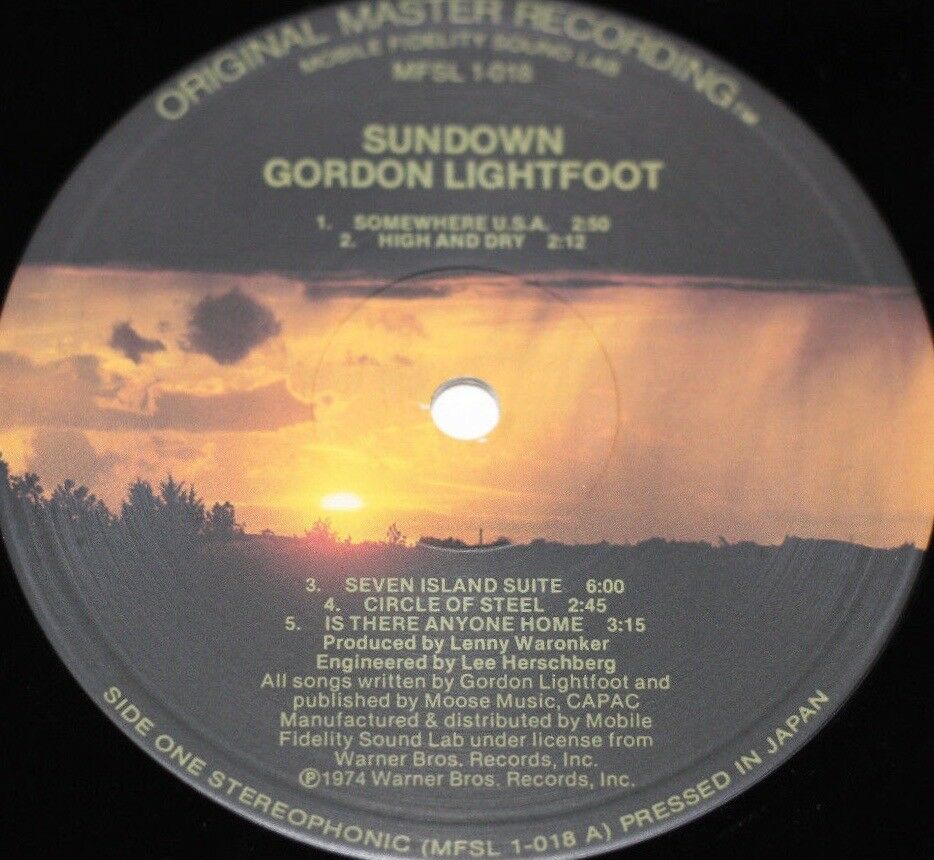
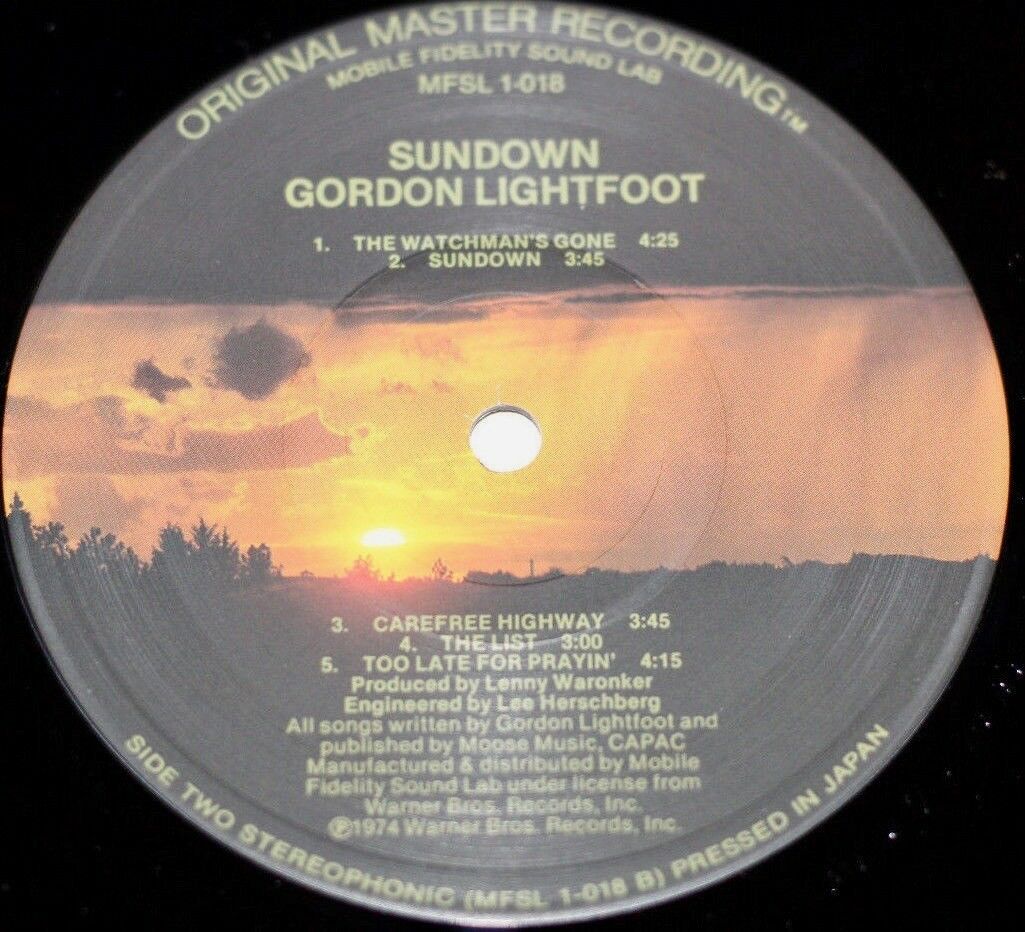
MFSL - Mobile Fidelity Sound Lab Record LP item - BLACK & BROWN record labels with SILVER lettering
-
Record Made in JAPAN
-
Pressing is in STEREO - recording is from 1974 - originally issued on the REPRISE label
-
Limited Edition LP
-
Record Speed: 33 1/3 rpm
-
Record Made issued in: 1979 (one of the earliest MFSL titles made)
-
Record Catalog Number: MFSL 1-018
Featured on this item:
Gordon Lightfoot
Title of this Audiophile LP -
Sundown
Track Listings -
A1 Somewhere U.S.A. 2:50A2 High And Dry 2:12
A3 Seven Island Suite 6:00
A4 Circle Of Steel 2:45
A5 Is There Anyone Home 3:15
B1 The Watchman's Gone 4:25
B2 Sundown 3:45
B3 Carefree Highway 3:45
B4 The List 3:00
B5 Too Late For Prayin' 4:15
Performed By / Credits on this LP include -
• Gordon Lightfoot – lead and backing vocals, six and twelve string acoustic guitars, chimes, bells, high string guitar
• Terry Clements – acoustic guitar (tracks 1, 3–10)
• Nick De Caro – accordion, horns, orchestration, piano, strings (tracks 3, 5–6, 8, 10)
• Jim Gordon – percussion, drums (tracks 1–3, 5–9)
• Rick Haynes – bass guitar (tracks 1, 4, 8–9)
• Milt Holland – percussion, congas (tracks 1, 5–6, 9)
• Gene Martynec – Moog synthesizer (tracks 3, 5)
• Red Shea – dobro, electric, acoustic and classical guitars, slide dobro (tracks 1–5, 7, 9–10)
• Catherine Smith – harmony vocals (track 2)
• John Stockfish – bass guitar (tracks 2–3, 5–7, 10)
• Jack Zaza – English horn, recorder (track 4)
• Engineer – Lee Herschberg • Engineer [Assistant] – Chris Skene • Photography – John Reeves • Producer – Lenny Waronker • Remastered By [Half-Speed] – Stan Ricker
Other Information -
Recorded At Eastern Sound Studios, Toronto
Half Speed Masters Cut By Stan Ricker, JVC
Pressed in Japan
• Manufactured By – Mobile Fidelity Sound Lab
• Distributed By – Mobile Fidelity Sound Lab
• Phonographic Copyright (p) – Warner Bros. Records Inc.
• Copyright (c) – Warner Bros. Records Inc.
• Recorded At – Eastern Sound Studios
CONDITION Details:
LP Jacket:-
The jacket is in Near MINT condition - no seam splits or corner dings!
-
The jacket has NO splits of any kind - it is completely solid and intact, and shows only some very minimal shelf wear.
-
It has NO drill holes or saw marks of any kind.
-
There is NO writing on the front or back of the jacket.
-
The cover has clean and sharp colors - see picture with this listing for more detail.
-
The LP is in Near MINT condition - super glossy and appears never played!
-
This is the near mint copy you want for your collection - any super picky audiophile would be happy with this one!
-
As for any record, even brand new, sealed ones, we always recommend a proper record cleaning before playing!
A Short Note About LP GRADING -
- Mint = Only used for sealed items.
- Near Mint = Virtually flawless in every way.
- Near Mint Minus = Item has some minor imperfections, some audible.
- Excellent = Item obviously played and enjoyed with some noise.
- Very Good Plus = Many more imperfections which are noticeable and obtrusive.
price rating