MEXICAN AVANT-GARDE LP MANUEL ENRIQUEZ+EDUARDO MATA-RAR
$
51


Favourite Auctions
To save auctions to your favourites, please login
If you don't have an account, please register
Description
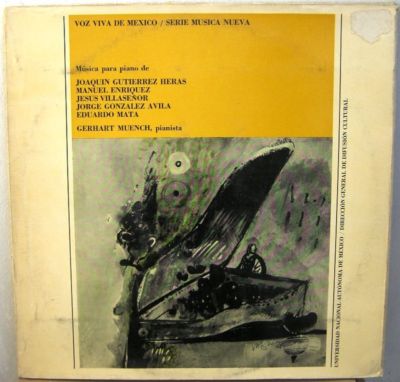
MANUEL ENRIQUEZ / EDUARDO MATA / JORGE GONZALEZ AVILA / JESUS VILLASENOR / JOAQUIN GUTIERREZ HERAS
MUSICA PARA PIANO LP
Universidad Nacional Autonoma de Mexico
Voz Viva De Mexico / Serie Musica Nueva
w/12" booklet
Rare original mexican issue from the 60's with the works of Manuel Enriquez, Eduardo Mata and others.
Some info on the release: Bloody rare original issue, released in Mexico sometime in the late 60's on the Universidad Nacional Autonoma de Mexico label. Coming with a 12"-sized booklet with biographies of the composers / performer.
Eduardo Mata was a Mexican conductor and composer. Mata was born in Mexico City. He studied guitar privately for three years before enrolling in the National Conservatory of Music. From 1960 to 1963 he studied composition under Carlos Chávez, Héctor Quintanar and Julián Orbón. In 1964 he received a Koussevitzky Fellowship to study at Tanglewood. There, he studied conducting with Max Rudolf and Erich Leinsdorf and composition with Gunther Schuller. He composed several works in the 1950s and 1960s, including three symphonies, chamber works, sonatas, and works for ballet. His third symphony and some of his chamber works have been recorded. In 1965 he was appointed head of the Music Department of the National Autonomous University of Mexico (UNAM) and conductor of the Guadalajara Orchestra. He also conducted the orchestra at the University, which later became the National Autonomous University of Mexico Philarmonic Orchestra. In 1972, he left Mexico to take the position of principal conductor of the Phoenix Symphony. The next year he was appointed as the Phoenix ensemble's music director, holding that position through the 1977-78 season. From 1977 to 1993 he was music director of the Dallas Symphony Orchestra and guest conductor of several famous orchestras in the U.S., Europe and Latin America. He recorded over fifty albums, most of them with the UNAM Symphony Orchestra, the Dallas Symphony Orchestra, and the London Symphony Orchestra.
Twentieth century Mexican music has witnessed the appearance of great composers who have had a major influence on it. Not only on the course of its creation, but also in other areas of musical endeavors. The first half of the century had Carlos Chávez at the helm of its development, Chávez contributed in a definitive way to the profile of music in Mexico between 1921 and 1960. During the second half of the century another predominant personality came on the scene of Mexican music, not only as a composer, but also as administrator, teacher, diffuser and active member of the most prestigious cultural institutions of the country. This was Manuel Enríquez, whose dynamic presence and abundant musical activity for three decades made him the other pillar in Mexican music. His violin studies began with his father and continued in Guadalajara in the academy of Aurea Corona with Ignacio Camarena. Later he made weekly trips to the city of Morelia to study with Miguel Bernal Jiménez. Years later, Enríquez would recall the great musician from Morelia, telling that thanks to Bernal Jiménez, "he got close to the deep, easy, truly and lasting knowledge about the techniques and practice of composers: he put into my hands in a simple way, __Enríquez said__ the medium to learn the skills of composing". His first works: Suite for violin and piano and Dos Canciones voice and piano date from this time. In 1955 he received a scholarship to attend the Juilliard School of Music in New York. Over the years he would often recall the outstanding teachers he met here: Ivan Galamian; Louis Persinger with whom he studied: chamber music; William Primrose, who also guided him in the execution of chamber music and Peter Mennin, his composition teacher who helped him take his musical compositions toward structural forms and to cultivate the expressionist language we find later in his mature music. Of equal importance were his dealings with Stefan Wolpe, a disciple of Anton Webern, who spoke to him not only of music, but also of politics and the humanities.
From 1934 to 1950 Enríquez did not visit Mexico City, where composers such as Chávez, Revueltas, Galindo, Moncayo and Huizar had consolidated and where "provincial composers" such as Rolón and Bernal Jiménez had reached a level of notoriety that placed them among the prestigious composers of Mexico. Enríquez was in a way also a "provincial composer". When he traveled a New York he was still unrecognized as a composer in the Mexican capital and he had already paid his dues to Nationalism (with his Suite for Violin and Piano and Sinfonía I) and he was ready to experiment with new proposals. His musical education begun in Guadalajara and Morelia and was to continue on a higher level in the city of the skyscrapers. When he received, in 1971, the Guggenheim Fellowship, he was already a recognized composer in the Mexican musical ambiance. However, Enríquez went to the Center of Electronic Music at Columbia University to experiment with Electronics and to study the new resources afforded by contemporary technology. He was not given over to this idiom, but did compose some electronic works. He considered electronics to be just another tool for the contemporary composer. Because of his desire to keep up with new tendencies in composition, he attended the renowned international courses of Darmstadt where he made contacts with the great European avantgarde composers: Luciano Berio, Iannis Xenakis, Karlheinz Stockhausen, Penderecki and Gyorgy Ligeti.
Condition: Vinyl and cover lie in very good+ condition. Vinyl looks clean with the exception of 2 superficial marks that don't affect playing and plays nicely with minor distractions, while cover has a small tear (white on white) at the top right corner and some age wear.
Tracklist
A1 Joaquín Gutiérrez Heras – Variaciones Sobre Una Canción Francesa A2 Manuel Enriquez – A Lápiz A3 Jesús Villaseñor – Sonata Para Piano B1 Jorge González Ávila – Nueve Invenciones Para Piano B2 Eduardo Mata – Sonata Para PianoCredits
- Artwork By – Roger Von Gunten
- Directed By [Artistic Director] – Eduardo Mata
- Piano – Gerhart Muench
SHIPPING & PAYMENT
Shipping: Shipping for this LP is 7$ airmail in Europe / 9$ for the rest of the world
Registered mail: +5$
Insurance: optional
Combined shipping: BIG discounts
Payment: Paypal
Packaging: I am a collector too and i know
price rating







![Bob Dylan Bringing It All Back Home LP UK Mono 1st Press [Ex/Ex-]](https://www.popsike.info/php/thumbnail.php?url=https://www.popsike.pics/pix/20240805/135180738917.jpg)